
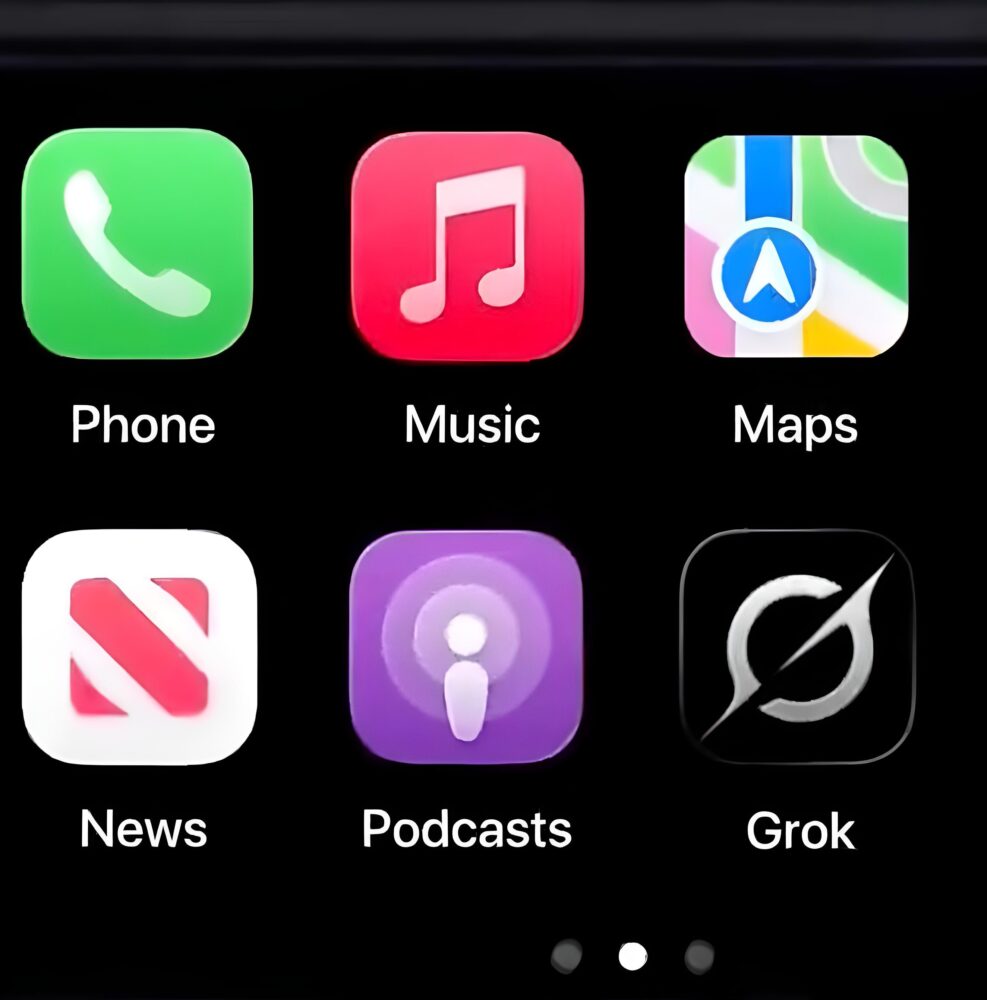
Grok voice mode has now reached Apple CarPlay, giving drivers the ability to converse hands-free with the xAI chatbot directly through their vehicle’s dashboard interface. The rollout, announced on May 8, 2026, marks another step in the gradual integration of third-party conversational AI into the infotainment systems many rely on daily.
Until recently, the Grok app on iPhone showed only a placeholder in CarPlay promising future hands-free support. That placeholder has been replaced with functional voice interaction, allowing users to ask questions or issue requests without touching their phones. The feature builds on Grok’s existing presence in Tesla vehicles, where it has been available for some time, but extends access to a much broader range of cars equipped with CarPlay.
Apple first opened the door to these voice-driven chatbot apps with iOS 26.4, requiring developers to obtain a special entitlement and adhere to strict design guidelines. Approved applications must use Apple’s voice control template, displaying a dedicated interface whenever active and limiting themselves to no more than four action buttons. Notably, chatbot responses cannot include text or images on screen, presumably to limit visual distractions while driving. These constraints reflect Apple’s long-standing caution with CarPlay, which has always prioritized approved categories such as navigation, audio, and communication to keep driver attention on the road.
Grok joins ChatGPT and Perplexity, which landed on CarPlay earlier in 2026. The pattern is clear: conversational AI is moving from phones and smart speakers into the car, where long commutes and solitary drives create natural opportunities for its use. Some drivers may appreciate quick answers to spontaneous questions, such as traffic explanations for curious children or summaries of incoming work matters during a commute. Others, however, see risks in further outsourcing basic thinking or curiosity to machines, arguing it could diminish the value of human conversation and critical reasoning.
Real-world utility remains debatable. While the technology works well enough in controlled settings, its value during actual driving depends heavily on how seamlessly it integrates without pulling focus from the task at hand. Past attempts to add digital assistants to vehicles have shown mixed results, sometimes improving convenience but occasionally contributing to cognitive overload. Safety advocates continue to watch these developments closely, especially as more powerful language models enter the driving environment.
The broader context is one of steady evolution rather than sudden transformation. CarPlay has expanded its capabilities over the years without fundamentally changing its core purpose: providing a familiar, controlled interface across vehicle brands. Adding voice chatbots fits this incremental approach, but it also tests the limits of how much secondary activity drivers can handle responsibly. For now, Grok’s arrival offers another option rather than a must-have feature, and its long-term staying power will likely depend on whether users find meaningful advantages over existing tools like Siri or simply prefer speaking to a different AI personality.
As these systems mature, the real test will be whether they genuinely enhance the driving experience or simply add another layer of digital noise to an already connected cabin.