
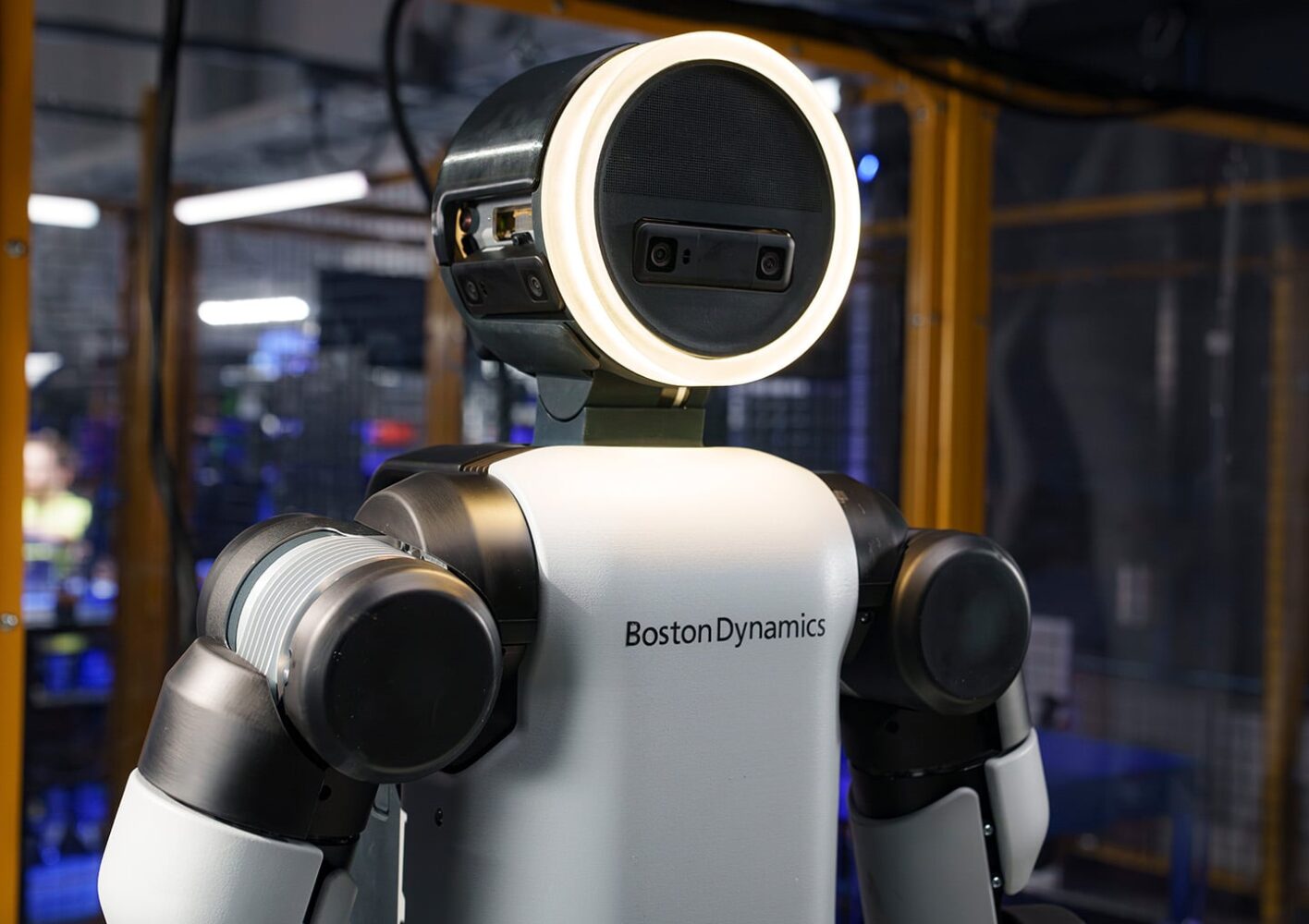
A newly released video from Boston Dynamics offers a more candid look at the development process behind its Atlas humanoid robot, showing not just polished demonstrations but also the missteps that precede them. The footage opens with Atlas completing a cartwheel followed by a backflip, executed with a level of control and timing that highlights how far the platform’s physical capabilities have progressed. Rather than stopping there, however, the video deliberately cuts to failed attempts, where the same maneuver ends with the robot collapsing onto the floor.
Those moments of failure are not framed as glitches or anomalies but as part of an iterative process. In several clips, Atlas stumbles while running or trips mid-stride, prompting audible reactions from the engineers observing the tests. The inclusion of these bloopers provides insight into the trial-and-error involved in developing dynamic locomotion, especially for a bipedal robot designed to move through unstructured environments.
As the video continues, later sequences show a newer iteration of Atlas performing jumps, running, and walking with noticeably greater stability. The transitions between movements appear smoother, and the robot maintains balance even when changing direction or speed. One of the most striking segments appears just over a minute into the video, where Atlas lands a backflip imperfectly but rapidly adjusts its posture to recover. The correction is not pre-scripted or rigid; instead, the robot shifts its weight in real time, echoing how a human gymnast might respond to a slightly off-balance landing.
This progress reflects ongoing collaboration between Boston Dynamics and researchers at the Robotics and AI Institute, where work has focused on improving full-body control and coordination. The emphasis is less on spectacle and more on responsiveness—how quickly the robot can sense instability and compensate for it without external input.
While acrobatic moves are unlikely to feature in Atlas’s eventual job description, the underlying skills on display are directly relevant to practical applications. Boston Dynamics has repeatedly stated that the long-term aim is to deploy Atlas in environments such as factories and warehouses, where uneven surfaces, obstacles, and unexpected interactions are common. Balance, coordination, and rapid adjustment are critical in those settings, even if backflips are not.
Earlier demonstrations have already shown Atlas using AI and machine learning to perform autonomous workplace tasks, such as sorting and moving engine components without teleoperation. More recently, the company confirmed plans for Atlas to assist with vehicle assembly at a U.S. manufacturing facility operated by Hyundai, which is Boston Dynamics’ primary backer.