

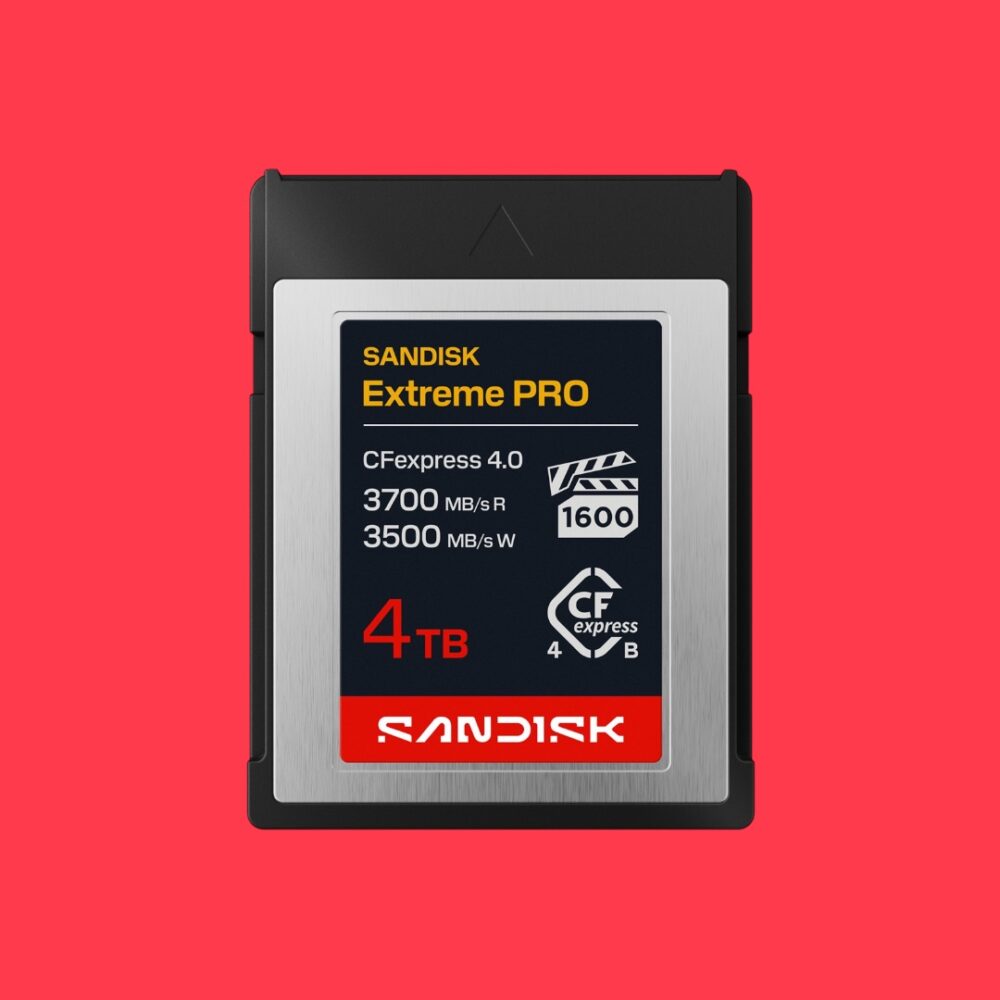
SanDisk has rolled out its latest professional memory cards, including a new generation of Extreme Pro CFexpress 4.0 Type B cards and updated Extreme Pro SDXC UHS-II V60 and V90 models now reaching 2TB capacities with improved speeds. The announcements, timed for the NAB show, reflect the growing pressure on storage as filmmakers and photographers push into 6K, 8K, and higher-bitrate workflows that demand both raw capacity and consistent performance without dropped frames or frequent card changes.
The headline addition is the CFexpress 4.0 Type B card, which promises read speeds up to 3700MB/s and write speeds up to 3500MB/s, with sustained performance tuned for high-bitrate video. Capacities now extend to 4TB, allowing significantly longer recording sessions in resolutions up to 12K. This positions the card for demanding cinema and broadcast applications where reliability during extended takes matters more than headline peak figures. In practice, real-world sustained speeds often prove more critical than burst benchmarks, especially when cameras are pushing raw or heavily compressed high-frame-rate footage.
On the SD side, the updated Extreme Pro SDXC UHS-II V90 cards target higher-end production crews working with 8K video. The new 2TB version can reportedly hold more than 1,118 minutes of 8K footage at 30fps on a single card, reducing the need for constant swapping during long shoots. Read speeds reach up to 310MB/s and write speeds up to 305MB/s on the larger capacities. The V60 variant, aimed more at prosumer and mid-tier professional users shooting 6K video and high-resolution stills, also scales to 2TB with read speeds up to 300MB/s and write speeds up to 250MB/s.
These updates continue a familiar pattern in the memory card market: incremental speed gains paired with aggressive capacity jumps as flash technology matures. Larger cards bring obvious convenience for on-set workflows, yet they also raise practical concerns around data security and workflow risk. A single 2TB or 4TB card failure during a critical production could mean losing hours or even days of irreplaceable footage, a reminder that redundancy and robust backup strategies remain essential no matter how advanced the hardware becomes.
Historically, SanDisk (now under Western Digital) has maintained a strong presence in the professional storage segment, competing with Sony, ProGrade, and Lexar among others. The move to CFexpress 4.0 aligns with the interface’s growing adoption in high-end mirrorless and cinema cameras, while the SD UHS-II refreshes address the reality that many working photographers and videographers still rely heavily on the more ubiquitous SD format for its compatibility and cost-effectiveness.
Overall, the new cards address genuine pain points in modern content creation—longer takes, higher resolutions, and fewer interruptions—but they also underscore the ongoing tension between capacity, speed, and reliability in field production. As cameras continue to evolve toward even higher data rates, the real test for these products will be how consistently they perform under the heat, vibration, and pressure of actual shoots rather than lab benchmarks.