
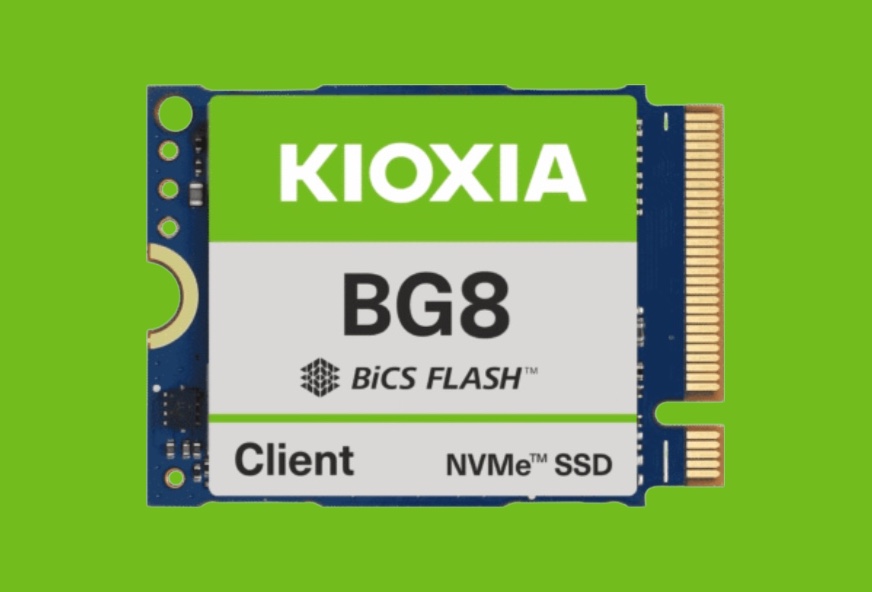
Kioxia has introduced its BG8 series of client SSDs, bringing PCIe 5.0 performance to the mainstream segment for PC OEMs. The new drives target slim laptops, commercial and consumer notebooks, and desktop systems, aiming to deliver faster data handling while maintaining reasonable power efficiency and design flexibility in an increasingly competitive market.
Built on the company’s eighth-generation BiCS TLC 3D flash memory, the BG8 series shows noticeable gains over its predecessor, the BG7. Sequential read speeds improve by up to 47 percent, sequential writes by up to 67 percent, random reads by 44 percent, and random writes by 30 percent. Peak figures reach 10,300 MB/s for reads and 10,000 MB/s for writes, with random performance hitting up to 1.4 million IOPS read and 1.3 million IOPS write. These numbers suggest the drives could meaningfully improve system responsiveness in everyday workloads, from boot times and application loading to lighter content creation tasks, though real-world results will always depend on the host device, thermal conditions, and sustained usage patterns.
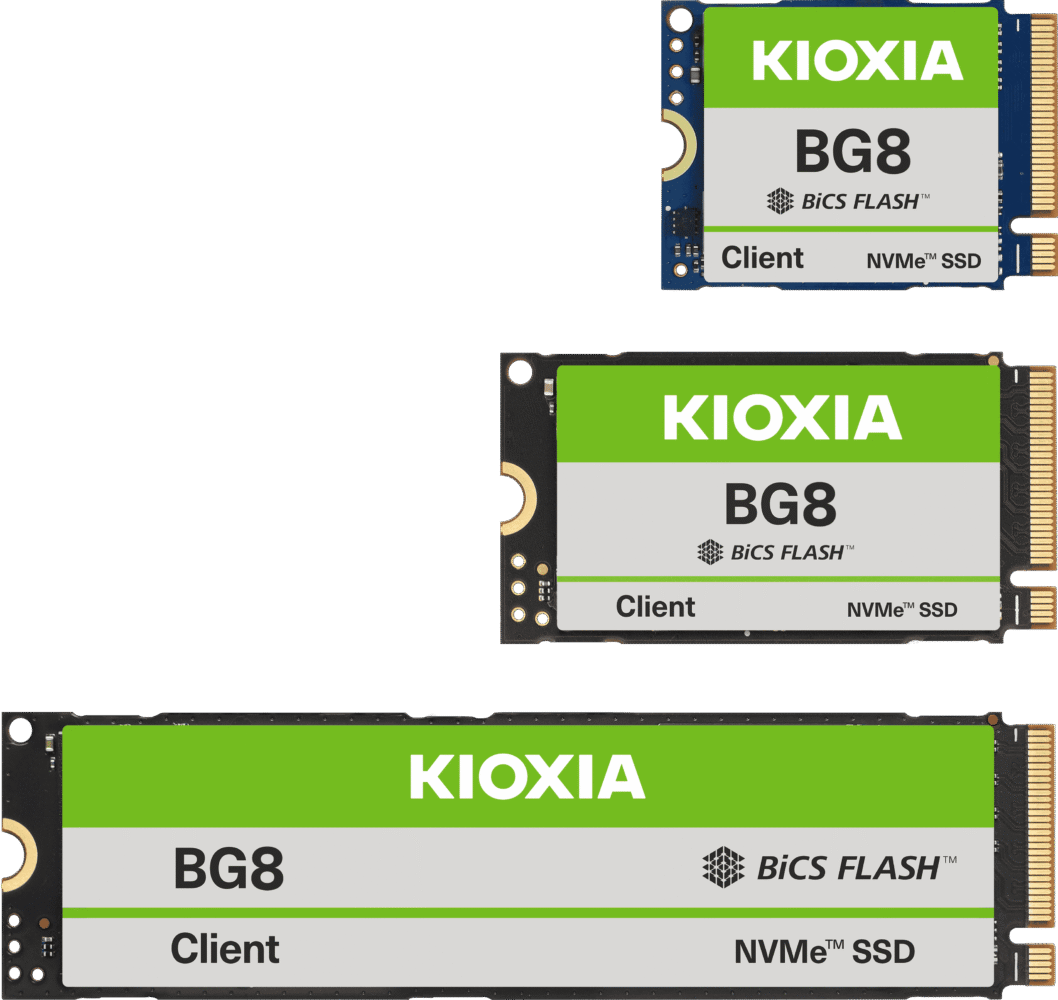
The BG8 remains a DRAM-less design, relying instead on the Host Memory Buffer feature that borrows from system RAM to manage mapping tables. This approach helps keep costs down and power draw modest, which matters for thin-and-light laptops where battery life and heat are constant concerns. The series supports multiple M.2 form factors — 2230, 2242, and 2280 — giving manufacturers more options when fitting storage into compact chassis or varied mounting layouts.
Security-wise, the drives include self-encrypting drive functionality based on TCG Opal 2.02, a standard feature that has become expected in professional and enterprise-oriented client systems. Available capacities start at 512 GB and go up to 2 TB, covering the typical range for mainstream notebooks and entry-level desktops.
Kioxia positions the BG8 as an accessible step up to PCIe 5.0 without pushing into the premium, high-power territory occupied by flagship gaming or workstation drives. That strategy makes sense as PCIe 5.0 adoption slowly trickles down from high-end platforms into more affordable machines. Still, the transition to the new interface has been gradual across the industry, with many systems still running comfortably on PCIe 4.0. Power efficiency gains and consistent performance under thermal throttling will likely prove more important to most users than raw peak speeds that few real applications can sustain for long.
The BG8 series is currently sampling to selected PC OEM customers, with systems featuring the drives expected to ship starting in the second quarter of 2026. Whether these SSDs deliver a tangible everyday advantage will ultimately depend on how well laptop makers integrate them with cooling solutions and power management, rather than on headline specifications alone.
This release continues Kioxia’s long presence in the NAND flash and SSD space, where incremental improvements in density, speed, and efficiency have become the norm as the market matures and competition from Samsung, SK hynix, and others remains intense.