

OnePlus is set to revolutionize smartphone displays with its upcoming OnePlus 13. The company has confirmed that the device will feature a groundbreaking “local high refresh rate” technology, allowing different areas of the screen to refresh at different rates. This innovation promises significant improvements in both performance and power efficiency.
Traditionally, smartphone displays operate at a fixed refresh rate across the entire screen. While higher refresh rates provide smoother visuals and more responsive interactions, they also consume more power. OnePlus’s local refresh rate technology addresses this trade-off by dynamically adjusting the refresh rate based on the content being displayed.
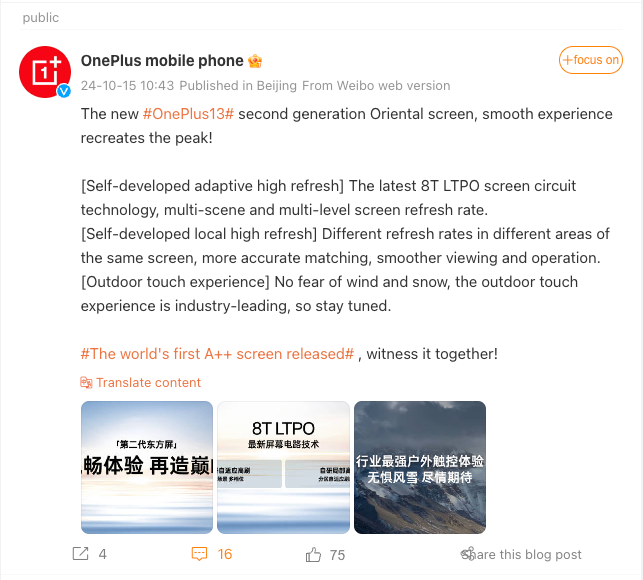
Imagine watching a video on your phone. With local refresh rate technology, the video itself could be displayed at a high refresh rate for smooth motion, while the static UI elements surrounding the video could operate at a lower refresh rate to conserve battery life. This intelligent adaptation allows the phone to optimize performance and power consumption simultaneously.
The potential applications of this technology are vast. In split-screen multitasking, demanding apps can run at high refresh rates while less demanding apps use lower rates. Gaming experiences can be enhanced by prioritizing high refresh rates for fast-paced action while maintaining lower rates for static game elements. Even simple tasks like reading an ebook can benefit from reduced refresh rates in static areas, prolonging battery life.
This innovative display technology is just one of the exciting features expected in the OnePlus 13. Rumors suggest the device will also boast a powerful Snapdragon 8 Gen 4 processor, a massive 6,000 mAh battery, an IP69 dust and water resistance rating, and a triple 50MP camera setup. With a potential starting price of $799, the OnePlus 13 is shaping up to be a strong contender in the flagship smartphone market.
OnePlus has a history of pushing the boundaries of smartphone technology, and the local high refresh rate display is the latest example of its commitment to innovation. This technology has the potential to become a standard feature in future smartphones, ushering in a new era of personalized and efficient display experiences.