

Apple has detailed the advertising guidelines for its upcoming Maps service, adopting a more restrictive stance than Google in several key local business categories. The new Apple Advertising Services policy, which took effect on July 14, prohibits promotions for home services such as plumbing, electrical work, locksmithing, HVAC repairs, pest control, roofing, and general contracting. Bail bond services and cryptocurrency ATMs are also banned outright, while medical services will face case-by-case review.
These limitations set Apple Maps apart from Google Maps, where local services ads for repair professionals represent a significant revenue stream. Apple appears to be prioritizing businesses with physical storefronts that customers can visit directly, likely to sidestep the complex verification processes required for on-site service providers. The approach aligns with the company’s longstanding emphasis on user experience and privacy, avoiding the more aggressive data practices that have fueled Google’s local advertising dominance.
Broader rules governing ads across Apple News, Stocks, Maps, and sports content maintain strict prohibitions on weapons, tobacco, recreational drugs, political messaging, deceptive claims, and discriminatory material. Products competing directly with Apple hardware undergo individual scrutiny. Categories like alcohol, gambling, dietary supplements, financial services, and prescription drugs face additional oversight rather than blanket bans. This framework reflects Apple’s careful navigation of content moderation, aiming to protect its brand reputation while gradually expanding into advertising.
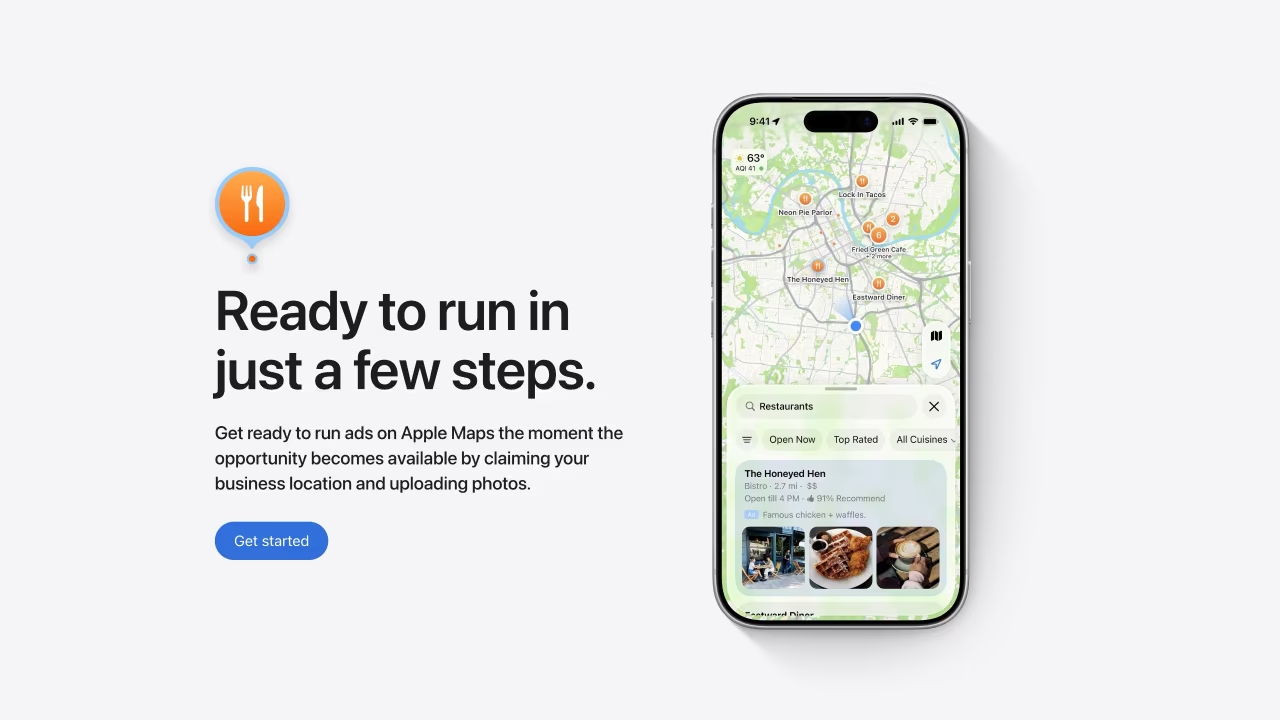
The company first signaled Maps ads for the United States and Canada earlier this year alongside the Apple Business launch in March. Code in iOS 26.5 introduced a Suggested Places section where sponsored listings will appear. Search results will feature a single sponsored entry, clearly labeled as an “Ad” with a blue halo around the map pin. Apple has stressed that user location data and ad interactions remain on-device, not linked to Apple Accounts or shared with third parties, reinforcing its privacy-centric positioning.
Industry observers note that these policies could limit initial revenue potential compared to more permissive platforms, particularly in home services where demand is high. Yet they may also reduce risks of low-quality or misleading ads that have occasionally plagued competitors. With the policy publication, a formal rollout in supported regions seems imminent, though Apple has not specified an exact date.
In the competitive mapping space, where Google holds substantial share through integrated search and advertising, Apple’s entry represents a measured expansion rather than a direct assault. The company has steadily improved Maps with better transit information, 3D views, and detailed city guides, but monetization has lagged. Introducing ads under tighter controls could provide new income without alienating users who value the cleaner interface. Still, success will depend on advertiser uptake and whether the restrictions prove sustainable as the platform matures.
For users, the addition may enhance discovery of nearby businesses while maintaining clearer separation between organic results and promotions. It underscores Apple’s ongoing balancing act between ecosystem growth and its core principles around privacy and quality control in an increasingly ad-driven digital landscape.