

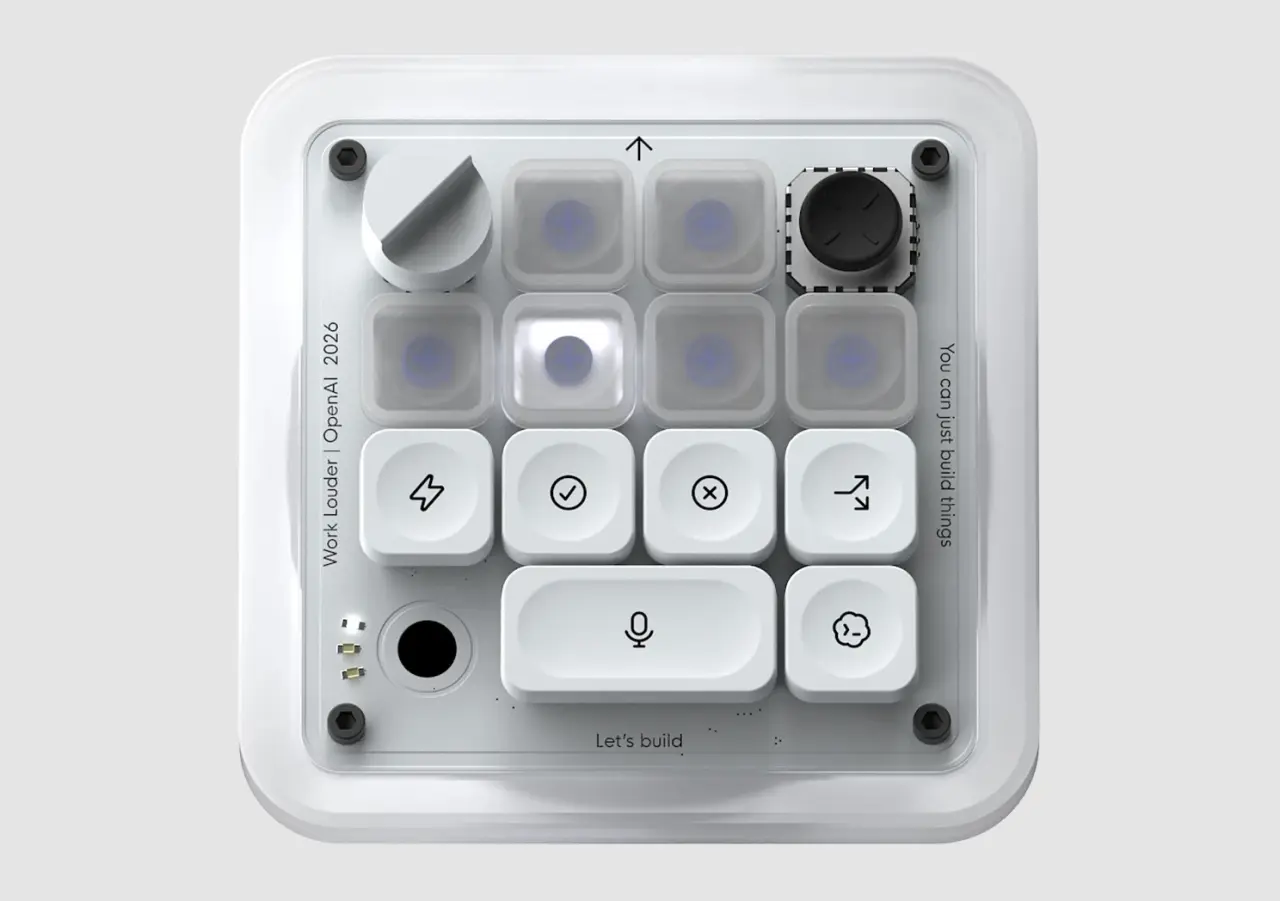
OpenAI has introduced a specialized hardware accessory aimed at developers working with its Codex agentic coding platform. The Codex Micro, developed in partnership with keyboard manufacturer Work Louder, is a compact control panel that moves certain workflow commands from software interfaces onto physical inputs. Priced at $230 as a limited-edition device, it reflects the company’s growing emphasis on tools that support more complex AI-assisted development rather than broad consumer products.
As coding agents handle longer and more intricate tasks, managing multiple instances simultaneously can become cumbersome within desktop apps alone. The Codex Micro addresses this by providing dedicated mechanical keys, a joystick, and a rotary dial. Its Agent Keys feature RGB lighting that indicates the status of connected agents—whether thinking, running, waiting, or finished—allowing quick switches between them. Customizable Command Keys handle common actions such as accepting code changes, starting new sessions, or enabling push-to-talk. The joystick supports shortcuts for tasks like reviewing pull requests or debugging, while the rotary encoder adjusts reasoning levels based on task demands.
All controls are configurable through the ChatGPT desktop application, with compatibility for both Windows and macOS via Bluetooth or USB-C. The unit includes 13 mechanical switches, a touch sensor, and additional keycaps themed around Codex. This setup draws comparisons to existing developer peripherals like Elgato’s Stream Deck, which has long offered customizable buttons for productivity workflows, though Codex Micro integrates more directly with OpenAI’s ecosystem.
The launch arrives amid rapid adoption of Codex. Weekly active users climbed from 3 million in early April to 4 million after updates introducing computer use and image generation capabilities. Following the recent unified ChatGPT app and GPT-5.6 release, the figure reached 8 million, with projections nearing 9 million. These numbers highlight genuine traction among professional coders seeking efficiency gains, yet they also underscore the uneven pace of AI tools in real-world software engineering, where agent reliability still varies widely across projects.
At this stage, the Codex Micro appears as a niche solution for power users deeply embedded in the OpenAI stack. Its value will depend on how seamlessly it reduces context-switching friction compared to keyboard macros or existing software dashboards. While it demonstrates OpenAI’s willingness to experiment with hardware beyond high-profile consumer collaborations, such as those reportedly involving Jony Ive, questions remain about longevity and broader accessibility. Developers outside the Codex environment may find similar functionality through more established, less brand-specific alternatives at comparable prices.
In a field where software updates arrive frequently, tying physical controls to a single platform carries risks if priorities shift. Nevertheless, for those managing fleets of AI agents daily, the device offers a tangible way to interact with an otherwise screen-bound process. It signals a maturing phase for agentic AI tools, where supporting hardware could become as relevant as the models themselves.