

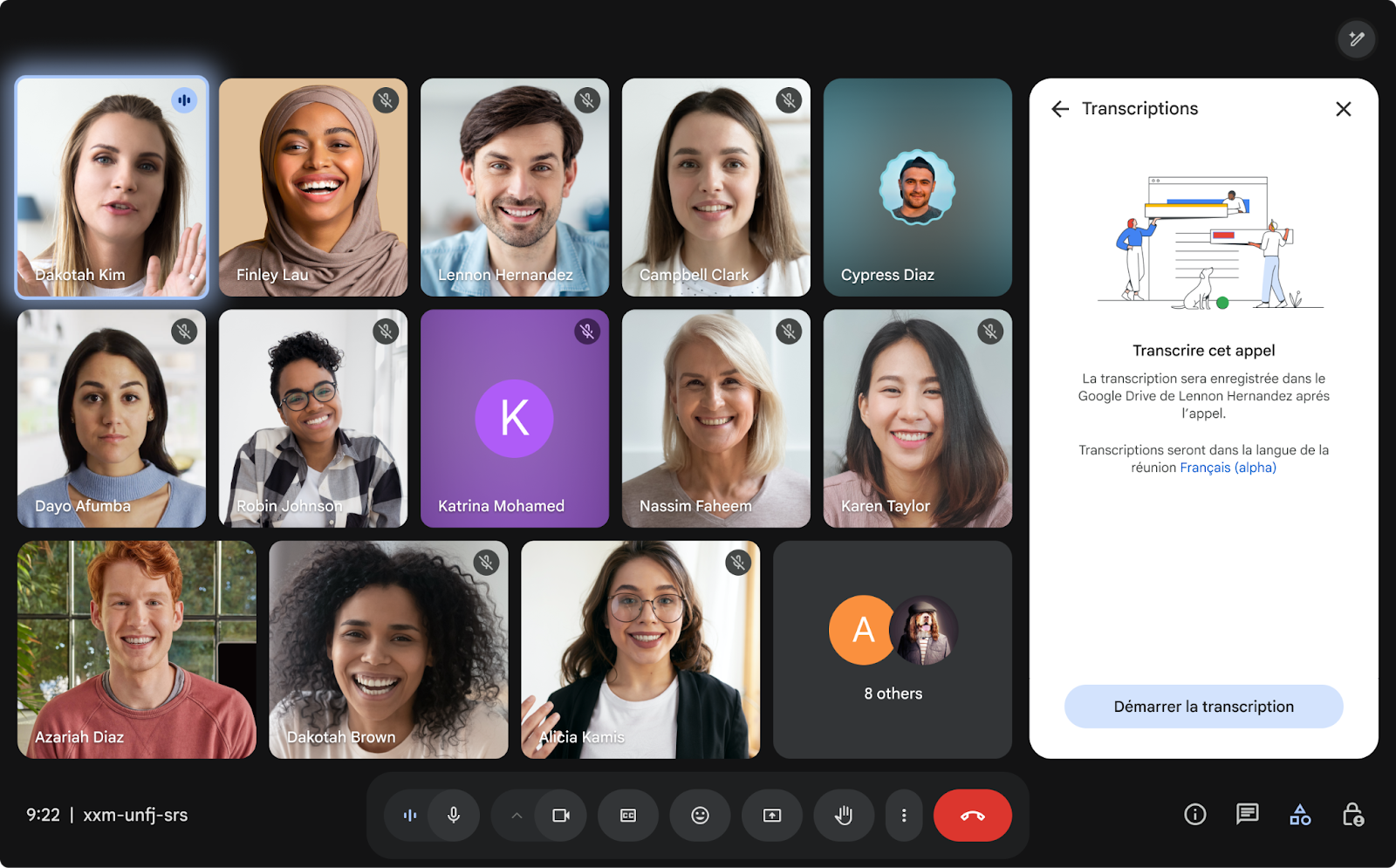
Google is extending its Gemini-powered “Take notes for me” feature in Google Meet to individual Google AI Pro and Ultra subscribers, moving beyond its initial Workspace-only availability. The tool uses the company’s AI model to transcribe meetings, generate summaries, extract action items, and compile everything into a Google Doc saved in the user’s Drive. Following the session, the host typically receives an email recap, with notes optionally attached to the corresponding Calendar event based on sharing configurations.
The feature operates across web and mobile versions of Meet, supporting a range of languages including English, French, German, Italian, Japanese, Korean, Portuguese, and Spanish. Users activate it manually via a pencil icon during calls or preconfigure it through meeting records settings. Importantly, all participants receive notifications when note-taking begins, and administrators for work or school accounts retain control over availability, often requiring explicit consent for privacy reasons. Limitations persist: the system handles one language per meeting and performs best within a 15-minute to eight-hour window, struggling with multilingual conversations that reflect real-world global team dynamics.
This expansion arrives as AI meeting assistants have become standard expectations rather than novelties. Microsoft Teams offers Copilot-driven recaps and highlights, while Zoom’s AI Companion delivers similar summaries across platforms. Google’s move narrows the gap but also underscores how these tools increasingly blur lines between helpful automation and passive surveillance. The ability to generate structured notes without manual effort appeals to professionals juggling back-to-back calls, yet it raises practical questions about accuracy in nuanced discussions, potential misattribution of action items, and data retention policies that users rarely scrutinize until issues surface.
Originally launched in 2024 for select Workspace customers, the feature has seen gradual refinements, including deeper Calendar integration. Its rollout to paid AI subscribers signals Google’s strategy to monetize Gemini capabilities more aggressively outside enterprise contracts. For individual users, the value depends heavily on meeting frequency and the reliability of AI-generated outputs—summaries can streamline follow-ups but occasionally oversimplify complex exchanges or miss contextual subtleties that human note-takers would catch.
In a broader sense, such AI enhancements reflect the productivity arms race among major platforms, where transcription and summarization features promise efficiency gains while contributing to the quiet accumulation of meeting data. Privacy-conscious users may appreciate the transparency notifications and admin controls, yet the default toward recording and processing conversations fits a pattern of expanding data collection that warrants ongoing caution. As these tools mature, their real test lies not in flashy demonstrations but in consistent performance across varied accents, technical jargon, and sensitive subject matter.
The addition brings Google Meet closer to parity with rivals, offering a capable, if not revolutionary, aid for organized users who value automated documentation. Whether it genuinely reduces meeting fatigue or simply shifts the burden to reviewing AI drafts remains an individual calculation.