
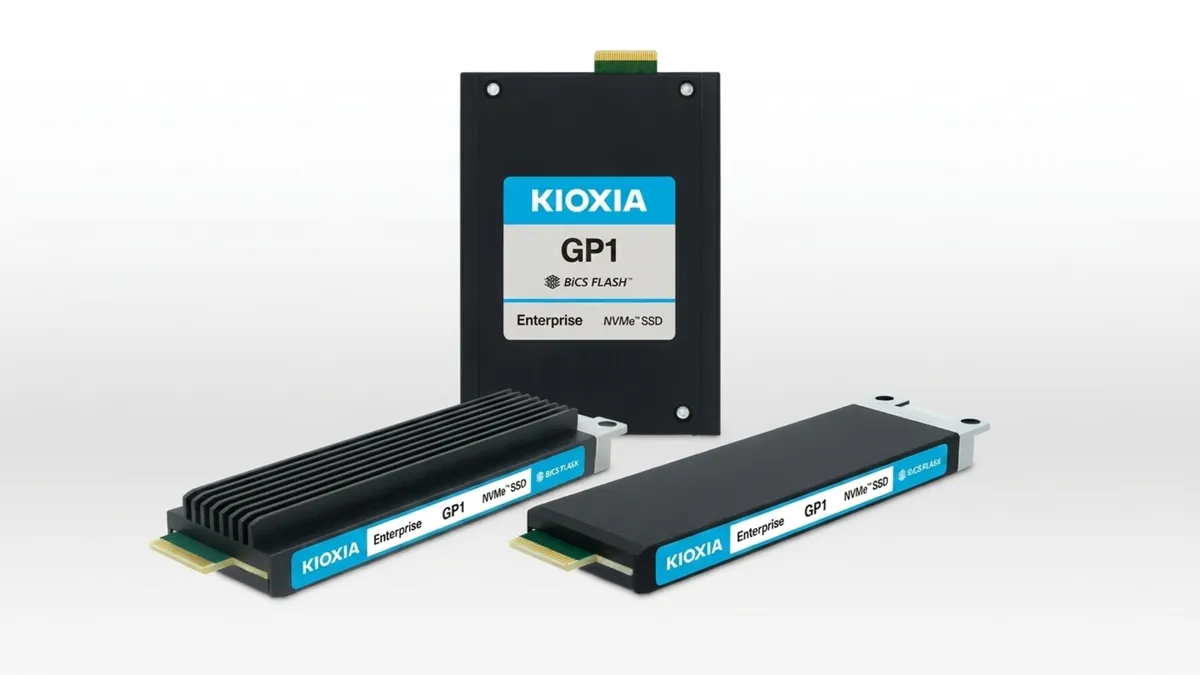
Kioxia has shown off an enterprise SSD capable of reaching 10 million random read IOPS, a figure that sounds excessive until you look at what the company actually wants the drive to do: keep increasingly expensive AI GPUs supplied with data.
The new Kioxia GP1 Series is a PCIe 6.0 NVMe SSD designed around direct GPU access and AI infrastructure rather than conventional servers or consumer PCs. It combines Kioxia’s second-generation XL-FLASH memory with an in-house controller and supports the NVMe 2.2 specification. At a 512-byte block size, Kioxia rates it for as many as 10 million random read input/output operations per second.
So why does 10 million IOPS matter?
AI accelerators are exceptionally good at processing huge amounts of data in parallel, but that performance becomes less useful if the GPU has to wait for information to arrive. High-bandwidth memory, or HBM, addresses part of that problem by placing extremely fast memory close to the processor. The problem is that HBM is expensive and limited in capacity.
Kioxia’s approach is to introduce flash storage as another layer in that memory hierarchy. Instead of expecting everything to fit inside HBM, larger datasets can sit on high-performance SSDs and be accessed directly by GPUs. Reducing CPU involvement can also cut overhead and potentially keep accelerators busy for longer.
That is where the unusually high IOPS figure becomes important. Sequential transfer speeds tend to dominate consumer SSD marketing, but AI workloads can involve enormous numbers of smaller, parallel storage requests. An SSD capable of processing more of those requests each second can reduce the amount of time a GPU spends waiting for its next piece of data.
The GP1 is also designed for workloads that write data aggressively. Kioxia rates the series at up to 50 drive writes per day, or DWPD. In practical terms, a drive carrying that rating could theoretically have its entire capacity overwritten 50 times every day within its specified endurance period.
That combination of performance and endurance is helped by XL-FLASH, Kioxia’s SLC-based flash technology. SLC stores one bit per memory cell, trading density for characteristics such as lower latency and stronger endurance. It is considerably different from the high-capacity TLC and QLC NAND commonly found in mainstream SSDs.
None of this means a 10-million-IOPS SSD is about to appear in your gaming PC. The GP1 is aimed firmly at data centers, AI systems, high-performance computing and analytics. It will be offered in E3.S and E1.S enterprise form factors, with both air cooling and cold-plate liquid-cooling support depending on configuration. Evaluation samples are expected to reach selected customers by the end of 2026.
And 10 million IOPS may only be an intermediate step. Kioxia says the GP architecture is intended to scale toward 100 million IOPS in future generations, reflecting where AI storage is heading as GPU performance continues climbing.
The interesting part, then, isn’t simply that Kioxia has built an extremely fast SSD. It is that AI infrastructure is beginning to change what an SSD is expected to do. Storage is moving closer to the GPU, and the next performance battle may be less about how quickly a drive copies one giant file and more about whether it can feed millions of tiny requests to accelerators without becoming the bottleneck.