

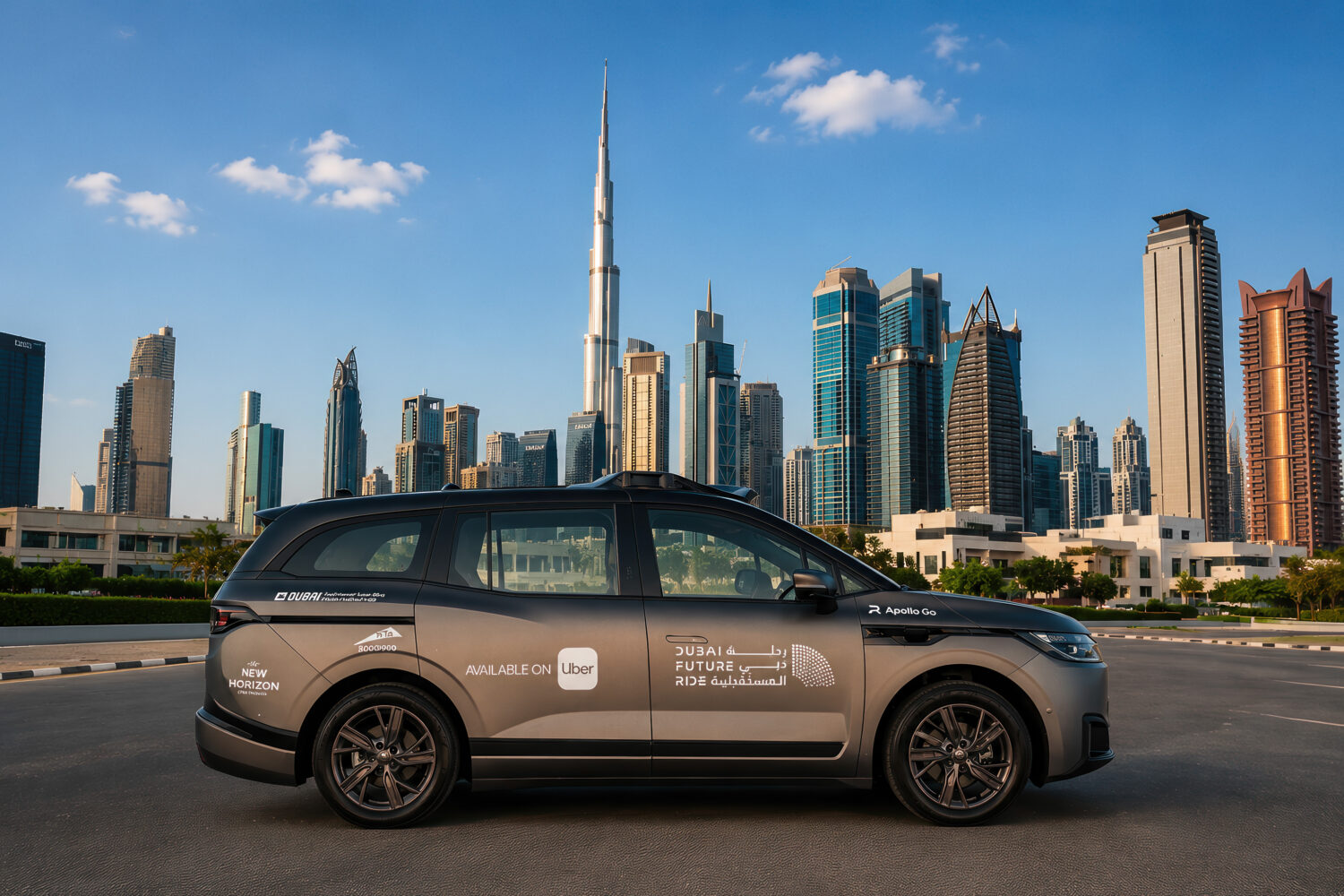
Dubai’s autonomous transport push is moving beyond trials, with Uber and Baidu launching fully driverless Apollo Go robotaxis through the Uber app in parts of the city. The rollout makes Dubai the first market to put the companies’ autonomous ride-hailing partnership into commercial operation.
From August 20, riders requesting UberX or Uber Comfort can potentially be matched with one of Baidu’s Apollo Go vehicles. Uber has also added an “Autonomous” option to its app for passengers specifically looking for a robotaxi ride.
Availability remains geographically limited at launch. The driverless service initially covers selected areas of Umm Suqeim and Jumeirah, with the companies planning to expand the operating zone over time. New Horizon Luxury Transport is operating the fleet locally.
The Dubai deployment is significant for both companies for different reasons. For Uber, it represents another step towards a ride-hailing network where human-driven cars and autonomous vehicles operate through the same marketplace. The company says it now works with more than 30 autonomous vehicle partners, suggesting its strategy is increasingly focused on becoming the distribution layer for competing AV technologies rather than developing the underlying self-driving systems itself.
For Baidu, Dubai gives Apollo Go another international showcase outside its established operations in China. The company says Apollo Go has operated across 28 cities and accumulated more than 350 million autonomous kilometres, including over 240 million kilometres without a human driver. Those figures are supplied by Baidu, but they illustrate the considerable amount of real-world deployment behind the technology arriving in Dubai.
Passengers will ride in Baidu’s sixth-generation RT6, a purpose-built electric robotaxi with capacity for up to three passengers. The vehicle uses more than 30 sensors to monitor its surroundings, alongside onboard computing designed to process driving data in real time.
The companies describe Dubai as the starting point of a multi-year agreement intended to eventually bring thousands of Apollo Go vehicles onto Uber’s wider network. No detailed timetable for that expansion has been announced, however, meaning the immediate test will be considerably smaller and more localised than those global ambitions suggest.
Dubai has become an increasingly important testing ground for autonomous mobility as the emirate works towards putting more self-driving transport on public roads. Moving from supervised testing to vehicles carrying paying passengers without a driver is a more consequential stage, particularly because public confidence, regulatory oversight and performance in everyday traffic will matter as much as technical capability.
Uber says autonomous vehicles joining its network must comply with its safety guidelines. As robotaxi partnerships multiply, the larger question is how smoothly these vehicles can be integrated into existing ride-hailing services without creating a fragmented experience for passengers.
For Dubai riders, that transition is now becoming tangible. A routine Uber request in parts of Jumeirah or Umm Suqeim could arrive without anyone behind the wheel, turning autonomous driving from a technology demonstration into something passengers can encounter during an ordinary trip.