
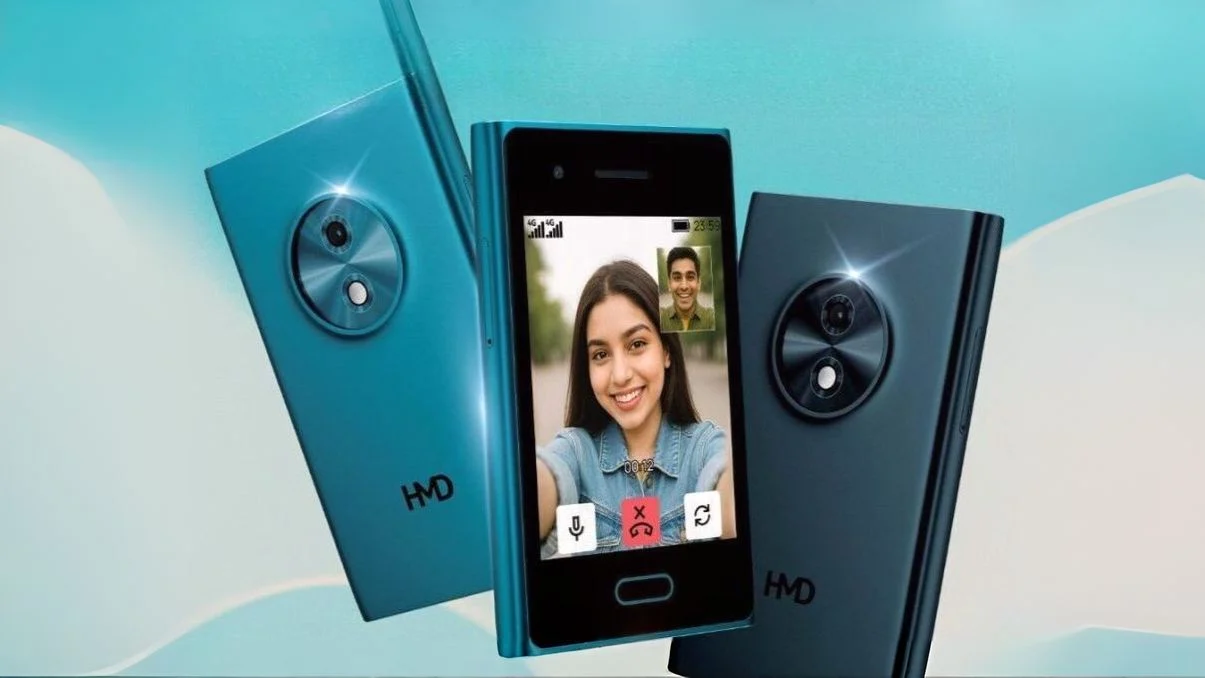
HMD appears ready to take another shot at the space between smartphones and traditional feature phones, with the compact HMD Touch AI reportedly heading to more international markets after its earlier launch in China.
At the centre of the HMD Touch AI is a 3.2-inch touchscreen, paired with dual-SIM 4G connectivity, Wi-Fi and a 1,950mAh battery that charges over USB-C. Those specifications put it firmly below even entry-level smartphones, but raw performance is not really the point. The device is designed around basic communication, portability and a limited selection of modern services rather than the full app experience of Android or iOS.
In China, the HMD Touch AI sells for CNY 469, roughly $69. The international package is reportedly set to include an 8GB microSD card, protective case and screen protector, although regional bundles could still vary.
More interesting is the software. The global version is said to include access to an AI service described as “Taobao AI,” alongside Alipay support and a QR code scanner. That differs from the Chinese model, which uses ByteDance’s Doubao AI and reportedly includes a 180-day free trial before requiring a subscription.
If accurate, those regional differences show how HMD is trying to add selective smartphone-style services without turning the Touch AI into a conventional smartphone. That approach also distinguishes it from the HMD Touch 4G launched in India in 2025, which followed a similarly compact format but offered a more limited feature set.
The design is likely to be part of the appeal as well. HMD has leaned into styling reminiscent of older Nokia Lumia devices, a direction that fits the growing interest in simpler phones with more distinctive hardware. Cyan and dark blue have already appeared on related models, while white and gold are reportedly being considered for the international Touch AI.
There is a practical audience for this category, even if it remains niche. Some buyers want a secondary phone with long standby time and fewer distractions, while others simply do not need the complexity or cost of a full smartphone. Older users may also value the smaller feature set, provided the interface remains easy to navigate.
The challenge is that “digital detox” phones still need to justify themselves against inexpensive Android models that offer far more flexibility for only a little more money. AI assistance, mobile payments and QR support could help HMD narrow that gap, but much will depend on local pricing and how useful those services actually are outside China.
If HMD can keep the price low, the Touch AI may find a modest audience among people who want modern connectivity without carrying a full smartphone everywhere.