
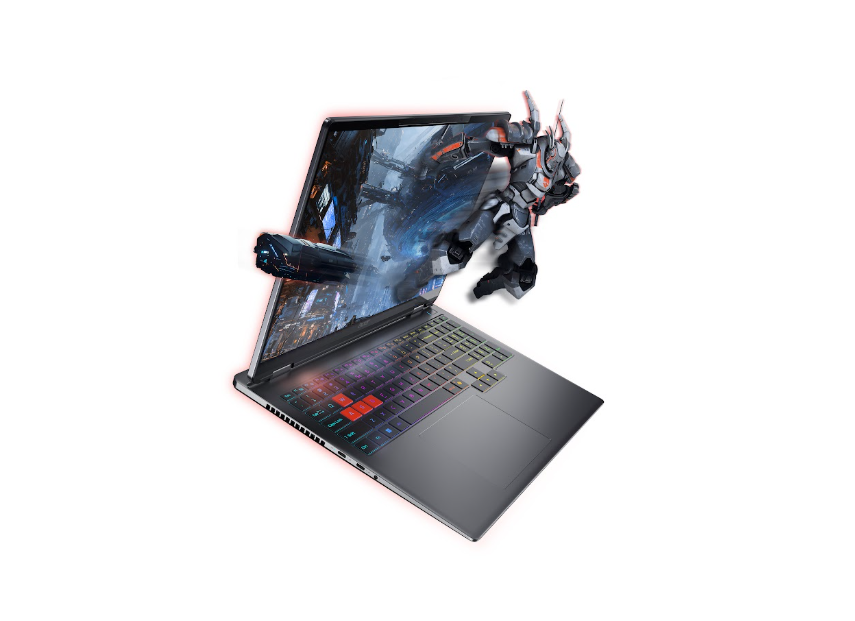
Acer’s glasses-free 3D experiment is moving down the range. The new Aspire G 3D 16 brings the company’s SpatialLabs display technology to its mainstream Aspire family, and pairs it with one of the most powerful laptop chips AMD currently sells. The laptop was announced alongside refreshed Aspire S all-in-one desktops at Acer’s next@Acer event during IFA 2026.
Acer has been building naked-eye 3D laptops since the ConceptD 7 SpatialLabs Edition in 2021, followed by Predator and Aspire 3D models. The idea hasn’t changed much. Two eye-tracking cameras follow your position and adjust a stereoscopic panel so each eye sees a slightly different image, creating depth without glasses. Acer says the system can also convert ordinary 2D photos, videos and supported games into 3D, through its preloaded SpatialLabs 3D Hub app. How convincing that conversion looks is something only hands-on testing will show.
The more surprising part is the hardware underneath. Instead of a separate graphics card, the Aspire G 3D 16 uses the AMD Ryzen AI Max+ 395, the high-end “Strix Halo” chip that has so far appeared in premium machines like the Asus ROG Flow Z13 and HP’s ZBook Ultra workstations. Its integrated Radeon 8060S graphics are strong enough to run serious games and creative apps without a dedicated GPU, and Acer quotes up to 126 TOPS of combined AI performance. Memory goes up to 128 GB of LPDDR5x-8000, with up to 2 TB of SSD storage.
The 16-inch IPS panel runs at 3840 x 2400 and 120 Hz with full DCI-P3 colour coverage, though horizontal resolution drops to 1920 in 3D mode because the screen has to split pixels between your eyes. A 99.9 Wh battery, the maximum allowed on most flights, helps offset a power-hungry chip and eye-tracking setup. Wi-Fi 7, Bluetooth 5.4, two USB4 ports, an RGB keyboard and a metal chassis round things out.
The Aspire S 27 and Aspire S 24 all-in-ones are simpler upgrades. Both move to Intel Core Series 3 processors, up to the Core 7 350, and add an optional touchscreen with stylus support. The 27-inch model offers QHD at 120 Hz or Full HD at 144 Hz, while the 24-inch sticks to Full HD at 144 Hz. Ports are sparse, with one data-only USB-C and a single HDMI, which may annoy families plugging in printers and drives.
Acer hasn’t shared pricing or regional availability. That figure matters most for the 3D laptop, since Strix Halo machines have rarely been cheap, and “mainstream” glasses-free 3D only makes sense if the price follows the branding.