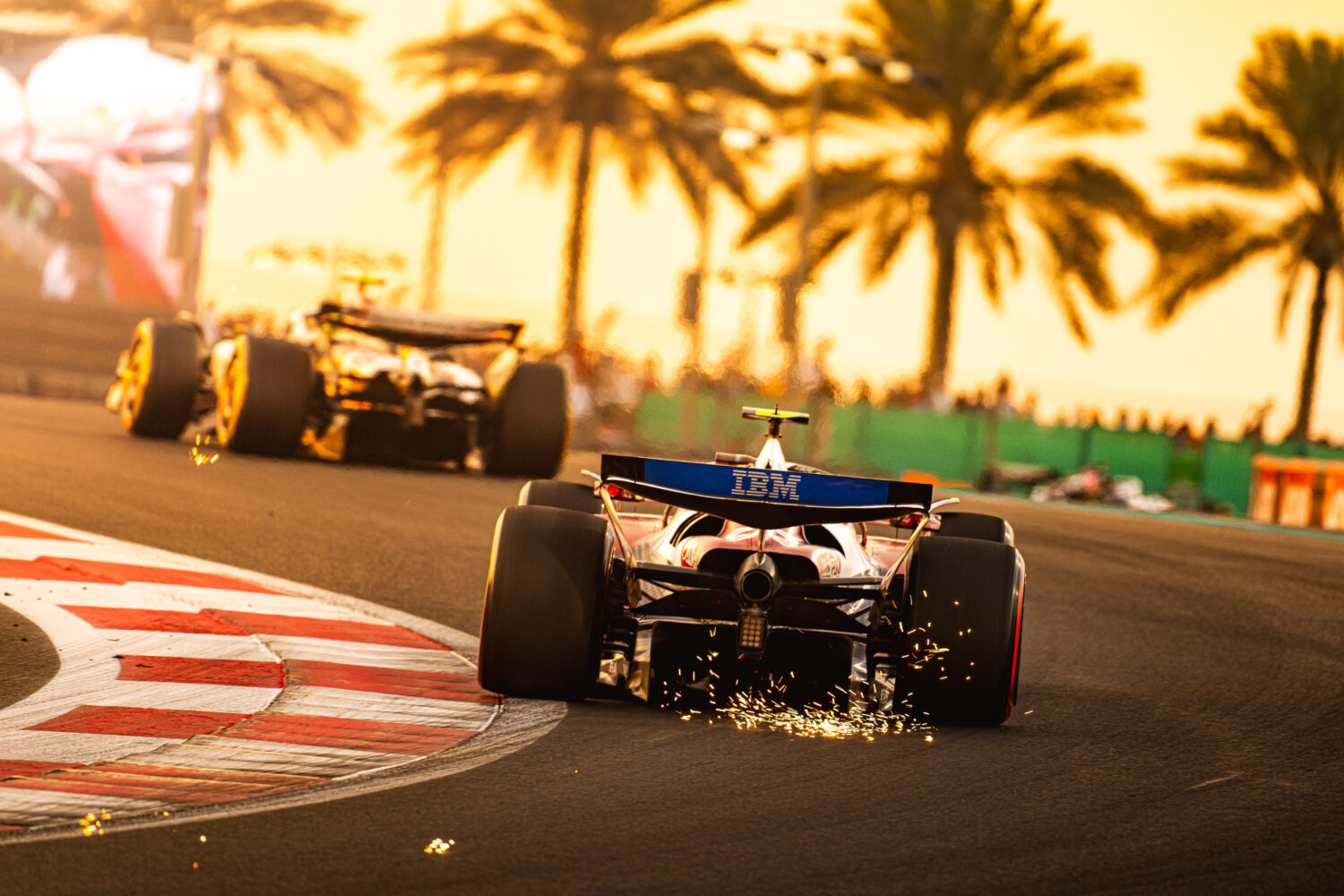

At Yas Marina Circuit, Formula 1 cars move faster than the eye can comfortably follow. Capturing them demands a finely tuned combination of anticipation, technique and some seriously fast imaging technology.
At approximately 350 km/h, a Formula 1 car covers almost 100 metres every second. Blink for a tenth of a second and it has travelled the length of a football penalty area. Hesitate for one second and the photograph you imagined is already disappearing into the next corner.
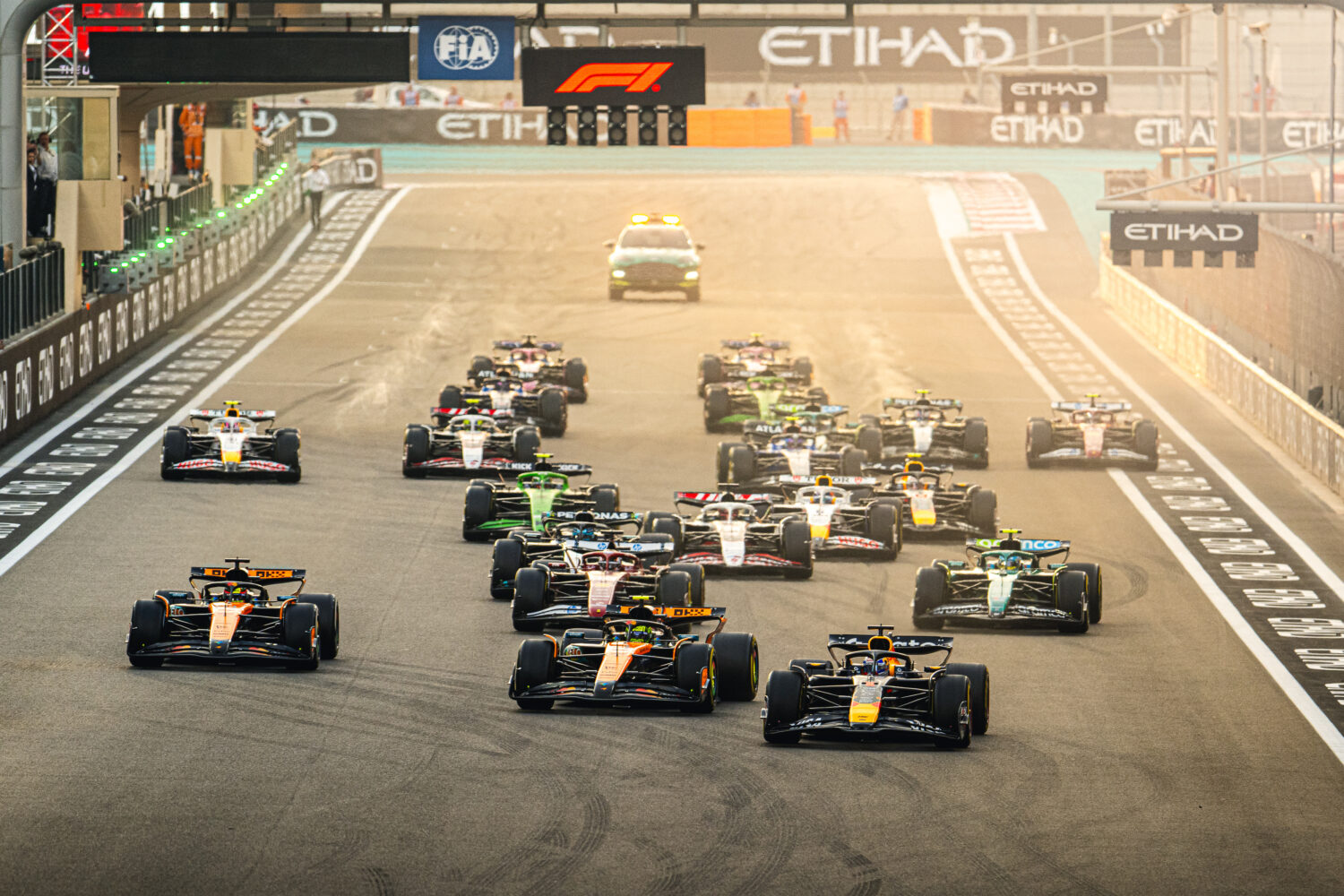
That is the reality facing the photographers stationed around Yas Marina Circuit during the Abu Dhabi Grand Prix. Behind safety barriers, inside designated media areas and at narrow openings through the circuit fencing, they work with a restricted view of machines moving at extraordinary speed.
The scale of the task is set by the circuit itself. Yas Marina runs to 5.281 km, and the grand prix covers 58 laps for a race distance of 306.183 km. Across that distance, freezing the car is only the beginning. The photographer must also capture its position, the driver’s intent, the glowing brake discs, the spray of sparks and the atmosphere of a season finale, all within a fraction of a second.
Welcome to the bunker.
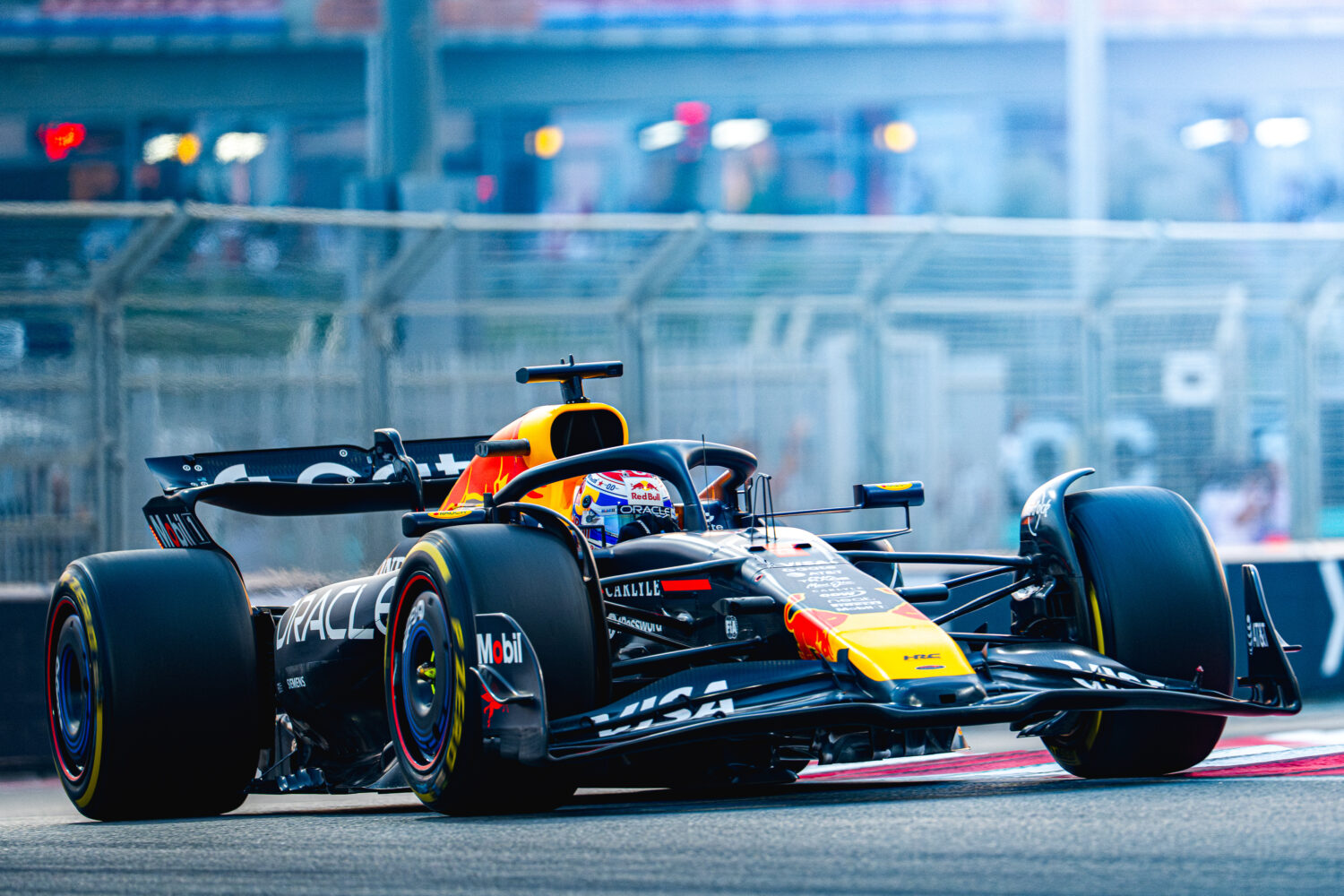
The race begins before the engines start
Sports photographers cannot simply arrive trackside, point a long lens at the circuit and hope for the best. Their first job is to understand what will happen before it happens.
They study the circuit map, the direction of the light and the backgrounds visible from each authorised shooting position. They identify where drivers are likely to brake, attack a kerb, run side by side or accelerate out of a corner.
Yas Marina presents a particularly complex canvas. The circuit combines long straights with slower technical sections, while the race’s signature transition from daylight into darkness transforms the colour and intensity of the scene.
A position that delivers warm, directional light at the start may be illuminated by floodlights later. A clean background can suddenly become a wall of headlights. Exposure settings, autofocus behaviour and white balance must evolve as quickly as the circuit itself.
The best photographers are not reacting to the car they can see. They are preparing for the car that will enter their frame next.
What 350 km/h does to a photograph
At 350 km/h, the car moves roughly 9.7 centimetres in a single millisecond. Even during an exposure of 1/2000 second, it travels almost five centimetres.
To render a Formula 1 car sharply, particularly when it is approaching at an angle, photographers may begin with shutter speeds between 1/2000 and 1/4000 second. A wide aperture helps maintain those speeds as the light fades, while Auto ISO can compensate for rapid changes in brightness.
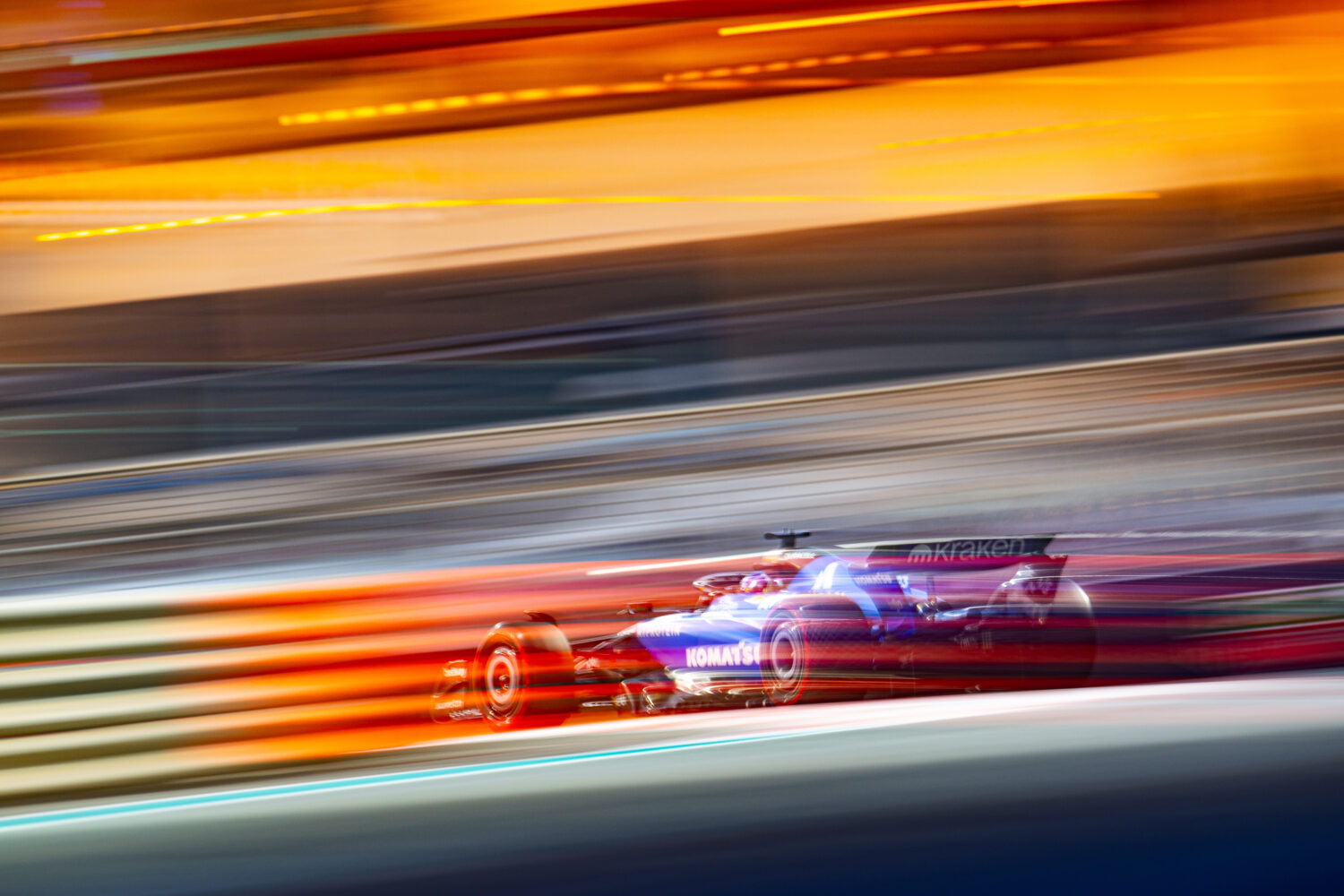
But a perfectly frozen car is not automatically an exciting photograph. Sometimes the more powerful image comes from doing the opposite: lowering the shutter speed and following the car through the frame.
What is panning?
Panning means moving the camera to follow a subject during the exposure, so that the subject stays in roughly the same place on the sensor while the background sweeps across it. The subject renders comparatively sharp; the barriers, grandstands and track markings stretch into streams of colour. The slower the shutter speed, the stronger the effect and the smaller the margin for error, because any vertical wobble or change in panning speed registers as blur on the subject too.
Depending on the car’s distance and direction, photographers might experiment between 1/60 and 1/250 second. The slower the shutter, the more dramatic the sensation of speed, and the greater the chance of returning with an artistic blur instead of a usable image.
That risk is part of the craft. A sharp photograph shows what the car looks like. A successful pan shows what it feels like.
Autofocus has to think at racing speed
Tracking a racing car is not the same as focusing on a stationary subject. It can appear as a distant dot, approach rapidly, fill the frame and then vanish behind a barrier within seconds.
Nikon states that the Nikon Z9 offers advanced auto-area AF with 405 focus points and 3D-tracking in stills, together with a blackout-free viewfinder that keeps the action continuously visible during a burst rather than briefly hiding the subject between frames. For photographers panning at high speed, that uninterrupted view matters: losing sight of the car for even a moment can break the movement of the camera and ruin the composition.
The Nikon Z8 carries the same 45.7MP fully stacked CMOS sensor and EXPEED 7 image-processing engine as the Nikon Z9 in a body approximately 30% smaller, and focuses down to -9EV across 493 AF points and nine subject types. The Nikon Z6III detects and acquires focus lower still:
“Autofocus detection down to -10EV” (Nikon Z5II and Nikon Z6III).
Qualifier: in photo mode, single-servo AF, single-point AF at centre, ISO 100, f/1.2 lens, at 20 degrees Celsius.
Keeping the subject visible is its own engineering problem, and it is one the Nikon Z6III addresses directly. Its electronic viewfinder runs at 4,000 cd/m², 5,760k dots and a 120fps refresh rate with DCI-P3 coverage:
“Brightest EVF of any mirrorless camera” (Nikon Z6III).
Qualifier: as of June 17, 2024, based on Nikon research.
In floodlit conditions with dark backgrounds, viewfinder brightness is not a luxury specification. It is what allows a photographer to hold a line through a pan when the only reference points are moving lights.
Nikon Ambassador Jasin Boland, quoted on Nikon Middle East and Africa’s own Z9 page, describes the system this way: “Shooting action, the eye detection stuck like glue and was picking up the target from over 50 metres away and tracking a face and then the eyes through a helmet visor.” Boland’s work is in film stills rather than motorsport, but the behaviour he describes, acquisition at distance and retention through an obstruction, is the same behaviour a trackside photographer depends on.
Technology cannot predict the decisive moment. It can reduce the number of technical distractions standing between instinct and execution.
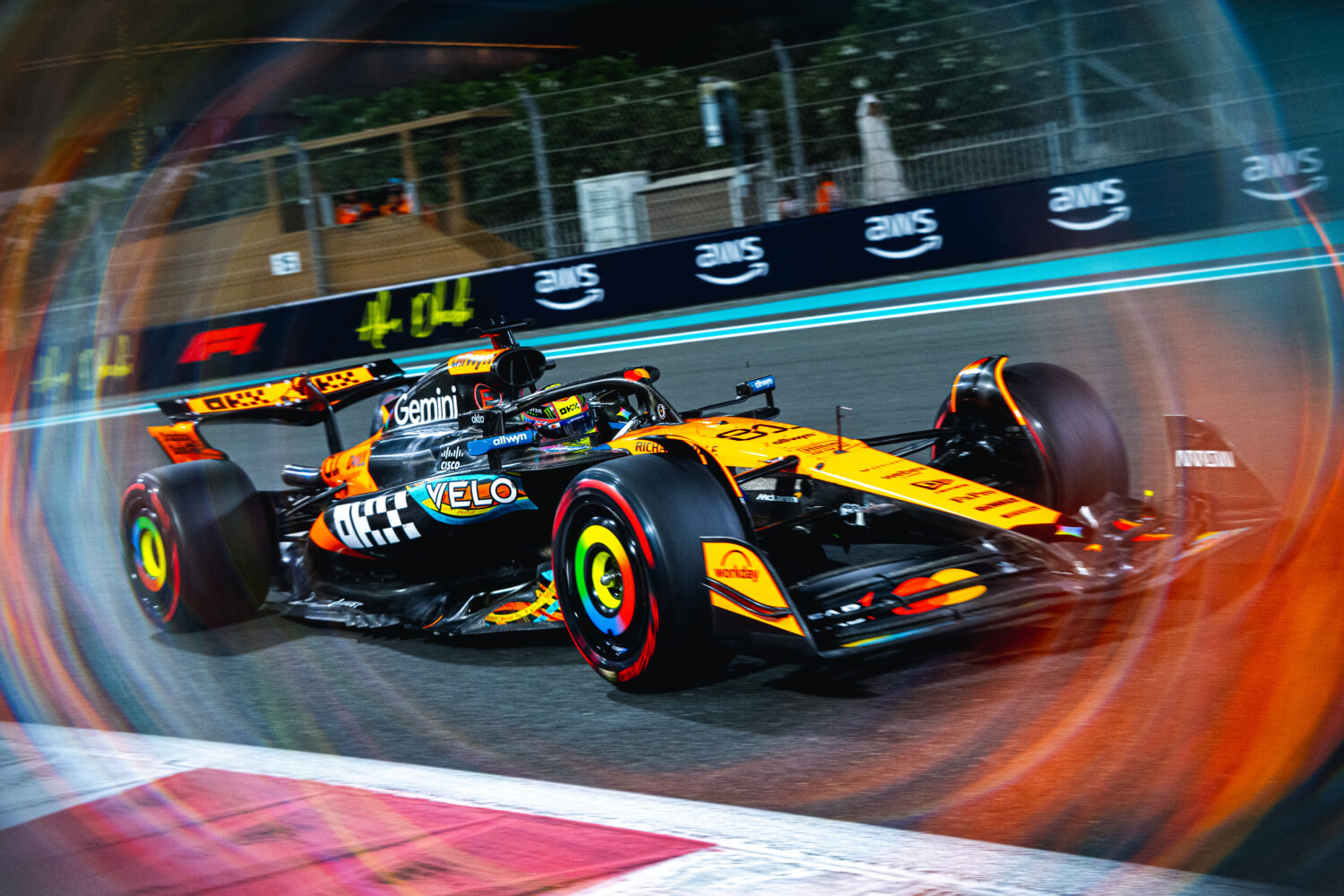
When 20 frames per second is not enough
Nikon states that the Nikon Z9 captures 45.7-megapixel stills at 30 fps, 19-megapixel stills at 60 fps, and 11-megapixel stills at 120 fps, all with full AF and AE performance and no blackout.
The Nikon Z8 delivers 20fps at full-resolution RAW, 30fps in JPEG and 120fps at reduced resolution. The Nikon Z6III reaches 120fps at a 10.6MP DX crop and 60fps at 24MP full frame, built on a sensor Nikon describes as follows:
“World’s first partially-stacked CMOS sensor in a full-frame camera” (Nikon Z6III).
Qualifier: as of June 17, 2024.
That sensor architecture is what makes the speed usable rather than merely numerical. Nikon puts the gain at approximately 3.5x faster readout than the Z6II, based on Nikon measurement. Readout speed governs rolling-shutter distortion on fast-moving subjects, and it governs how quickly the viewfinder refreshes between frames.
All of which sounds excessive until a wheel touches a kerb, a front wing flexes or a shower of sparks lasts for less than a second. At 20 fps, the camera records an image every 50 milliseconds. During that interval, a car travelling at 350 km/h moves almost five metres. Increasing the frame rate creates more opportunities to capture the exact relationship between car, track and background.
Pre-Release Capture, available on the Nikon Z6III, adds another layer of insurance by recording images from immediately before the shutter button is fully pressed. It is valuable for moments that cannot be repeated: a sudden lock-up, an unexpected overtake or a reaction in parc fermé.
The aim, however, is not to return with tens of thousands of nearly identical frames. Burst speed is most effective when combined with anticipation. Professionals begin shooting around the moment they have already visualised; the camera helps refine the timing.
Bodies compared, locked specifications only:
| Body | Sensor and engine | Autofocus | Burst and stabilisation |
| Nikon Z8 | 45.7MP fully stacked CMOS, EXPEED 7, as the Nikon Z9 in a body approx. 30% smaller | -9EV, 493 points, nine subject types | 20fps full-res RAW, 30fps JPEG, 120fps reduced. VR 5.5 stops (CIPA) |
| Nikon Z6III | 24.5MP partially-stacked CMOS, EXPEED 7, readout approx. 3.5x faster than Z6II (Nikon measurement) | -10EV, nine subject types (see qualifier) | 120fps at 10.6MP DX crop, 60fps at 24MP. VR 8.0 stops, CIPA standard |
Choosing the right glass for the story
Inside a circuit, photographers cannot always move closer to the action. Lens choice becomes their way of changing position.
The NIKKOR Z 70-200mm f/2.8 VR S II suits the pit lane, grid, podium and wider trackside scenes, and its fast aperture helps as daylight fades. At 998g excluding the tripod collar it is approximately 26% lighter than its predecessor, and its Silky Swift VCM drive delivers autofocus approximately 3.5x faster when used with a camera equipped with the EXPEED 7 image-processing engine, measured in accordance with Nikon standards. It is also the first NIKKOR lens to support Arca-Swiss screw-type quick-release mounting, which matters more than it sounds when a monopod head has to come off and back on between sessions.
The NIKKOR Z 100-400mm f/4.5-5.6 VR S offers more reach while retaining the flexibility to reframe quickly when a car moves from one part of the corner to another. It weighs 1,435g excluding the collar, delivers Vibration Reduction of 5.5 stops, rising to 6.0 stops with Synchro VR, and accepts teleconverters to reach 560mm with the TC-1.4x or 800mm with the TC-2.0x.
From more distant positions, the NIKKOR Z 400mm f/2.8 TC VR S brings the action dramatically closer. At approximately 2,950g including the tripod foot it is approximately 20% lighter than the F-mount lens it replaces, and it was the first NIKKOR Z lens to adopt both the Silky Swift VCM and Meso Amorphous Coat. Its built-in 1.4x teleconverter switches the lens between 400mm f/2.8 and 560mm f/4 by lever, without breaking weather sealing. External teleconverters extend it to 800mm or 1,120mm.
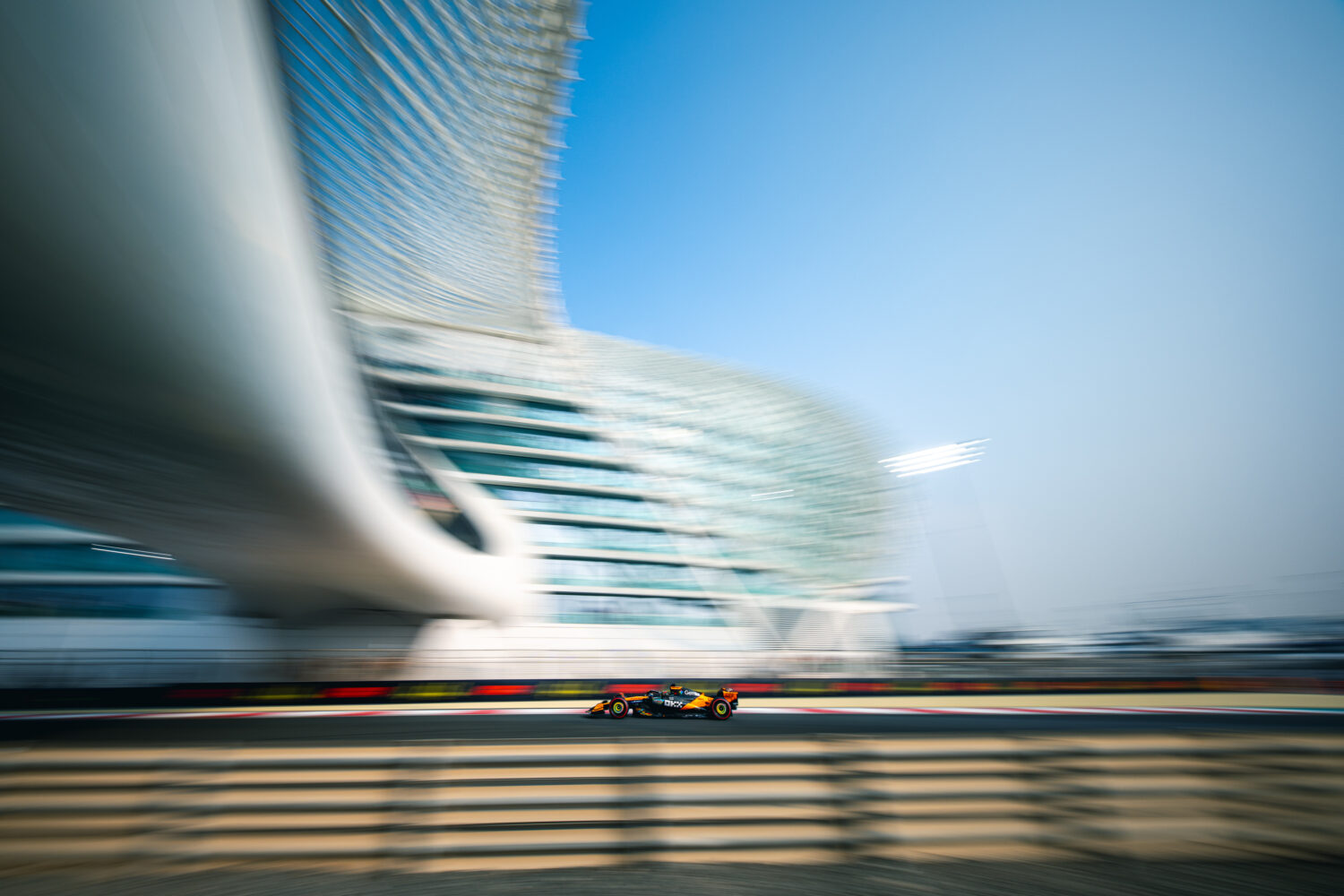
Long lenses do more than magnify. They compress the scene, bringing the car, floodlights, spectators and Yas Marina architecture into a tighter visual relationship. The result can communicate the scale of the event in a way that a close-up alone cannot.
Do not use this product if you have a pacemaker or other medical device. The magnets in this product could cause medical devices to malfunction.
Surviving the sunset-to-floodlight switch
The Abu Dhabi Grand Prix is famous for beginning in daylight and finishing beneath the circuit lights. It is spectacular for viewers and technically demanding for photographers.
As the ambient light falls, the contrast between illuminated cars, bright LED panels and darker backgrounds increases. Reflective bodywork can clip highlights, while shadowed areas of the track quickly become noisy if they are underexposed.
Sensitivity range shapes what is recoverable. The Nikon Z8 runs ISO 64 to 25,600, expandable to 102,400, and that low base is useful in the bright opening stint. The Nikon Z6III runs ISO 100 to 64,000, expandable to 204,800, which is the more relevant figure once the floodlights take over.
Shooting in NEF (RAW) preserves the greatest flexibility, but exposure still needs to be right at the moment of capture. Highlight warnings and the histogram are more trustworthy than judging brightness from the rear screen in a dark environment.
Some photographers use manual exposure with Auto ISO to maintain control over shutter speed and aperture. Others work in shutter-priority mode when panning, allowing the camera to respond as the light changes. White balance also affects the story: a fixed setting keeps a sequence visually consistent, while Auto White Balance may respond more effectively as the scene transitions between natural and artificial light. There is no universally correct choice. The priority is understanding how the camera will behave before the decisive lap.
The other race: getting the image out
A motorsport photographer’s job does not end when the shutter closes. The image may need to reach an editor, news desk or social channel while the race is still happening. That turns file selection and transmission into part of the camera’s performance.
The working pattern is consistent across agencies: a RAW file is retained for later editing while a smaller JPEG is sent immediately, and images move from trackside to a server without waiting for the photographer to return to the media centre. Remote cameras can provide angles that would otherwise be impossible to cover once the circuit is live, although their installation and operation must always follow event and safety regulations.
The first technically perfect image is not necessarily the picture that leads the story. In live sports media, the winning image is often the one that is both exceptional and available.
The photographer still makes the photograph
Modern autofocus, blackout-free viewing and extreme burst speeds have changed what is technically possible. They have not removed the need for judgement.
The camera cannot decide whether to freeze a car against the Yas Hotel or pan it into a ribbon of colour. It cannot notice a mechanic’s expression after a difficult pit stop, anticipate a driver climbing from the cockpit or recognise when the quiet frame behind the grid tells a stronger story than another head-on action shot.
“Every specification in a camera like this exists to buy back time,” says Dr. Ali Mohamad, CEO of House of Content and Founder of TECHMISSION platform. “A faster readout, a brighter viewfinder, a lens that focuses in a fraction of the time: each one shortens the gap between deciding and capturing. What none of them does is make the decision. At Yas Marina the photographers who come away with the frame that runs are the ones who knew, three corners earlier, exactly what they were waiting for.”
That is why the photographers’ bunker remains such a compelling place. It is where human anticipation meets machine speed.
When the Formula 1 season returns to Yas Marina from 3 to 6 December 2026, the cars will complete 58 laps covering 306.183 kilometres. The photographers will experience the race in much smaller units: corners, gestures, reflections and fractions of a second.
At 350 km/h, there is no time to ask whether the moment has arrived. You either see it, or you don’t.
“At 350 km/h, the photograph begins before the car enters the frame. You read the corner, the light and the driver’s line, then trust the Nikon Z9 to keep up. The goal is not simply to show a fast car—it is to make the viewer feel the speed.”
— Evgeniy Safronov, Formula 1 and commercial photographer