


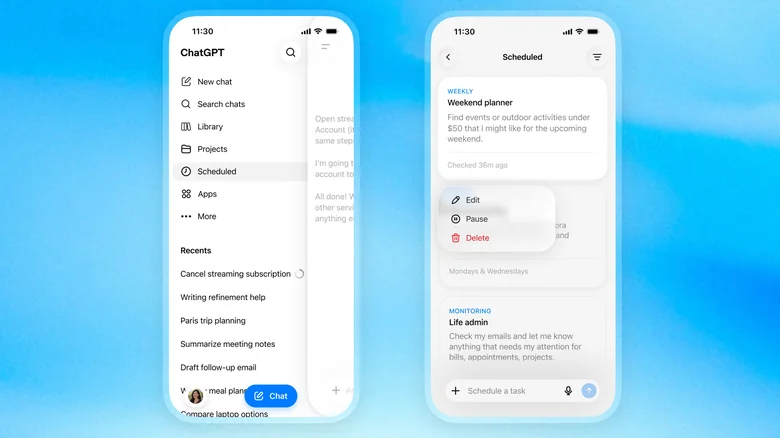
OpenAI has introduced a more prominent way to handle scheduled tasks in ChatGPT, adding a dedicated hub that makes it easier for users to manage prompts set to run at future times. Previously somewhat hidden, this capability now appears as a shortcut in the sidebar, offering a centralized view of active requests, including their scheduled execution details. From there, users can pause, edit, or delete upcoming tasks, providing greater control over automated interactions with the chatbot.
The update improves reliability and speed across scheduled operations. Prompts can now target specific times or broader windows, such as morning, afternoon, or evening, accommodating varied daily routines. This expands practical applications, from generating regular reports and reminders to setting up monitoring tasks that involve proactive web searches or checks within connected apps. For instance, one could configure periodic summaries of news or data trends without manual intervention each time.
The feature targets ChatGPT Plus, Pro, Business, and Enterprise subscribers, leaving free users without access for now. Its rollout coincides with the phase-out of Pulse, OpenAI’s earlier personalized daily summary service. Pro users retain temporary access to Pulse for about two weeks before needing to transition to the new scheduling tools for similar functionality. This shift streamlines OpenAI’s offerings, consolidating automation features into a single, more flexible system rather than maintaining separate experiences.
In the broader landscape of AI assistants, scheduled tasks represent an incremental but useful evolution. Tools from competitors have offered basic automation or reminders for some time, yet ChatGPT’s integration with its conversational strengths and external data access potentially allows for more nuanced, context-aware executions. That said, success will hinge on consistent performance, especially for monitoring duties that rely on real-time information or app integrations. Reliability issues common to large language models, such as occasional inaccuracies or hallucinations, could undermine trust in hands-off tasks where users expect dependable results.
Privacy considerations also arise with proactive searching and app connections, as users grant the system ongoing access to personal or work-related data streams. OpenAI’s emphasis on enterprise tiers suggests awareness of these sensitivities in professional settings. For individual users, the hub could genuinely reduce friction in productivity workflows, turning occasional queries into reliable background processes. Yet it stops short of full agent-like autonomy, remaining dependent on user-initiated setups rather than truly independent operation.
Overall, the change highlights OpenAI’s focus on practical enhancements that embed AI more deeply into everyday routines without overpromising transformative capabilities. As AI tools mature, features like this may become standard expectations, pushing the industry toward better task management and user oversight. Early adopters on paid plans stand to benefit most immediately, while the broader user base awaits wider availability. The update underscores a subtle but meaningful step in making conversational AI feel less like a one-off interaction and more like a persistent assistant.