

TL;DR: Criminal Minds delivers a chilling blend of folk-horror pathology and high-stakes psychological warfare, masterfully setting up a brilliant new antagonist who uses the FBI’s own tactics as a weapon against them.
Criminal Minds Season 19
There is a distinct, almost primal comfort in the way a classic procedural establishes its rhythm. For over a decade and a half, Criminal Minds functioned as the ultimate late-night comfort food for the macabre-minded, a dependable loop of jet-setting profilers, horrific localized pathology, and the reassuring click of handcuffs just before the credits rolled. Yet, when the series transitioned into the streaming landscape with the moniker Criminal Minds: Evolution, the DNA of the show underwent a radical, necessary mutation. Gone was the neat, self-contained closure of the forty-two-minute broadcast window. In its place emerged an interconnected web of modern existential dread, corporate-level serial murder, and a lingering sense that the monsters had finally outpaced the bureau’s ability to categorize them.
With the arrival of Season 19, Episode 4, the series ventures backward to move forward, dipping its toes into a sub-genre that traditionally yields the show’s most visceral nightmares: the ritualistic, occult-tinged fever dream. Historically, when the Behavioral Analysis Unit encounters killers wrapped in religious mania or historical zealotry, the narrative engine shifts from mere detective work to an exploration of ancient human malice adapted for the digital age. This particular hour, however, does something far more insidious than merely offering a creepy case-of-the-week. It serves as the official catalyst for a terrifying paradigm shift, formally introducing an overarching antagonist known simply as “The Fan.” By positioning this new threat not just as a rogue predator, but as a hyper-obsessive disciple of the imprisoned Elias Voit, the narrative shatters the traditional boundaries of the profile. The rules of engagement have fundamentally changed because the monster is no longer operating in a vacuum; he is peer-reviewing the FBI’s methods in real-time.
Deconstructing the Medieval Echo in Modern Suburbia
The episode wastes no time establishing its atmospheric stakes, plunging the audience into a scene of stark, localized terror that feels stripped from a foundational folk-horror text. A home invasion transformed into a kangaroo court, a sledgehammer striking down a victim while a restrained spouse is forced to bear witness, and an assailant screaming demands for a confession of heresy—all while wearing a mysterious, glistening vial around his neck. It is a sequence designed to evoke immediate, bone-deep discomfort. When the BAU takes the reins, the immediate challenge is filtering this archaic methodology through the lens of modern criminal psychology. The breakthrough comes not from forensic technology, but from institutional memory and historical precedent.
When Unit Chief Emily Prentiss allows her seasoned intuition to guide the team toward the psychological architecture of historical witch hunts, the narrative taps into a rich vein of series nostalgia. The revelation that the killer’s theological framework is explicitly drawn from the Malleus Maleficarum—the infamous medieval treatise on prosecuting witches—allows David Rossi to do what he does best: bridge the gap between ancient zealotry and modern behavioral science. Categorizing the UnSub as a classic “moral enforcer” acts as a brilliant narrative anchor for long-term viewers. It recalls the golden era of the franchise when behavioral typologies like “sexual sadist” or “angel of death” were explicitly weaponized to demystify the terrifying anomalies of human behavior.
The Domestic Trojan Horse and the Subverted Profile
The true horror of this specific procedural thread lies in how the killer gains access to his victims. The revelation that the perpetrator is a substitute teacher who actively exploits the innocence of children to map out the fractures in domestic spaces is a skin-crawling twist. He isn’t peering through windows from the bushes; he is sitting at the front of a classroom, earning the trust of kids, and extracting the intimate secrets of parental infidelity under the guise of mentorship. It is a potent reminder of how easily predatory behavior camouflages itself within the institutions built to protect us.
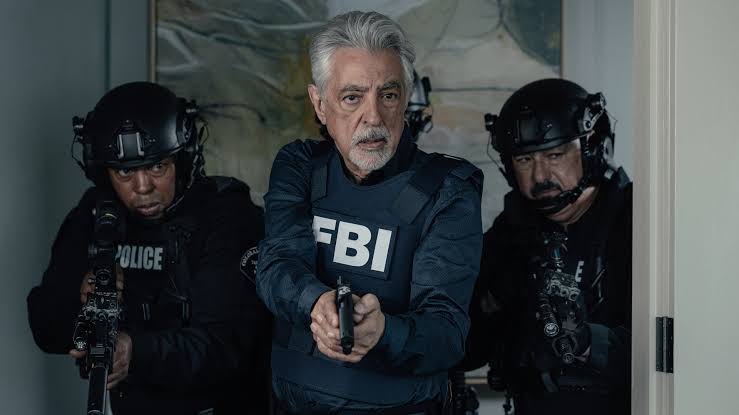
While the tactical resolution of the case—a high-stakes intervention ending with the UnSub being neutralized by Agent Tyler Green—follows a relatively linear trajectory, the lasting impact of the sequence is purely atmospheric. The case functions less as an intricate puzzle and more as a thematic mirror. It showcases a world where individuals are driven to extreme, meticulous violence by their obsessive relationship with texts and figures they deem superior. This obsessive emulation is the precise connective tissue that bridges the gap between a localized religious fanatic and the macro-threat lurking in the shadows of the entire season.
The Architecture of an Unlikely Alliance
Beneath the grand, macro-narrative of serial murder networks, the episode excels in its quiet, character-driven subplots, most notably the developing dynamic between David Rossi and Tyler Green. For several seasons, Rossi has occupied the space of the weary titan—a brilliant mind weighed down by decades of looking into the abyss, occasionally slipping into an aloof, cynical detachment. However, positioning Green as a raw, eager-to-please rookie provides the narrative narrative with an old-school energy the franchise hasn’t felt since its inaugural season. The casual, almost effortless banter between the two serves as a spiritual successor to the historic mentorship between Jason Gideon and a young Spencer Reid.
Rossi’s approach to teaching is defined by a suave, slightly arrogant patience, encouraging Green to vocalize his theories even when they veer wildly off-course. This methodology allows the newcomer to build his analytical stamina, or as Rossi notes, to get his reps in and learn how to organically connect disparate behavioral clues. The resulting dynamic infuses the often-bleak environment of the BAU with a much-needed layer of warmth and human continuity, proving that despite the psychological toll of the job, the institutional knowledge of the unit survives through legacy.
“A great profiler isn’t born from memorizing case files; they are forged in the uncomfortable spaces where intuition meets ugly reality, and someone has to teach you how to survive that drop.”
The Distant Echoes of the Home Front
Concurrently, the series continues to explore the lingering emotional fallout of Jennifer “J.J.” Jareau’s domestic life, a narrative thread that feels intentionally grounded and distinctly heavy. Navigating the demanding world of federal law enforcement as a mother has always been central to J.J.’s identity, but the absence of her husband, Will, casts a long, complicated shadow over her interactions with her eldest son, Henry. The revelation that Henry is quietly contemplating abandoning his dreams of attending college in California to stay closer to home is a heartbreakingly authentic look at the collateral damage of a profiler’s life.
The quiet, domestic interlude where mother and son share ice cream and confront the realities of their changing family structure provides a necessary emotional decompression chamber for the audience. J.J.’s vulnerable admission of utter exhaustion, paired with her unwavering vow to support her son’s autonomy, anchors the show in a recognizable human reality. Even if the pacing of these domestic scenes occasionally feels out of alignment with the breakneck momentum of an active FBI manhunt, they are crucial for maintaining the stakes. We must care about the lives of the people trying to save the world, or the act of saving it loses all narrative value.
The Evolutionary Leap of True Crime Obsession
The true thematic core of the episode crystallized during Dr. Tara Lewis’s tense, clinical confrontation with Elias Voit. The terrifying brilliance of Zach Gilford’s portrayal of Voit lies in his transition from an active, subterranean threat to an institutionalized, Hannibal Lecter-esque consultant who understands the systemic weaknesses of the FBI better than they do. When Voit surrenders the physical correspondence he received from his anonymous disciple, the narrative elevates from a standard crime drama into a scathing critique of modern true-crime culture and the weaponization of parasocial influence.
The physical nature of the notes themselves—crafted meticulously on an authentic, analog typewriter—signals a calculated evolutionary leap in the mythology of the series’ villains. This isn’t a chaotic, disorganized copycat acting on a sudden violent whim; this is a patient, highly intellectual archivist of violence. As Voit coldly points out, the Fan hasn’t even shed blood yet, which makes him infinitely more dangerous. His violence exists as a pure, distilled intellectual exercise, a multi-layered challenge explicitly directed at both his imprisoned idol and the federal agents who put him there. The Fan is treating the psychological profile not as a tool for his capture, but as a blueprint to be systematically subverted.
The Lance Interrogation and the Illusion of Control
The complexity of this new threat becomes blindingly apparent during the brief, frustrating investigation into a potential suspect named Lance. On the surface, Lance checks all the boxes of a volatile, dangerous individual—he is an obsessive stalker who has systematically harassed his ex-girlfriend, providing a concrete trail of disturbing photographs that led the BAU straight to his doorstep. Yet, during a high-stakes interrogation spearheaded by J.J. and Tara Lewis, the psychological illusion falls apart. Lance is too emotional, too fragile, and far too undisciplined to possess the ice-cold, obsessive-compulsive precision displayed in the typewritten manifestos.
The brilliant, unsettling realization that follows elevates the episode into top-tier Criminal Minds storytelling. The entire trail leading to Lance was a psychological Trojan horse. The Fan intentionally manipulated a volatile, predictable stalker, knowing precisely how the BAU would react, intercept, and interrogate him. By using Lance as an unwitting proxy, the Fan effectively gained a direct window into the bureau’s active investigative playbook. He forced the team to reveal their behavioral priorities, their interrogation techniques, and their operational speed. It is a chilling tactical maneuver that leaves the BAU completely exposed, hunting an antagonist who isn’t hiding from their profile, but actively using it to map his next move.
Final Verdict
While Season 19, Episode 4 occasionally bears the structural hallmarks of a traditional transition episode, it succeeds wildly by reinventing the mechanical predictability that often plagues late-stage procedurals. By blending a deeply unsettling, old-school ritualistic case with the cerebral, overarching threat of the Fan, the series effectively honors its past while aggressively pushing its narrative boundaries into terrifying new territory. The evolving mentorship between Rossi and Green provides the show with a vital injection of humanity, balancing the dark, meta-analytical chess match occurring between the BAU and the duo of Voit and his disciple. The episode serves notice that the series is no longer just about catching the monster; it is about surviving an era where the monsters are actively profiling the profilers.