


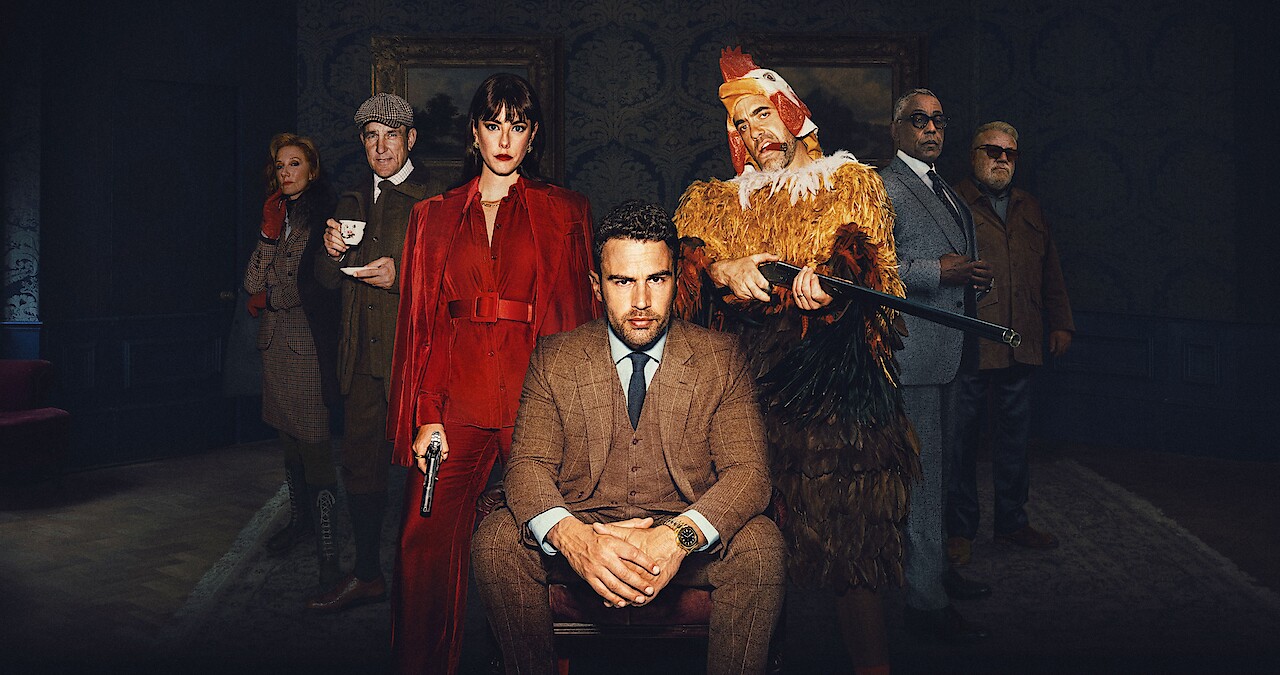
TL;DR: A stylish, frequently hilarious gangster series powered by Theo James and Kaya Scodelario, The Gentlemen turns an aristocrat’s attempted escape from crime into a convincing origin story for his embrace of it.
Guy Ritchie has spent enough time around sharply dressed criminals, expensive cars and men making catastrophically poor decisions that the territory practically comes with his name on the lease. Netflix’s The Gentlemen could easily have felt like an eight-hour attempt to stretch the swagger of Ritchie’s 2019 film into streaming television. Instead, Season 1 finds a surprisingly comfortable rhythm of its own, combining aristocratic absurdity, gangster politics and black comedy without losing the dangerous edge underneath all that tailoring. Theo James’ Eddie Horniman becomes our reluctant guide into this ecosystem after inheriting Halstead Manor and discovering a cannabis empire operating beneath the family estate. What follows is less a traditional crime story than an elaborate lesson in how quickly “I want out” can evolve into “perhaps I should be running this.”
An inheritance with some very complicated paperwork
The cleverest decision The Gentlemen makes is turning Eddie’s attempted escape from criminality into the engine of his transformation. He begins as the responsible Horniman brother, particularly when compared with Freddy, whose £8 million debt and spectacular talent for making every situation worse drag Eddie into immediate trouble. Yet the series gradually reveals that Eddie’s competence is not merely useful around criminals; it may make him unusually well suited to becoming one. Each new crisis gives him another opportunity to negotiate, manipulate or improvise his way through a world he supposedly dislikes. By the time Bobby Glass tests whether Eddie has the appetite to compete for his empire, the question is no longer whether Eddie belongs in this business. It is whether Eddie has finally stopped pretending he does not enjoy being good at it.
That progression gives the season a stronger backbone than its episodic criminal adventures initially suggest. Stolen cannabis, a Lamborghini containing 150 kilos of cocaine, aristocratic blackmail, smuggling routes and financial sabotage can occasionally make The Gentlemen resemble a particularly expensive criminal side-quest generator. Some detours are more entertaining than narratively essential, and the middle stretch occasionally tests how many eccentric gangsters and wealthy lunatics one series can introduce before the novelty starts depreciating. Still, the chaos serves a purpose because Eddie is learning something from almost every disaster. His network expands, his methods become colder and his supposed moral boundaries become increasingly negotiable, until the respectable duke and the emerging crime boss are difficult to separate.
Eddie and Susie are the real business
Theo James understands that Eddie becomes more interesting when the performance does not announce every stage of that transformation. There is restraint to him, even when circumstances become ludicrous, and that controlled presence makes the flashes of ruthlessness land harder. Kaya Scodelario’s Susie Glass provides the ideal counterweight. She already understands the rules Eddie is learning, but she is not simply his criminal-world tutorial character; she has loyalties, vulnerabilities and ambitions that repeatedly complicate their partnership. Their chemistry is built less around conventional romance than the far more entertaining question of whether either could safely turn their back on the other.
That tension becomes especially effective once trust starts collapsing. Eddie discovers that Jethro, whom he deliberately spared, apparently never received the escape Eddie intended for him, while Susie later learns that Eddie has been secretly cooperating with Stanley Johnston. Both betrayals matter because the series has spent considerable time making Eddie and Susie frighteningly efficient together. They can solve problems as partners while simultaneously becoming problems for each other, giving their relationship a volatility that carries the quieter stretches of the season. Bobby Glass sees their potential before either of them fully acknowledges it, and the finale wisely turns their uneasy partnership into something more consequential than another temporary gangster alliance.
Crime with a very British dress code
Visually, The Gentlemen knows exactly what fantasy it is selling. Country estates, underground cannabis facilities, boxing rings, luxury vehicles and impeccably curated criminal wardrobes create a world where old money and illicit money seem separated mostly by etiquette. The production design makes that collision especially enjoyable because Halstead never feels like a random backdrop pasted onto a gangster story. The estate becomes part of the joke and eventually part of the show’s thematic machinery: inherited privilege literally sits above an industrial criminal enterprise. There is something wonderfully Ritchie-esque about nobility discovering that maintaining the ancestral pile might require considerably more than selling a few paintings and pretending nobody notices what is growing downstairs.
The direction and editing lean into that confidence with brisk exchanges, sudden violence and comic escalation, although the familiar stylistic machinery can occasionally feel a little too pleased with itself. Ritchie’s crime universe has always operated according to heightened rules, where bizarre characters arrive with memorable nicknames and apparently everyone possesses either a criminal specialty or an aggressively specific personality disorder. The Gentlemen embraces that tradition rather than challenging it. Viewers already exhausted by Ritchie’s particular brand of swagger may not experience a conversion here, but fans of Snatch, Lock, Stock and Two Smoking Barrels or the original The Gentlemenwill recognize the rhythm immediately. The important difference is that television gives the characters more room to exist between the punchlines and double-crosses.
Freddy, Stanley and the art of making everything worse
Daniel Ings’ Freddy deserves special recognition as the human embodiment of an emergency notification. His decisions are so reliably disastrous that watching Eddie attempt to protect him becomes both hilarious and increasingly revealing. Freddy’s debt starts the domino effect, his gambling makes matters worse, and his killing of Tommy Dixon creates consequences that continue stalking the Horniman family long afterward. Yet reducing him to comic incompetence would undersell what he contributes. Freddy gives Eddie something personal to protect, ensuring that the protagonist’s slide into criminality begins with an understandable motive before ambition quietly takes over.
Giancarlo Esposito’s Stanley Johnston operates at the opposite end of that spectrum, preferring strategic pressure to Freddy-style combustion. His campaign against the Glass operation gradually connects several apparently independent threats, including Gabrielle’s manipulation of Jimmy and Henry Collins’ involvement in destabilizing the business. The eventual revelation of that broader strategy helps tighten a season that can sometimes feel deliberately scattered. More importantly, Stanley gives Eddie an opponent who cannot simply be intimidated or outspent. Eddie ultimately has to outmaneuver him, and arranging Stanley’s removal from the bidding through a tax-evasion arrest demonstrates just how far the supposedly reluctant aristocrat has travelled.
The transformation is the payoff
The finale works because it understands that the real prize was never Halstead Manor. Bobby’s supposed decision to sell his empire becomes a test, and Eddie responds by doing precisely what the man from the opening episodes would have insisted he never wanted to do. He assembles investors, brings Susie into the bid, neutralizes Stanley and raises £235 million to pursue control of the operation, with Susie contributing £35 million. Bobby ultimately accepts Eddie’s offer and brings him into the business as a partner, revealing that the sale itself was essentially designed to discover what Eddie would become when offered genuine power. The twist works because the answer has been developing in plain sight all season.
Verdict
The Gentlemen Season 1 is at its best when the gangster spectacle supports Eddie Horniman’s gradual discovery that criminality fits him disturbingly well. Not every detour earns equal screen time, and the parade of eccentric villains occasionally makes the season feel like it is opening criminal side quests faster than Eddie can close them. Still, Theo James and Kaya Scodelario provide a compelling centre, the British class satire gives the familiar Guy Ritchie formula a useful playground, and the finale pays off the season’s central character arc with delicious irony. Fans of stylish crime dramas, morally flexible protagonists and black comedy should find plenty to enjoy, particularly if Ritchie’s signature swagger remains their cup of tea. Eddie wanted the gangsters out of his house; by the end, he has effectively decided he would rather own the gang, which is one hell of a character-development problem.