

TL;DR: A sharp, entertaining hour that lets Maggie build something hopeful while Negan proves he is still the same dangerous man, only now the stakes feel bigger than personal revenge.
The Walking Dead: Dead City Season 3
The Walking Dead: Dead City Season 3 Episode 2 wastes almost no time reminding everyone that the apocalypse never really stops testing the people who claim they have changed. Maggie Rhee is busy trying to turn a battered New York hospital into something that actually feels like a future, throwing open the doors to anyone who might still carry a spark of decency, while Negan Smith circles the edges of that dream like a man who knows exactly how fragile it is. The episode leans hard into that tension without ever turning it into a simple good-versus-bad lecture, and the result is some of the sharpest character work the spin-off has delivered so far. You can feel the writers trusting the audience to sit with the discomfort of watching two survivors who have already buried too many versions of themselves try to decide which version gets to live next.
What makes the hour land so cleanly is the way it refuses to rush the philosophical argument at its center. Maggie’s decision to expand the community is framed less as pure idealism and more as a calculated bet on numbers and shared purpose, the kind of practical hope that only someone who has already lost everything can still afford. Negan, meanwhile, has carved out his own temporary sanctuary in a bar that feels like a neon-lit denial machine, complete with festive lights that somehow make the end of the world look almost inviting if you squint hard enough and keep the drinks coming. The production design on that little watering hole does more heavy lifting than most dialogue ever could, turning a filthy corner of the wasteland into a place where a man can pretend the walkers are just background noise instead of the constant reminder that civilization is still mostly a rumor.
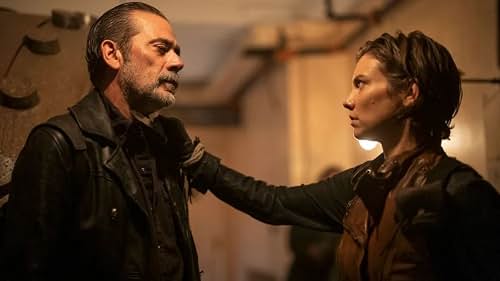
The capture of The Dama arrives with the kind of chaotic energy that feels almost cartoonish at first, a clumsy chase through a theater that somehow still manages to crackle with real stakes. Once she is locked away, the real conversation begins, and it is a conversation the show has been circling for seasons. Maggie wants to believe people can still be saved or at least contained long enough to prove they deserve another chance. Negan looks at the same woman and sees only the same old arithmetic of survival, the cold math that says some threats have to be removed before they grow roots again. Watching Jeffrey Dean Morgan deliver that quiet certainty while Lauren Cohan’s Maggie wrestles with the moral weight of every possible outcome is the kind of scene that reminds you why these two still command the screen even after all these years of blood and regret.
Negan’s little side trip into pure visual absurdity, staring at a painting and somehow seeing nothing but an aggressively obvious pair of breasts, should not work as well as it does. It is crude, it is ridiculous, and it is also the most honest window into his current state of mind the episode offers. The man is not evolving in tidy arcs or learning neat lessons. He is still the same predator who once built an empire on fear, only now he is stuck inside a softer world that keeps asking him to help build instead of break. The joke lands because it refuses to apologize for itself, and because it underlines the larger truth that Negan still experiences the world through the same filter of appetite and threat assessment that made him dangerous in the first place.
By the time Maggie lights up the Statue of Liberty like a signal fire, the episode has already made its quiet case that season 3 is interested in more than another round of personal score-settling. The hospital is starting to feel like an actual community with plans that stretch past the next meal and the next walker herd. Talk of turning Central Park into farmland is the kind of forward-looking detail that lands with surprising emotional force after years of pure survival storytelling. Negan’s final act of quiet violence inside The Dama’s cell is not framed as a shocking twist so much as an inevitable expression of who he still is when the lights go down and the hard choices arrive. He removes the problem so Maggie does not have to carry the weight of it, then steps back into the shadows of his own making, still not sure whether he belongs inside the new world or simply beside it as the man who does the necessary dirty work.
The Walking Dead: Dead City has always thrived when it lets its two leads push against each other without forcing either of them into easy redemption or permanent villainy. Episode 2 understands that dynamic better than most hours in the spin-off’s run. It gives Maggie a genuine sense of purpose that feels larger than her old grudges, and it lets Negan remain gloriously, frustratingly himself while still contributing to the larger project in the only language he fully trusts. The result is an episode that feels both intimate and expansive, a reminder that the most interesting stories left in this universe are the ones about what kind of people these survivors are still capable of becoming when the walking dead are no longer the only threat on the horizon.
Verdict
The Walking Dead: Dead City Season 3 Episode 2 delivers a confident, character-driven hour that balances dark humor, moral tension, and genuine forward momentum. Maggie’s growing community vision feels earned rather than forced, Negan remains the same gloriously complicated force of nature he has always been, and the production design turns even the smallest locations into rich storytelling spaces. It is the kind of episode that trusts its audience to sit with the messiness of these people instead of demanding tidy answers, and that trust pays off in some of the strongest work the series has offered this season.