
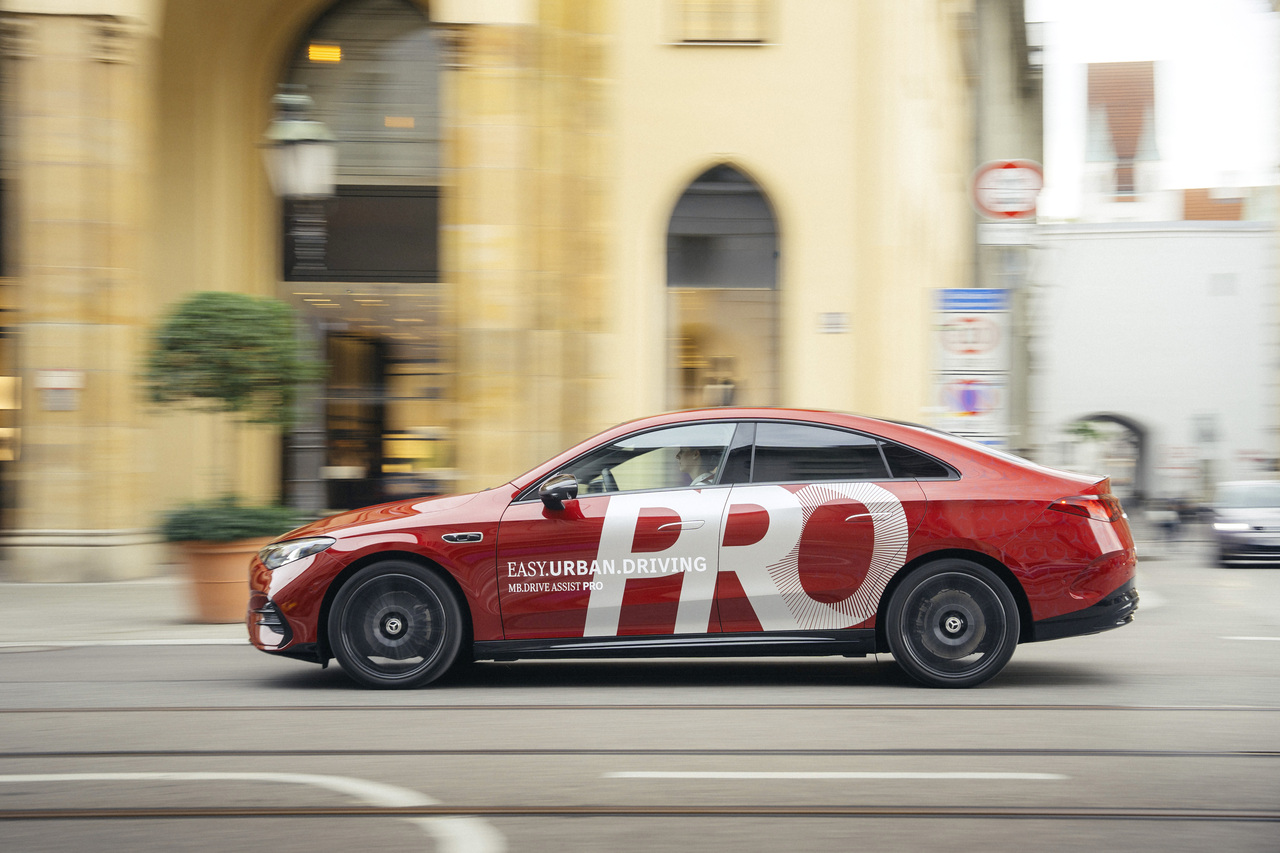
Mercedes-Benz wants its cars to handle the whole commute, not just the motorway part, and German drivers will soon get to test that promise on their own streets. MB.DRIVE ASSIST PRO is a partially automated Level 2 driving system developed with NVIDIA, and it will be available to order in Germany from the first half of 2027. Mercedes says that makes it the first carmaker to offer point-to-point assisted driving in the country, adding Germany to China and the United States, where the system is already offered.
Most driver assistance today works on highways, where lanes are clear and traffic flows one way. City streets are much harder, with junctions, traffic lights and lane merges. Mercedes says the new system follows the active navigation route from start to finish. It changes lanes, picks the right lane before a turn, turns at junctions, and stops and moves off at traffic lights. Drivers switch it on with a button on the steering wheel while a route is set.
The key word is assist. Because this is SAE Level 2, the driver must keep watching the road, stay in control and remain legally responsible the whole time. Mercedes uses a “hands-on cooperative steering” approach, which means the driver can steer at any moment without the system fighting back. That makes it a different product from the company’s Level 3 Drive Pilot, which lets drivers look away from the road in limited conditions.
The hardware is substantial. The car uses 27 sensors in total: ten cameras, five radars and twelve ultrasonic sensors. They feed a computer that can handle up to 254 TOPS. The software combines Mercedes’ own MB.OS operating system with NVIDIA’s Hyperion compute and sensor platform, its Halos safety framework and its Alpamayo software stack. For NVIDIA, this is another high-profile showcase for its push into automotive AI.
Regulation may matter more than the technology here. The system was built to meet UN R171, a new rule covering Driver Control Assistance Systems (DCAS) that sets strict safety requirements. Mercedes says this shared framework could let the feature launch in other EU markets in the future without separate approvals. That would remove one of the main reasons Europe has fallen behind the US and China in assisted driving.
Before the full launch, selected owners in Stuttgart and Munich will get early access through an over-the-air update from the end of 2026. Mercedes will contact eligible owners directly, and their real-world driving data will help improve the system. After launch, a free one-month trial will be offered through the Mercedes-Benz Store.
Mercedes hasn’t said which models will qualify or what it will cost. It has said only that eligibility depends on the car’s hardware and that the rollout will cover cars and vans. Whether the price makes sense for a system that still needs your full attention is the question buyers will face in 2027.