
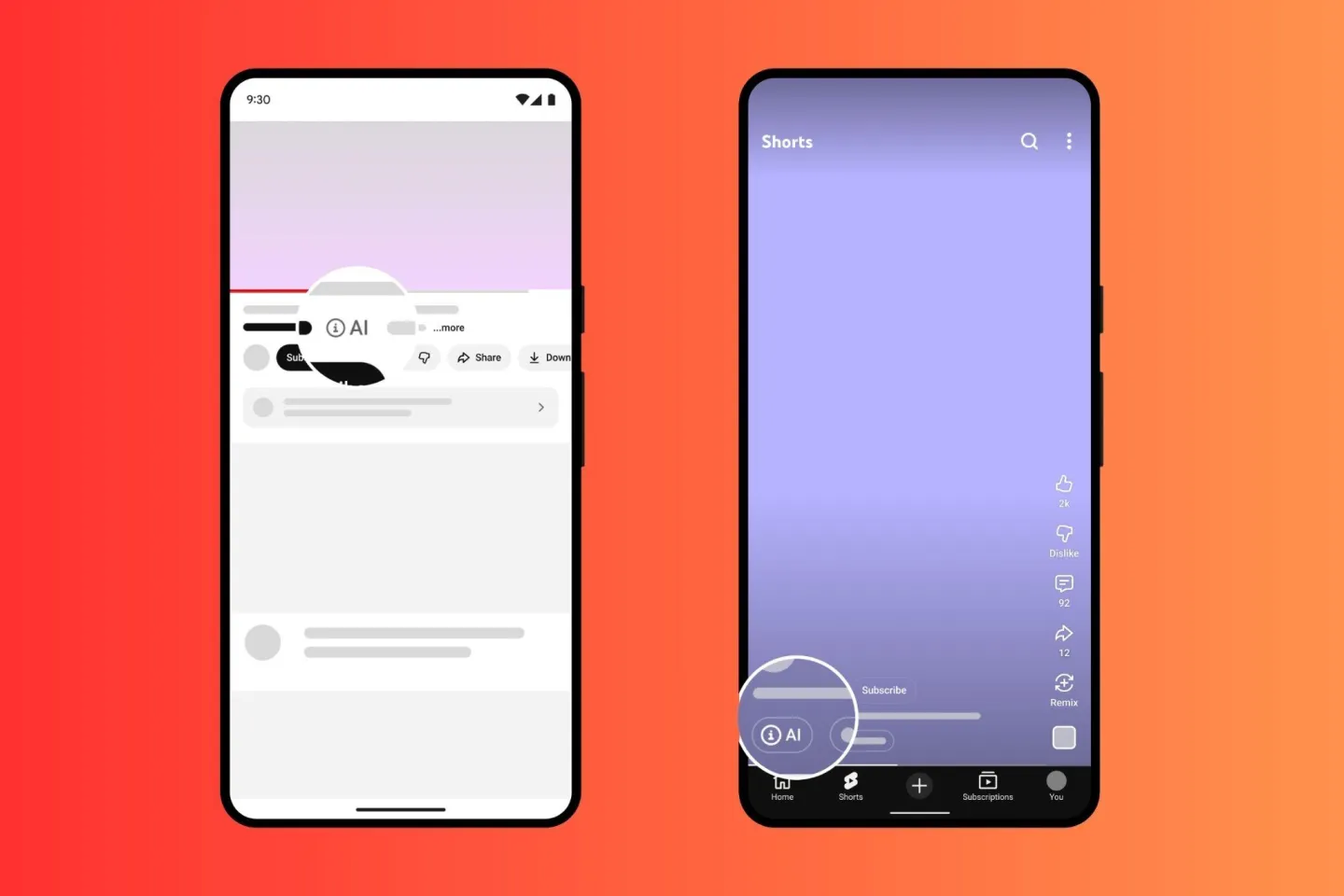
YouTube is adjusting how it discloses AI-generated content by placing clearer labels in more visible locations across its platform. The changes, announced on May 27, 2026, move AI markers from their previous buried position in video descriptions to spots where viewers are more likely to notice them. For standard videos, an “AI” label with an information icon now appears directly below the player and above the description. On Shorts, it shows as an overlay on the video itself.
This update follows years of inconsistent handling of synthetic media on YouTube. Previously, disclosures sat hidden under a “How this content was made” section that required users to actively expand the description. The new approach aims to provide immediate context, particularly for photorealistic or meaningfully altered videos. YouTube says it will also become more proactive in automatically detecting and labeling such content rather than relying solely on creator disclosures.
The timing aligns with broader industry pressure around AI transparency. As generative tools have grown more accessible and convincing, platforms face increasing scrutiny over deepfakes, misleading clips, and the general flood of synthetic material. YouTube’s move represents a step toward better viewer awareness, yet questions remain about enforcement and effectiveness. Automatic detection systems have historically struggled with edge cases, and the line between light editing and meaningful AI alteration can be subjective. Past efforts by the platform, including earlier overlay tests on Shorts, showed mixed results in consistency.
In a media environment saturated with short-form video, these labels matter more than ever. Podcasts, news interviews, and entertainment clips increasingly incorporate AI elements, from voice synthesis to visual effects. Without clear signaling, audiences risk consuming altered content as authentic, which can distort public understanding on topics ranging from politics to product reviews. YouTube’s emphasis on photorealistic material acknowledges this risk, but success will depend on how rigorously the system flags content and whether creators comply or find ways around it.
Critics have long noted that Big Tech’s approach to AI governance often feels reactive. While Google has expanded verification tools at recent events, implementation across YouTube has lagged. The updated labels are a practical improvement, yet they arrive late in the game. Many users already encounter AI slop daily, and a simple icon may not fully counter sophisticated manipulation. There is also the matter of over-labeling versus under-labeling—too broad an application could stigmatize legitimate creative uses of AI, while too narrow leaves gaps.
For regular viewers, the change should make navigation slightly more informed without disrupting the experience. Saved or shared clips will hopefully carry context, reducing the spread of misleading segments. Still, this feels like incremental progress rather than a comprehensive solution. As AI tools evolve rapidly, platforms like YouTube will need to refine detection, update policies frequently, and balance creator freedom with audience protection.
Overall, the adjustments highlight the ongoing challenge of maintaining trust in user-generated platforms amid advancing technology. They offer modest reassurance but underscore how much work remains to address AI-driven content at scale.