
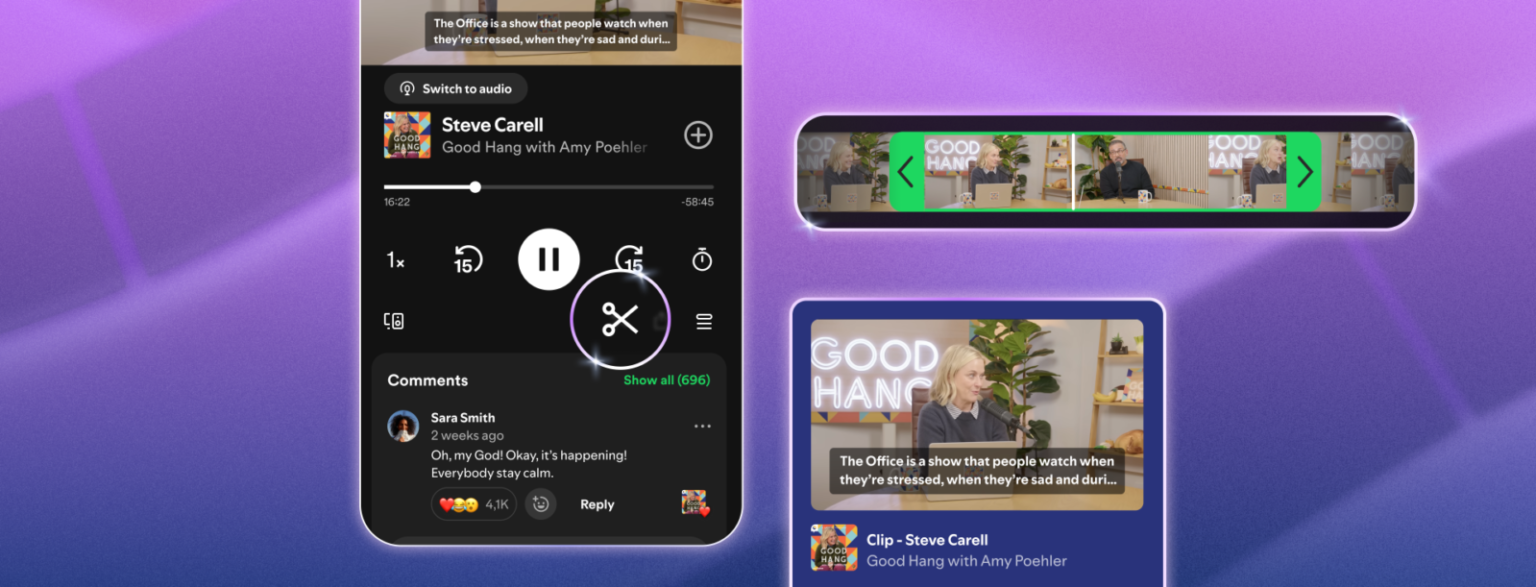
Spotify has introduced a new feature that lets users create and share short audio clips from podcasts directly within its app. Rolled out on May 27, 2026, the tool adds a scissors icon to the Now Playing screen, enabling listeners to select a specific segment, trim it, preview the result, and distribute it across social platforms or messaging apps.
The process is straightforward. After marking the desired portion, users can choose to share a link to the full episode, a chapter, a timestamp, or the new clip itself. Saved clips are stored in the user’s Spotify Library for later reference or addition to playlists. The feature is now available globally to both free and Premium subscribers on mobile, though support will expand gradually to more shows.
This development arrives at a moment when podcasts have become a primary outlet for in-depth conversations, particularly in tech and business circles. Many executives now prefer long-form podcast appearances over traditional interviews, citing greater reach and softer questioning. As a result, significant announcements and insights often surface in episodes that run an hour or longer, creating demand for easier ways to surface key moments. Spotify’s clip tool addresses this by lowering the barrier to sharing highlights, potentially helping important segments find wider audiences without requiring listeners to commit to the entire recording.
The company reports early success with its Chapters feature, launched earlier in 2026, which has seen over two million saves and playlist additions per month. Clips appear positioned as a natural extension of that bookmarking behavior, with added potential for organic promotion. Creators could use them to tease compelling sections and draw in new listeners, while fans gain a simple way to highlight favorite exchanges.
Yet the feature also invites some practical questions. In an already fragmented media environment dominated by short-form video, turning podcasts into bite-sized clips risks reducing nuanced discussions to isolated soundbites. Context can easily be lost, and the most shareable moments may not always represent the most substantive parts of an episode. There is also the matter of discoverability: while the tool makes sharing easier, it remains to be seen how effectively these clips will drive meaningful traffic back to the full shows rather than satisfying users with excerpts alone.
Spotify’s move fits a broader pattern of audio platforms adapting to changing consumption habits. Similar to how YouTube popularized video clipping years ago or how social networks turned quotes into shareable graphics, the company is attempting to keep podcasts relevant in a fast-scrolling digital landscape. Whether this genuinely enriches the listening experience or simply accelerates the trend toward snackable content is something only time and usage data will clarify.
For now, the feature offers a practical addition for regular podcast consumers who want to capture and circulate noteworthy segments without third-party tools. Its success will depend less on technical execution and more on whether it encourages deeper engagement with the medium or simply adds to the noise.