

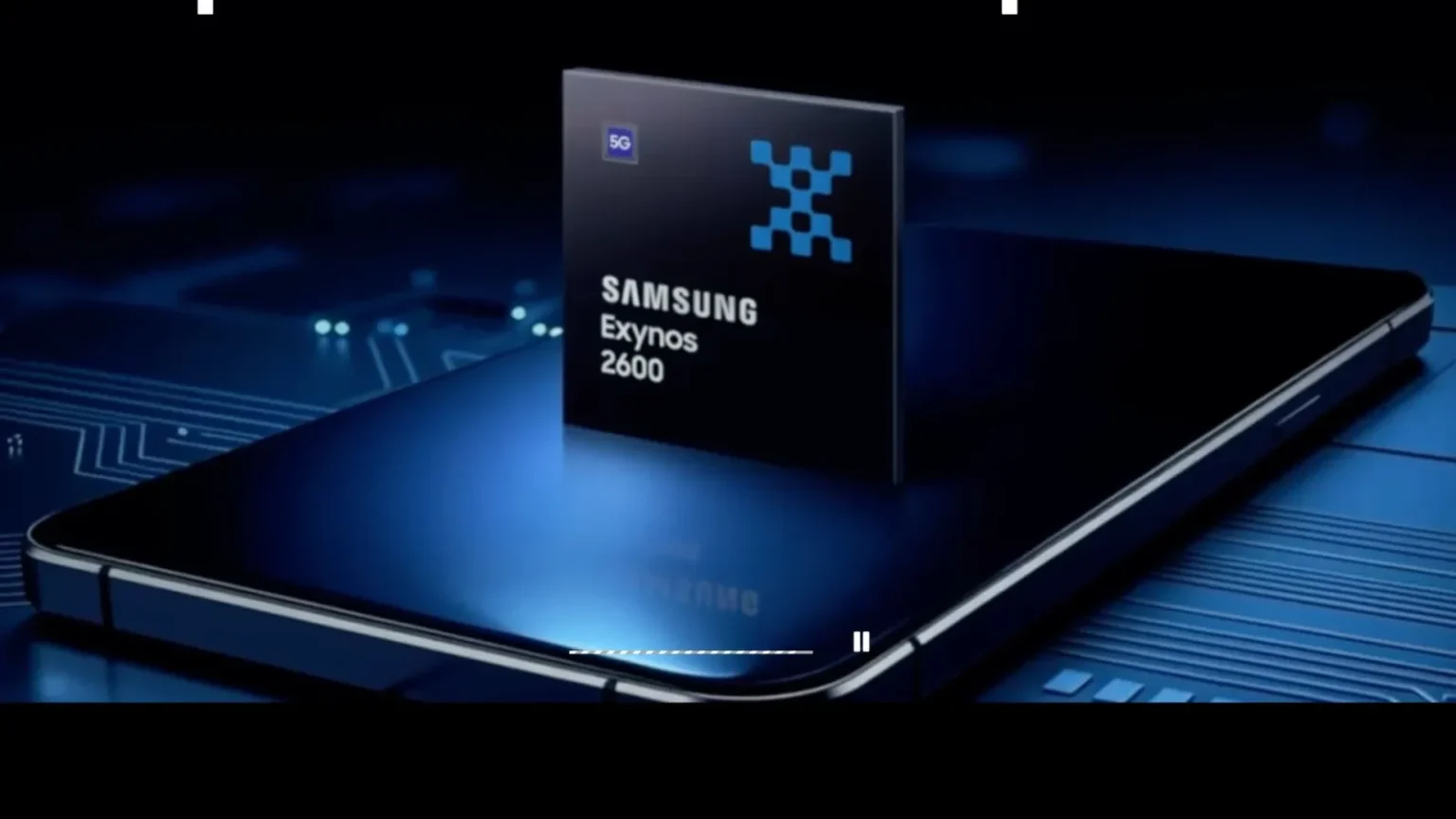
Samsung has officially announced the Exynos 2600, its next flagship smartphone processor and the first mobile system-on-a-chip built using a 2nm Gate-All-Around manufacturing process. The chip is expected to appear in at least some variants of the Galaxy S26 lineup, depending on region, and represents one of Samsung’s most ambitious attempts yet to reset the reputation of its in-house silicon.
Moving to a 2nm process is a technical milestone, but Samsung is framing the Exynos 2600 less as a breakthrough for its own sake and more as a corrective step. Previous Exynos generations have often lagged behind competitors from Qualcomm, MediaTek, and Apple in sustained performance and thermal stability. Samsung claims the smaller process node enables measurable improvements in performance, power efficiency, and heat management, areas where criticism has been consistent over the past few years.
At the core of the Exynos 2600 is a 10-core CPU based on Arm’s v9.3 architecture. The configuration includes one prime C1-Ultra core clocked at 3.8GHz, three high-performance C1-Pro cores at 3.25GHz, and six efficiency-focused C1-Pro cores running at 2.75GHz. Notably, Samsung has abandoned traditional low-power “little” cores entirely, opting instead for a mix of large and mid-tier cores. The company says this structure delivers up to a 39% uplift in CPU performance compared to the Exynos 2500, alongside better efficiency under sustained loads. Support for Arm’s SME2 instructions is also intended to improve on-device machine learning and reduce latency for AI-driven features.
Graphics duties are handled by the new Xclipse 960 GPU, which Samsung says offers roughly double the compute performance of its predecessor and up to 50% better ray tracing capabilities. The chip also introduces Exynos Neural Super Sampling, an AI-based approach to upscaling and frame generation designed to smooth gameplay without significantly increasing power consumption.
Artificial intelligence is a central focus of the Exynos 2600. Samsung claims the upgraded NPU delivers a 113% improvement in AI performance over the previous flagship Exynos chip, allowing more complex generative AI models to run locally rather than relying on cloud processing. The company positions this as both a performance and privacy benefit, keeping sensitive data on-device.
Camera and video capabilities have also been expanded. The integrated image signal processor supports sensors up to 320MP, zero shutter lag for 108MP photos, 8K video recording at 30fps, and 4K video at up to 120fps with HDR. Samsung says the ISP is up to 50% more power-efficient and includes new systems for detail detection and improved low-light video processing.
Thermal performance may be the most closely watched aspect of the Exynos 2600. Samsung has introduced a new Heat Path Block design using high-k EMC materials, which it claims reduces thermal resistance by up to 16 percent. If these improvements translate to real-world devices, they could address the throttling issues that have defined earlier Exynos chips.
The Exynos 2600 supports LPDDR5X memory, UFS 4.1 storage, HDR10+ playback, and 4K displays at up to 120Hz. Connectivity appears to rely on separate modem components rather than an integrated solution. While Samsung has not officially confirmed which phones will use the chip, it is already in mass production and widely expected to power the Galaxy S26 and Galaxy S26 Plus in select markets.