
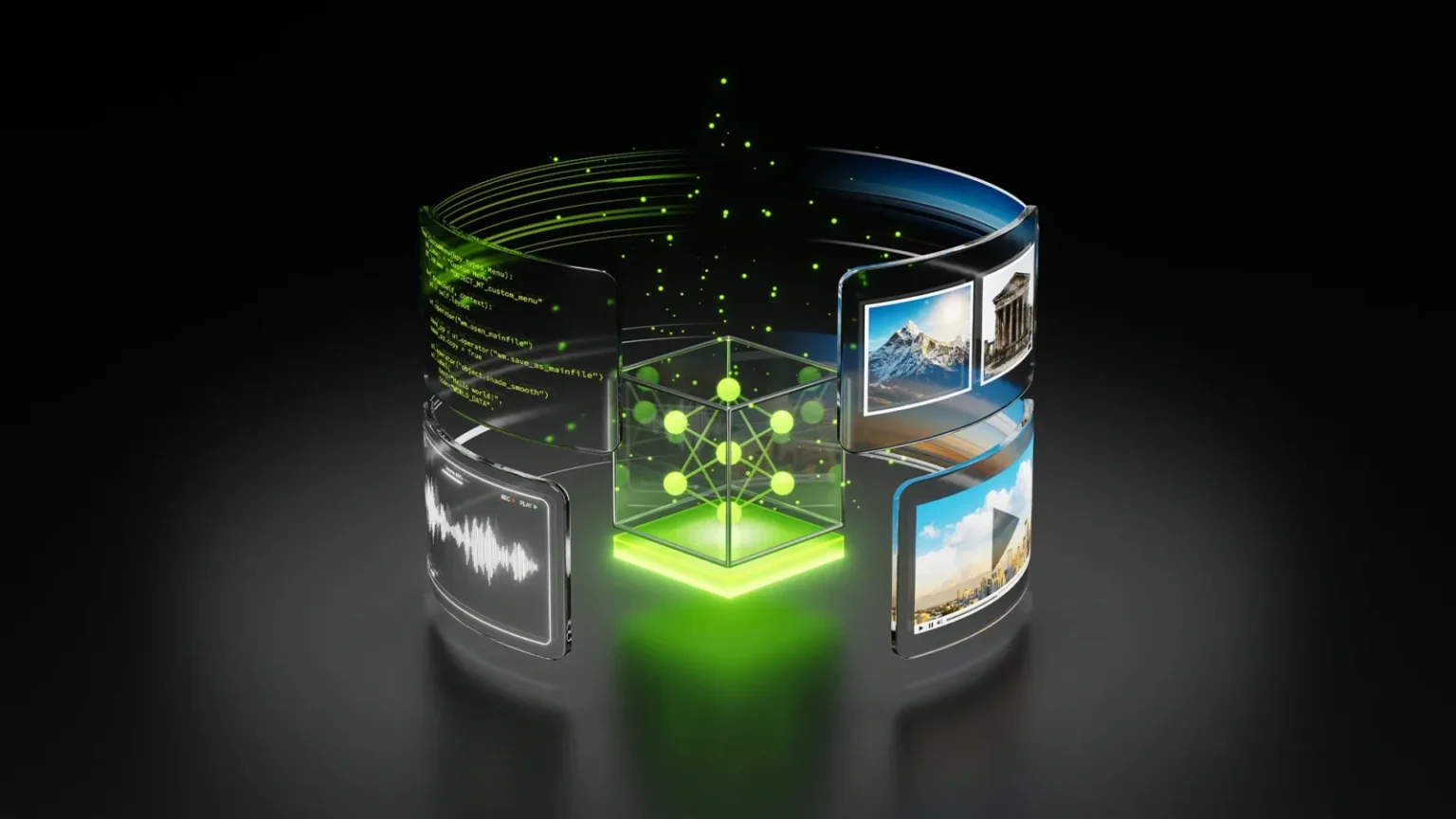
Nvidia has released Nemotron 3 Nano Omni, a 30-billion-parameter multimodal model that integrates text, vision, and speech processing into a single system for agentic AI applications. Built on a mixture-of-experts architecture, the model combines vision and audio encoders to handle perception tasks without relying on separate modules, aiming for lower latency and better efficiency in real-world deployments.
The design targets scenarios where quick interpretation of screens, documents, voice, and video matters. Nvidia claims it delivers up to nine times the throughput of comparable open multimodal models, which could make it more practical for interactive agents that need to respond rapidly rather than waiting through lengthy inference cycles. A smaller footprint also means it can run on higher-end consumer hardware after compression or scale efficiently in cloud environments, potentially reducing costs compared with larger proprietary systems.
Nvidia positions the model to work alongside its other Nemotron variants, such as larger ones for complex planning or high-frequency tasks. This modular approach reflects a growing trend in enterprise AI toward composable systems that let developers mix specialized components instead of depending on one oversized model for everything. Early feedback, including a comment from H Company CEO Gautier Cloix, highlights its ability to process full HD screen recordings quickly enough for practical agent use—something that has often proved cumbersome with previous tools.
The Nemotron family as a whole has seen more than 50 million downloads over the past year, indicating solid interest from developers. The new Omni variant extends that lineup into stronger multimodal and agentic territory. It is now available on Hugging Face, OpenRouter, and Nvidia’s build platform as a NIM microservice, with options for local deployment on hardware like the DGX Spark. Open access and lightweight design give developers flexibility to experiment and customize without heavy vendor lock-in.
Yet the release arrives in a crowded field. Many organizations are still wrestling with the gap between promising agentic prototypes and reliable production systems. Multimodal models have advanced quickly, but challenges around accuracy, hallucination in visual reasoning, and consistent performance across diverse hardware remain. Efficiency gains on paper do not always translate smoothly when scaled across real enterprise workloads with messy data and edge cases. Nvidia’s emphasis on integration with its broader ecosystem makes strategic sense for the company, but adopters will need to evaluate whether the performance claims hold up in their specific environments.
In the wider context of 2026 AI development, moves like this show continued focus on practical, deployable intelligence over raw scale. Smaller, specialized multimodal systems could help bridge the gap between cutting-edge research and everyday tools, especially as more companies seek agents that interact naturally with users and digital interfaces. Success will ultimately depend less on benchmark numbers and more on how well these models perform when embedded in actual applications over time.