
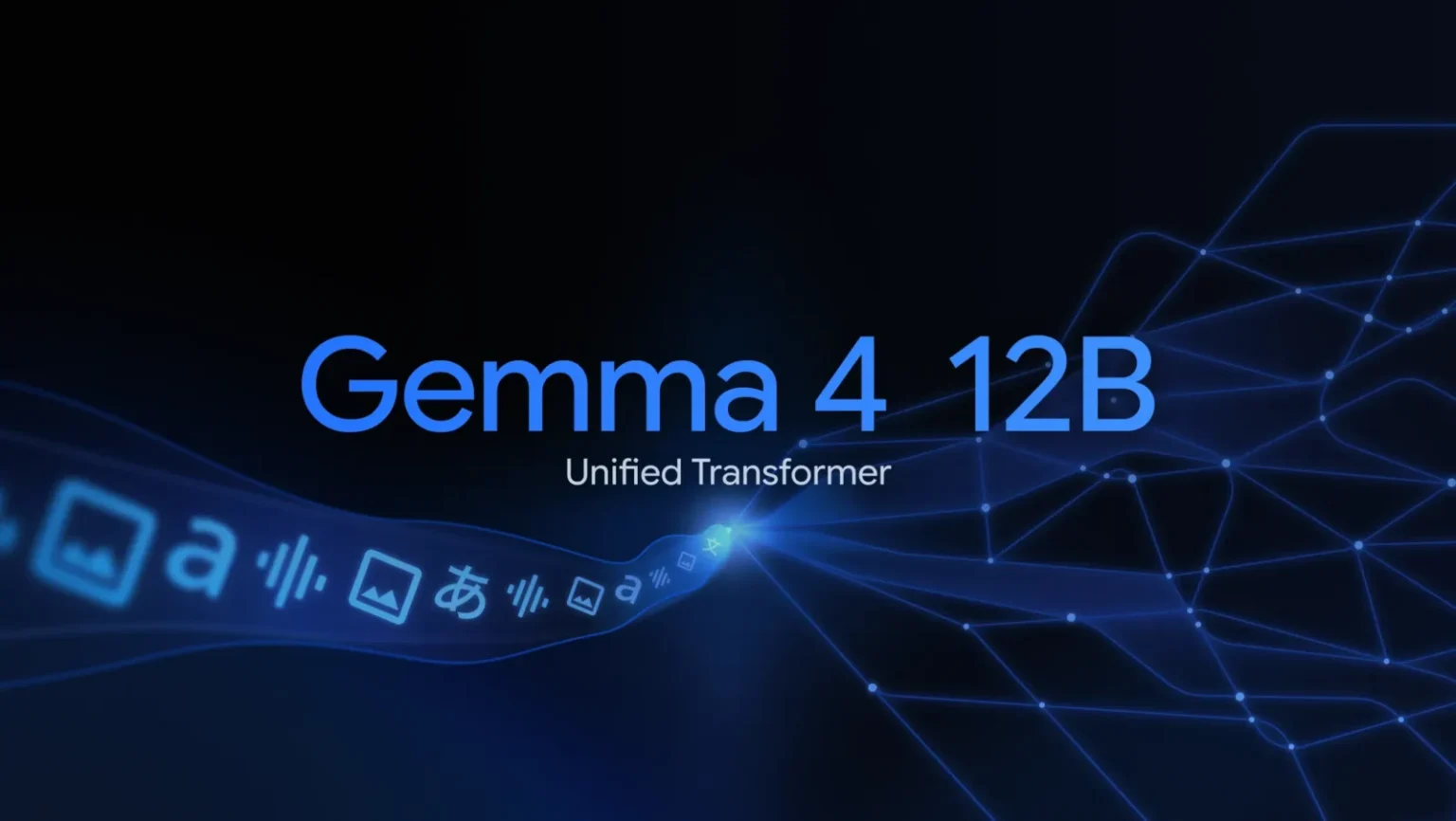
Google has released Gemma 4 12B, a mid-sized multimodal model that integrates vision and audio processing directly into its language model backbone without relying on separate encoders. Positioned as an option for local deployment on consumer laptops, the model targets developers and users seeking advanced capabilities on hardware with around 16GB of unified memory or VRAM. It represents another incremental step in Google’s effort to make more sophisticated AI tools available outside massive cloud infrastructure, though its real-world impact will depend on how effectively it balances performance with the constraints of everyday devices.
The architecture stands out for its streamlined approach. Traditional multimodal systems often use dedicated encoders to handle images and audio before feeding processed data into the main model, adding complexity and resource demands. Gemma 4 12B eliminates these, projecting raw inputs into the same space as text tokens. For vision, a lightweight embedding module handles initial processing, while audio bypasses encoders entirely. This design supports native audio input, allowing offline tasks like transcription, formatting, and translation. The model also incorporates Multi-Token Prediction to help reduce latency, making it potentially more responsive for interactive applications.
In benchmarks, Gemma 4 12B approaches the reasoning performance of Google’s larger 26B Mixture of Experts variant while using significantly less memory. This efficiency matters in an era where interest in on-device AI has grown alongside concerns over cloud dependency, data privacy, and latency. The release builds on the Gemma series, which has accumulated over 150 million downloads, with developers applying earlier versions to projects ranging from assistive robotics to security tools. Availability under an Apache 2.0 license, combined with support across ecosystems like Hugging Face, Ollama, and llama.cpp, lowers barriers for experimentation and fine-tuning.
Yet the announcement fits a familiar pattern in the AI industry. Companies continue racing to shrink powerful models for edge deployment, driven by both genuine user needs and competitive pressure. While running capable multimodal systems locally sounds appealing, practical limitations remain. Consumer laptops vary widely in thermal management and sustained performance, and even 16GB configurations may struggle during complex agentic workflows or when handling large media files. Privacy benefits exist by keeping data on-device, but accuracy and reliability in varied real-world conditions still require scrutiny, especially as audio and vision inputs introduce new variables.
Google positions Gemma 4 12B as a bridge between lighter edge models and more demanding ones, supporting agentic development through a new skills repository. Integration options span local tools to cloud deployment via Google Cloud services. This flexibility acknowledges diverse developer requirements, but it also reflects the fragmented nature of current AI tooling, where choosing the right model often involves trade-offs between size, capability, and accessibility.
As multimodal AI moves toward laptops and mobile hardware, models like Gemma 4 12B highlight progress in efficiency. They also underscore persistent challenges around equitable access and sustainable computing demands. For independent developers and smaller teams, open releases like this provide valuable opportunities to build without relying solely on proprietary APIs. Whether this version delivers meaningful advantages over predecessors will emerge through community testing and practical applications in the coming months.