

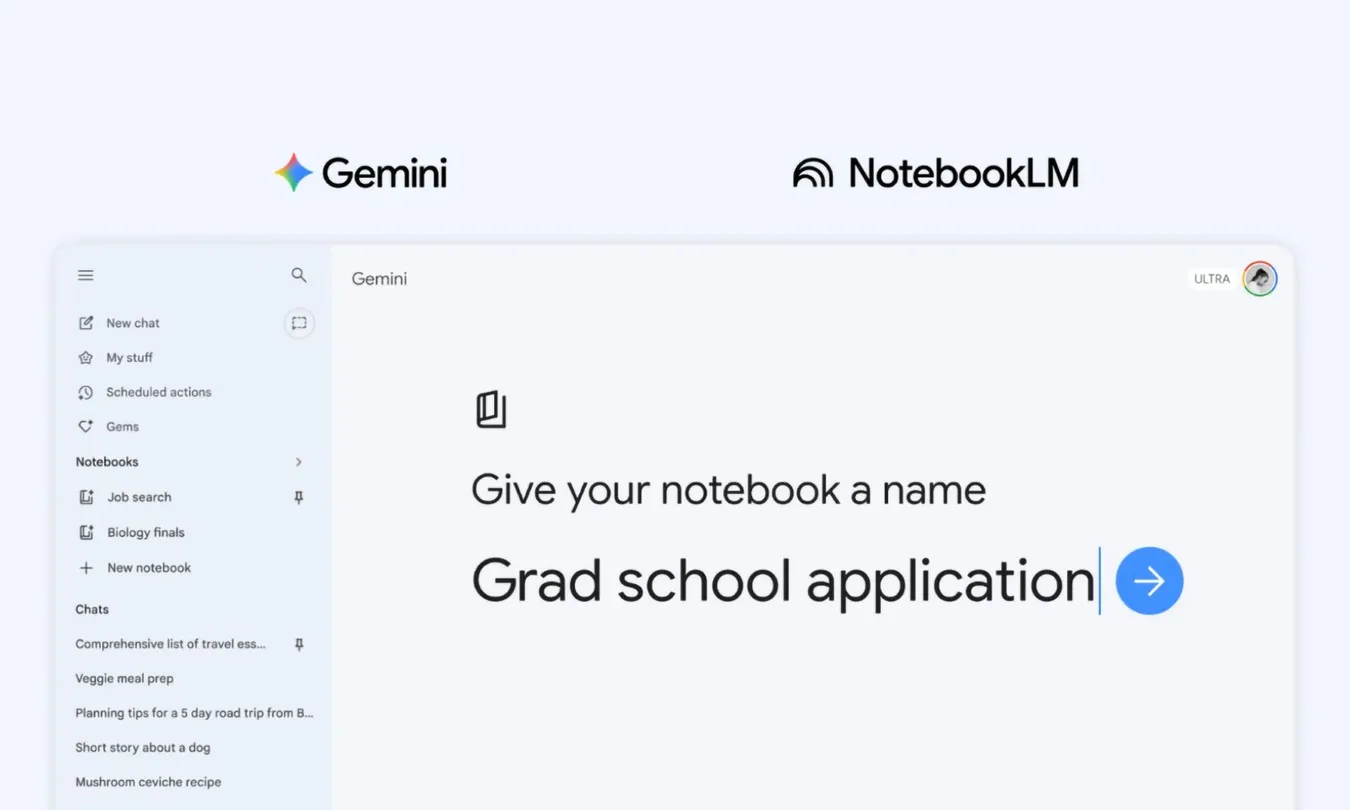
Google has extended access to the Notebooks feature in its Gemini AI to all users on the web, including those on the free tier. Previously limited to paid subscribers when introduced earlier in April 2026, the tool now appears in the side panel of the Gemini web interface, positioned between Gems and Chats.
Notebooks function as a persistent workspace within Gemini. Users can collect conversations, uploaded files, and other sources under a single topic, allowing the AI to reference that accumulated context in subsequent queries. This setup reduces the need to repeat background information with every new chat. Custom instructions can further shape response tone, format, or style, and an option exists to disable notebook memory when desired.
A key aspect of the feature is its seamless connection to NotebookLM, Google’s dedicated research application. Notebooks created or updated in one tool sync automatically with the other. Researchers or writers can therefore gather material through Gemini conversations and immediately apply NotebookLM’s specialized outputs, such as audio overviews or generated infographics, without copying data manually. This integration tightens the link between general chat-based AI and more structured knowledge work.
Free users can add up to 50 sources per notebook, with the full range of Gemini tools—including web search—still available. Paid tiers receive higher limits: 100 sources for AI Plus, 300 for Pro, and 600 for Ultra. The current rollout covers only the web version; mobile and Mac app support has not arrived yet, though broader availability is anticipated soon.
In practice, Notebooks address a common friction in AI interactions: the tendency for each conversation to feel isolated and context-free. By maintaining project-specific memory, the feature edges Gemini closer to acting as a personal knowledge base. Still, the source caps, particularly on the free plan, may constrain deeper research projects, and reliance on cloud syncing raises familiar questions about data privacy and long-term accessibility should access terms shift.
This move reflects a broader pattern among AI providers: gradually opening advanced capabilities to free users to boost engagement and data collection, while reserving scaled capacity for those willing to pay. Whether it meaningfully shifts daily workflows depends on how reliably the context holds across sessions and how well it competes with dedicated note-taking or research apps that have matured over years without heavy AI layering.
At the same time, the expansion arrives amid ongoing discussions about AI’s role in information handling. Tools that promise to organize and synthesize large volumes of material can streamline certain tasks, yet they also risk amplifying biases present in the underlying models or in the sources users choose to feed them. Careful curation remains essential.
Google’s decision to make Notebooks freely available on the web lowers one barrier to organized AI-assisted work. For casual users or those testing ideas, the change offers a practical upgrade without added cost. For heavier users, the tiered limits and pending mobile rollout will determine whether the feature becomes a daily staple or remains a convenient but bounded option.