
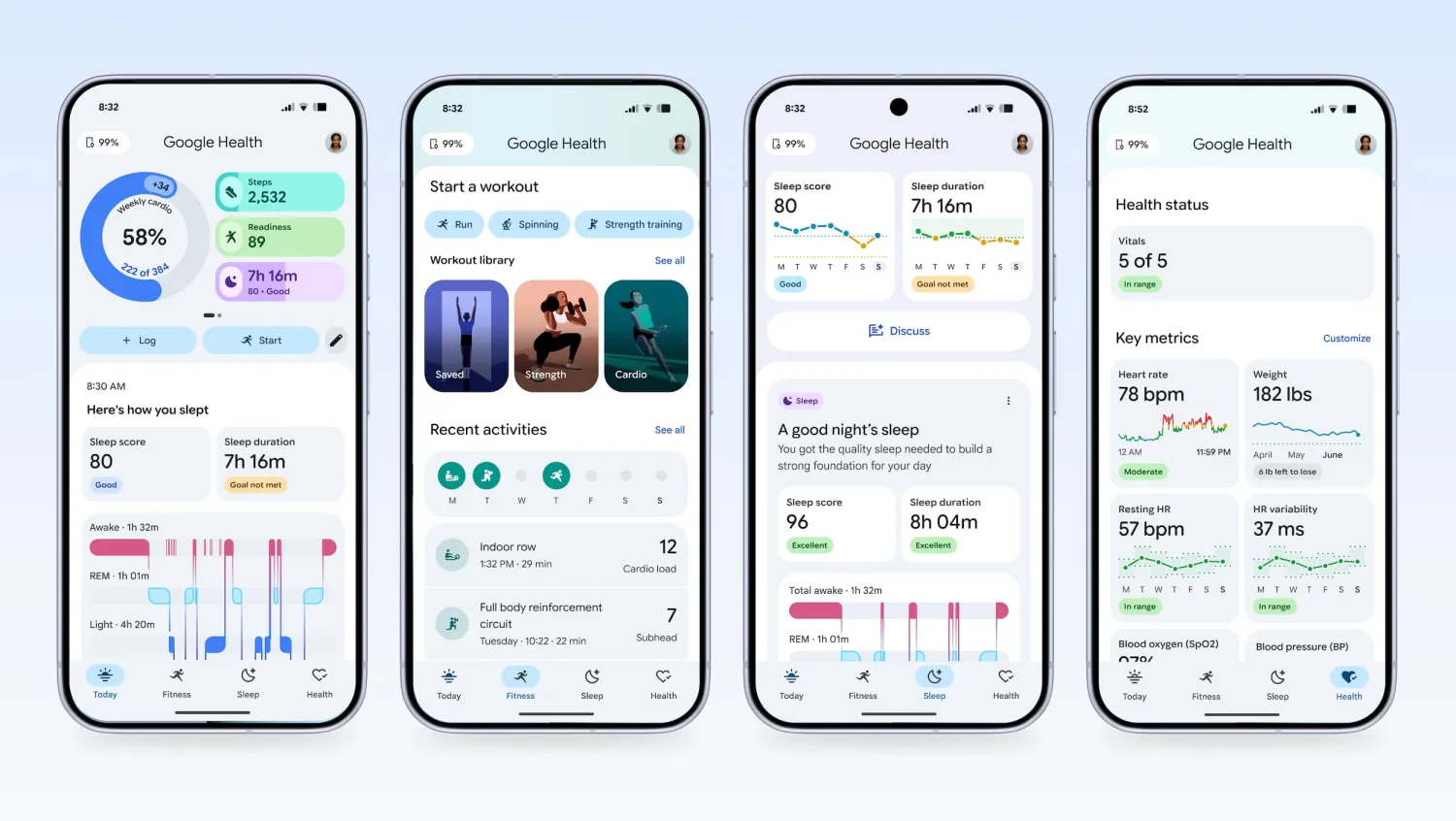
Google Health 5.0 is now deploying as a major update to the former Fitbit app, marking another step in Google’s consolidation of its health and fitness services. On Android, the release introduces a new Quick Access Widget for the homescreen that pulls key statistics directly from the app’s Today tab, replacing the older circular steps tracker with a more flexible layout.
The widget can display up to six user-selected metrics in a 5×3 grid configuration, offering a denser overview than before. Users can tap individual sections to dive into detailed stats pages or shrink the widget to highlight just one metric. Additional controls include a heart icon for launching the full app, quick access to Health Coach features, and a refresh button, with the widget also showing the timestamp of the last data sync. This change aims to make daily health tracking more glanceable without needing to open the application repeatedly.
Visually, version 5.0 replaces the Fitbit branding entirely with a new Google Health icon, positioning the software as a broader platform while reserving the Fitbit name strictly for hardware products. The update is also a prerequisite for setting up the upcoming Fitbit Air wearable, expected to launch in late May. Rollout on Android began on May 19 and should reach all users by May 26.
This rebrand and redesign fit into a larger shift at Google. The company has been phasing out the standalone Google Fit app, with a migration tool promised later in 2026. Some longstanding Fitbit elements, including badges, sleep animals, and certain social or motivational features, will not carry over to Google Health. At the same time, the service is introducing a new Premium subscription tier alongside an AI-focused plan, reflecting the industry’s broader move toward monetizing health data through advanced analytics and coaching tools.
The evolution from Fitbit to Google Health reflects years of integration following Google’s 2019 acquisition. What began as a simple activity tracker ecosystem has grown into a more comprehensive health dashboard, incorporating data from Pixel devices, Wear OS, and third-party sources. The new widget addresses a common complaint about fragmented tracking apps by surfacing insights without extra navigation. Yet it also highlights ongoing tensions: users lose some familiar gamification elements that once encouraged consistency, while gaining potentially more clinical-style metrics.
Critics might note that Google’s health ambitions have faced execution hurdles in the past, from privacy concerns around data handling to inconsistent feature parity between Android and iOS. The reliance on subscriptions for deeper insights raises questions about accessibility, especially as competitors like Apple continue refining their own Health app with strong hardware integration. Battery impact from frequent widget refreshes and accuracy of AI-driven coaching remain areas worth watching once adoption widens.
Overall, Google Health 5.0 represents a functional refresh rather than a transformative leap. It streamlines the interface and aligns the software more closely with Google’s broader ecosystem, but success will depend on how well it retains user engagement without the motivational tools many came to expect from Fitbit. For those already invested in Google’s wearables and services, the update provides welcome convenience on the homescreen. For others, it serves as a reminder that health apps are increasingly becoming data hubs as much as personal companions.