
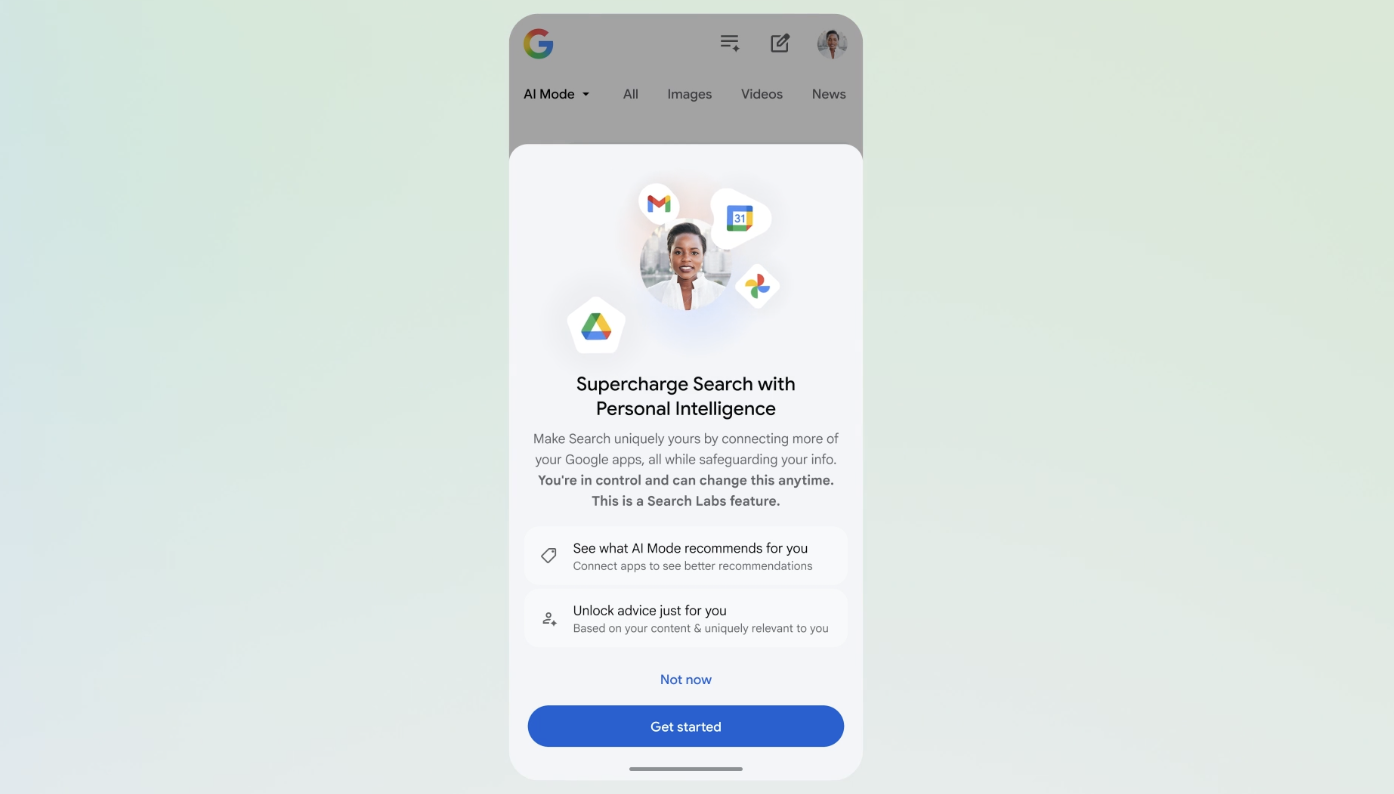
Google is expanding how its search engine responds to individual users, introducing what it calls Personal Intelligence inside AI Mode. Announced on January 22, 2026, the update allows Search to factor in personal context from other Google services, including Gmail and Google Photos, to generate responses that reflect a user’s habits, plans, and preferences rather than relying solely on general web data.
The feature is rolling out as an opt-in experiment for subscribers to Google’s AI Pro and AI Ultra tiers in the United States. When enabled, Personal Intelligence connects selected personal data sources to AI Mode in Search, with the goal of reducing the need for users to repeatedly explain context that already exists within their accounts. Instead of starting from scratch with every query, Search can draw on things like travel confirmations, past purchases, or photo history to shape its suggestions.
In practice, this means search results can shift from broadly relevant to more situationally aware. For example, planning activities for an upcoming trip may prompt AI Mode to reference hotel bookings found in Gmail alongside patterns from past travel photos. Rather than returning a generic list of attractions or restaurants, Search might prioritize family-friendly venues or activities that align with previous behavior. Similarly, shopping-related queries can incorporate inferred preferences, such as favored brands or styles, while also accounting for timing and location drawn from travel details.
Google positions this approach as especially useful for everyday decision-making, from buying clothing suited to a specific destination and season to discovering products similar to those a user has recently purchased. The system can also respond to more abstract or playful prompts, generating reflective or creative answers based on accumulated personal signals rather than factual lookup alone.
At the same time, Google acknowledges the trade-offs and limitations involved. Personal Intelligence is designed to be optional, with users able to connect or disconnect Gmail and Google Photos at any time through Search settings. According to the company, AI Mode does not directly train on the contents of a user’s inbox or photo library. Instead, training is limited to prompts and generated responses to improve system performance. Google also notes that errors are possible, particularly when the system draws incorrect connections between unrelated information, and encourages users to correct results or provide feedback when recommendations miss the mark.
The rollout is limited to personal Google accounts and is not available for Workspace users in business, enterprise, or education environments. Access is being enabled gradually through Google Labs, with eligible users receiving invitations or the option to manually activate the feature through their personalization settings.
Overall, Personal Intelligence reflects a broader shift in search toward individualized assistance rather than one-size-fits-all results. Whether users view this as a meaningful improvement or an unnecessary layer of complexity will likely depend on how accurately the system interprets context and how comfortable individuals are with linking more of their personal data to Search.