
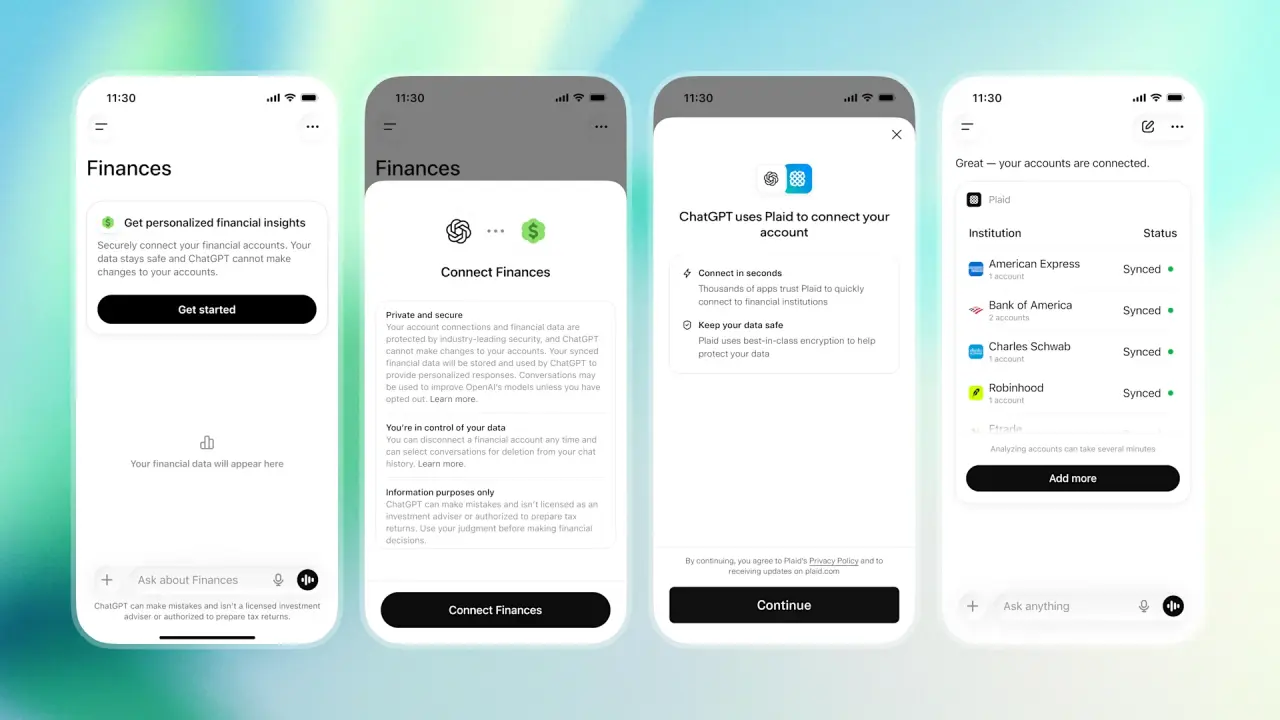
OpenAI is pushing ChatGPT further into personal productivity territory with a new financial planning feature that allows users to connect their bank accounts directly through Plaid. The integration gives ChatGPT access to transaction histories, balances, investments, and liabilities in order to generate more personalized budgeting advice and long-term financial planning suggestions.
The move reflects a broader shift happening across the AI industry. Chatbots are no longer being positioned as standalone conversation tools. Instead, companies increasingly want them embedded inside the systems people use every day — email, calendars, cloud storage, workplace apps, and now personal finance.
According to OpenAI, users will be able to ask ChatGPT more context-aware financial questions after linking accounts through Plaid, the financial connectivity platform used by thousands of banks and fintech services. Rather than offering generic budgeting advice, ChatGPT could theoretically analyze spending habits and suggest realistic savings strategies tailored to an individual’s actual finances. Example prompts include planning for a home purchase, paying off loans, preparing for a car purchase, or improving monthly savings habits.
The feature currently appears limited to a subset of U.S.-based Pro subscribers, with broader rollout plans expected later alongside additional integrations like Intuit. OpenAI says the system runs on GPT-5.5 Thinking, its newer reasoning-focused model designed for more complex contextual tasks.
On paper, the concept makes practical sense. Personal finance software has historically struggled because many budgeting tools require users to manually categorize transactions or actively maintain financial habits over time. AI systems, at least theoretically, reduce some of that friction by interpreting messy financial behavior conversationally instead of forcing users into rigid spreadsheet structures.
Still, the announcement also highlights how quickly AI companies are normalizing access to increasingly sensitive personal data. OpenAI stresses that ChatGPT cannot move money, access full account numbers, or perform transactions directly. Users can also disconnect their accounts and delete stored financial memories at any time. But even with those safeguards, giving a conversational AI detailed visibility into spending patterns, debts, investments, and recurring payments introduces a level of personal profiling that would have seemed unusually invasive only a few years ago.
That tension reflects the larger direction of consumer AI. The usefulness of these systems increasingly depends on context, and context requires access. The more deeply AI assistants integrate into personal workflows, the more companies must convince users to trust them with highly sensitive information.
There is also the issue of reliability. Financial advice is rarely straightforward, even for human professionals. Budgeting decisions depend heavily on local housing markets, income volatility, healthcare costs, taxes, debt structures, and personal priorities. AI systems may become useful financial companions for organization and planning, but there remains a meaningful difference between identifying spending trends and providing sound long-term financial guidance.
For now, OpenAI appears to be approaching the rollout cautiously. The feature does not currently support autonomous “agentic” actions like moving funds or paying bills automatically, which is probably wise given the risks involved. Instead, ChatGPT functions more like an interactive financial dashboard layered on top of transaction data.
Whether users ultimately embrace AI-driven financial coaching may depend less on the technology itself and more on comfort levels around privacy. The convenience is obvious. The tradeoff is becoming increasingly difficult to ignore.