
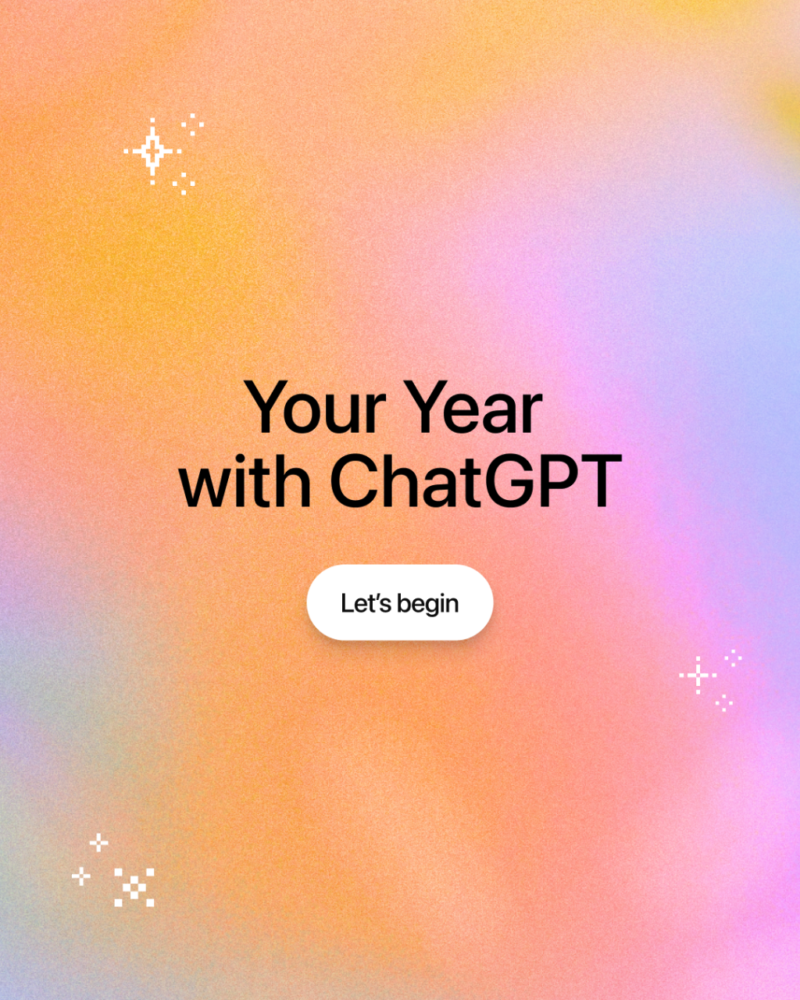
OpenAI has begun rolling out a year-end summary feature for ChatGPT that mirrors the familiar format popularized by Spotify Wrapped. The new experience, called “Your Year with ChatGPT,” offers users a retrospective look at how they interacted with the chatbot throughout 2025. Rather than positioning it as a novelty, the feature functions primarily as a usage recap, combining basic metrics with broader thematic insights drawn from conversation history.
For users who have access, the summary includes statistics such as overall activity levels alongside generalized themes that reflect the types of questions or topics most frequently discussed. These themes are presented at a high level, avoiding granular or message-by-message detail, and appear designed to give users a sense of patterns rather than a detailed archive. Accounts that do not meet a minimum activity threshold will see a reduced version limited to basic statistics, reinforcing that the feature is tied closely to sustained usage.
Availability is currently constrained. The year-in-review experience is open to Free, Plus, and Pro users, but it excludes Business, Enterprise, and Edu accounts. In addition, both saved memory and reference chat history must be enabled, a requirement that may give some users pause given ongoing discussions around data retention and privacy. At launch, the feature is available only in English and limited to users in the United States, United Kingdom, Canada, Australia, and New Zealand. OpenAI has indicated that access may roll out gradually, encouraging users to check back if it does not immediately appear.
Users who qualify can access the feature either through a prompt—by asking ChatGPT to show their year in review—or by adding “Your Year with ChatGPT” via the plus icon in the app. An updated version of the app is also required, suggesting the rollout is tied to recent client-side changes rather than server-side activation alone.
Alongside the year-end summary, OpenAI has also expanded ChatGPT’s personalization options. A new settings pane allows users to fine-tune aspects of the assistant’s behavior beyond choosing a general style. Adjustments now include warmth, enthusiasm, the use of headers and lists, and emoji frequency. These controls reflect a broader push toward customization, giving users more direct influence over how ChatGPT communicates without changing its underlying capabilities.
Taken together, the updates point to a steady shift in how ChatGPT is positioned: less as a one-size-fits-all tool and more as a configurable service shaped by individual preferences and long-term usage patterns. Whether features like “Your Year with ChatGPT” become a recurring fixture—or expand to more regions and account types—will likely depend on how users respond to the balance between personalization and data sharing.