
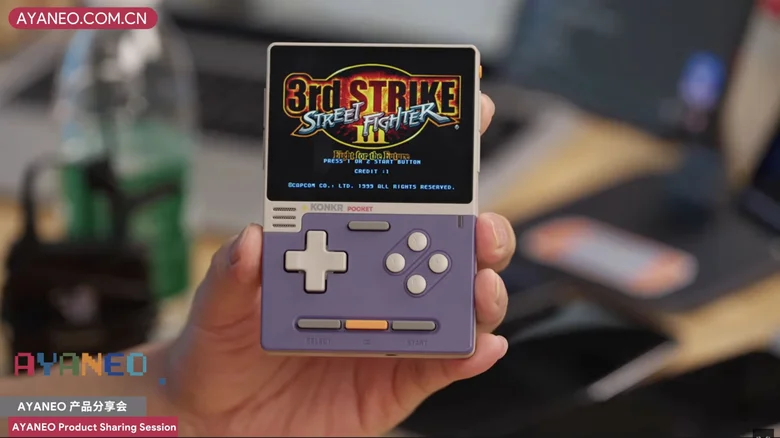
Ayaneo has announced another compact retro gaming handheld, the Konkr Pocket Block, continuing its pattern of revisiting classic Game Boy designs with a smaller form factor and some added artificial intelligence capabilities. The device positions itself as more affordable than the company’s higher-end models, which often exceed $1,000, and falls under a budget sub-brand. While details remain limited, the announcement highlights Ayaneo’s ongoing efforts to blend nostalgia with modern hardware in an increasingly crowded portable gaming space.
The Konkr Pocket Block adopts a distinctly retro aesthetic, moving away from the sleeker profiles of previous Ayaneo vertical handhelds like the Pocket Vert and Pocket DMG. During a recent streaming event, CEO Arthur Zhang compared it directly to those earlier devices, emphasizing its pocketable size and compact build. This approach taps into persistent demand for devices that evoke the feel of 1980s and 1990s handheld gaming, a segment that has seen renewed interest through emulation-focused hardware. Yet the repeated focus on Game Boy-inspired designs also raises questions about innovation fatigue. Ayaneo has released multiple variations on this theme, suggesting a strategy that relies heavily on familiar visuals rather than groundbreaking new concepts.
What sets this model apart, at least in marketing terms, is its claim to be the world’s first AI handheld. Specific features were not disclosed in the initial reveal, leaving observers to speculate on potential uses such as enhanced emulation assistance, in-game recommendations, or basic voice controls. In practice, integrating meaningful AI into a low-cost portable device presents technical hurdles, including power efficiency and processing limitations. Many existing handhelds already handle emulation effectively without AI, so the real test will be whether these additions provide genuine value or amount to little more than promotional checkboxes.
Pricing remains a key unknown, though the budget positioning suggests it could come in below the Pocket Vert’s $269 starting point. This aligns with broader trends in Chinese hardware manufacturing, where companies have driven down costs for portable gaming devices amid global supply chain adjustments. For consumers, more affordable options can expand access, especially as traditional players like Nintendo maintain premium pricing on their own handhelds. However, budget models sometimes compromise on build quality, battery life, or software support, areas where Ayaneo’s track record has been mixed.
The wider handheld market has grown more competitive in recent years. Devices ranging from mainstream consoles to niche emulation ports have proliferated, fueled by improvements in mobile processors and open-source emulation communities. Ayaneo’s frequent releases reflect this momentum but also contribute to market saturation. Consumers now face an array of similar-looking options, making differentiation difficult beyond price and minor feature tweaks. Past experience shows that sustained success in this space depends less on initial hype and more on long-term software updates, community support, and reliable performance.
As more details emerge about the Konkr Pocket Block’s hardware specifications and actual AI implementation, it will become clearer whether the device represents a practical step forward or another incremental iteration. For now, it exemplifies the industry’s blend of nostalgia, cost reduction, and emerging technologies in portable gaming. While the promise of AI in a compact handheld sounds appealing, its real impact will depend on execution rather than announcement alone.