
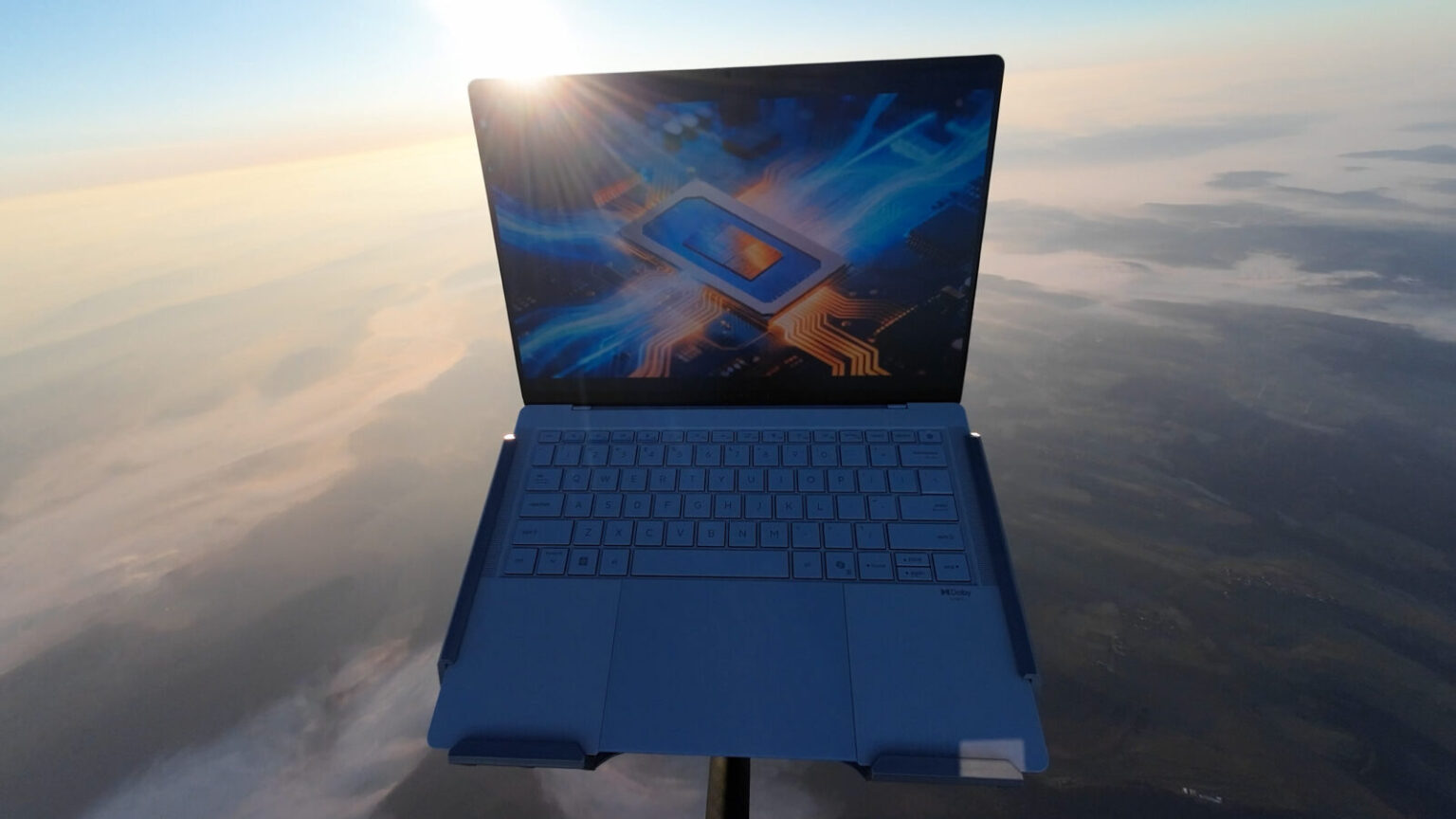
ASUS has put its latest ExpertBook Ultra laptop through an unusual durability test, sending the device to an altitude of 8,856 meters aboard a high-altitude balloon—slightly above the summit of Mount Everest. The experiment aimed to assess how the machine holds up under combined stresses of extreme cold, low air pressure, and physical shocks that standard laboratory protocols rarely replicate together.
During the ascent, the laptop operated continuously while temperatures plunged to minus 42.5 degrees Celsius and atmospheric pressure dropped sharply. After reaching peak altitude, it descended and landed at around seven meters per second on damp ground. According to the company, the device continued functioning without interruption throughout the flight and impact. The test setup involved mounting the laptop in a custom 3D-printed rig, exposing it to rapid environmental shifts that mimic the unpredictable conditions professionals might encounter in travel or remote work.
This kind of real-world validation highlights a practical challenge in laptop design. Most consumer and business machines undergo controlled tests for drop resistance, temperature cycling, and vibration, yet few face multiple extremes simultaneously. Historical examples, from early rugged laptops built for military use in the 1990s to today’s slim professional models, show that durability often trades off against weight and battery life. The ExpertBook Ultra attempts to balance these by using a magnesium-aluminum alloy chassis that is both light and rigid, along with reinforced internals. Whether such extreme altitude trials translate directly to everyday reliability remains open to question—after all, few users will subject their devices to stratospheric balloon flights—but the effort does underscore growing expectations for portable computers that can endure more than office desk duty.
At the heart of the machine sits an Intel Core Ultra X9 Series 3 processor, offering up to 50 TOPS of neural processing unit performance for AI tasks. This supports demanding workflows like data analysis, video editing, and multitasking, backed by a thermal system called ExpertCool Pro that sustains up to 50 watts of TDP while aiming to keep noise levels low. Battery life and overall portability receive emphasis in the design, targeting business users who move frequently between locations and need consistent performance without constant recharging.
The approach reflects broader trends in professional computing, where manufacturers increasingly market devices as reliable companions rather than delicate tools. Yet critics might note that dramatic stunts like this Everest-altitude test, while attention-grabbing, do not fully address common failure points such as long-term hinge wear, battery degradation, or software stability over years of use. Still, for professionals operating in harsh or mobile environments—field researchers, frequent flyers, or those in regions with unreliable infrastructure—the focus on combined stressors adds a layer of reassurance beyond typical MIL-STD certifications.
The ExpertBook Ultra is scheduled to reach GCC markets by July 2026. Pricing and exact configurations have not yet been detailed publicly.
This durability experiment adds an interesting chapter to the evolution of business laptops, reminding us that while laboratory standards provide a baseline, genuine resilience often reveals itself only under the messy conditions of actual use.