

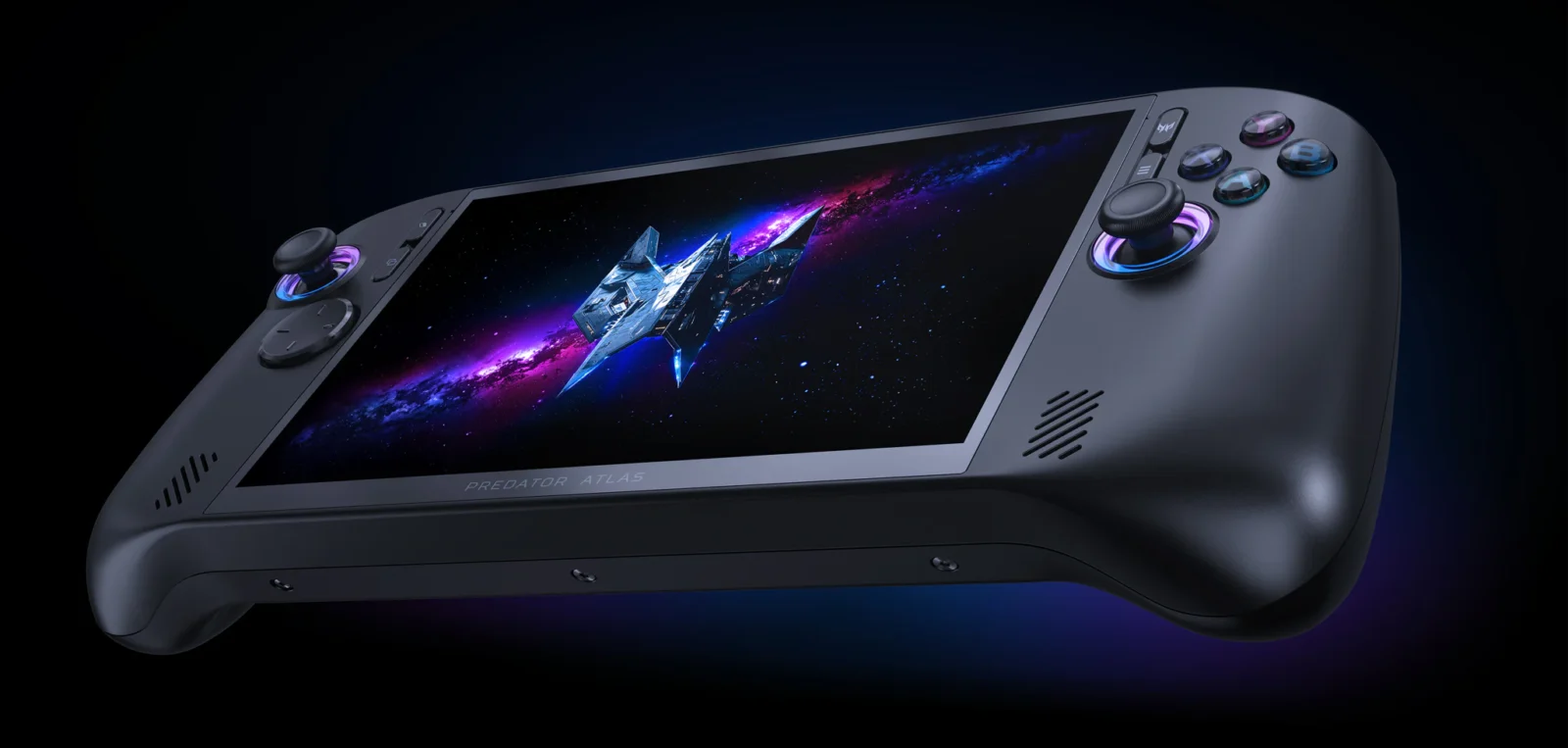
Acer has entered the competitive handheld gaming market with the Predator Atlas 8, a device that builds on the company’s earlier Nitro Blaze 7 but aligns more closely with its established Predator gaming lineup. Positioned as a portable PC gaming option, the Atlas 8 incorporates Intel’s latest processors, including the Arc G3 and the higher-end Arc G3 Extreme, alongside integrated graphics options like the Arc B370 and B390. These components support hardware ray tracing and Intel’s XeSS 3 AI upscaling technology, features that aim to improve visual performance in demanding titles on a compact device.

The hardware configuration includes up to 24 GB of LPDDR5x memory and storage expandable via a full-sized PCIe Gen4 NVMe M.2 2280 SSD slot reaching 1 TB. At the front sits an 8-inch WUXGA IPS touchscreen displaying 1920 x 1200 resolution in a 16:10 aspect ratio, with a 120Hz refresh rate for smoother gameplay. Corning Gorilla Glass Victus adds a layer of protection against everyday wear. Standard handheld controls come included, while connectivity covers Wi-Fi 7, Bluetooth 5.4, dual Thunderbolt 4 ports for external accessories or GPUs, a 3.5mm audio jack, and a UHS-II microSD card reader.
Cooling receives attention through Acer’s Vortex Flow system, featuring a dual-fan setup with one plastic fan and one metal Predator AeroBlade fan to enhance airflow. Power comes from an 80Wh lithium-ion battery, which should provide reasonable runtime for mobile sessions, though real-world endurance will depend on game intensity and settings. The device is scheduled for release in North America, EMEA, and Australia starting in October, with pricing details still undisclosed. It will include three months of PC Game Pass and two months of Xbox Game Pass Ultimate as part of the bundle.
The handheld gaming segment has matured significantly since Valve’s Steam Deck helped popularize the format a few years ago. Competitors like ASUS’s ROG Ally and Lenovo’s Legion Go have pushed boundaries in performance and ergonomics, yet many devices struggle with heat management, battery life, and overall value once the novelty fades. Acer’s approach with the Atlas 8 appears measured, focusing on solid specifications without overpromising disruption. The inclusion of Thunderbolt 4 ports is practical for users seeking desktop-like flexibility through docking or eGPU setups, addressing a common limitation in pure portables.
That said, success will hinge on factors beyond raw specs. Thermal performance under sustained loads remains a question mark for most handhelds, and the October launch timing places it in a crowded holiday market. Without confirmed pricing, it’s difficult to assess whether the Atlas 8 offers compelling advantages over more established options. Early indications suggest a capable machine for PC gamers wanting portability, but tempered expectations are wise given past handheld iterations that delivered strong hardware yet faced software optimization challenges or limited ecosystem support.
In a broader sense, Acer’s continued investment in this category reflects growing demand for versatile gaming devices that bridge console convenience with PC power. Whether the Predator Atlas 8 carves out meaningful space depends on its balance of performance, usability, and cost once full reviews emerge.