

TL;DR: The Madison is Taylor Sheridan’s most introspective and visually stunning series yet, anchored by Michelle Pfeiffer’s career-best performance and a deliberate slow-burn that rewards patient viewers with genuine emotional depth. It’s not another Yellowstone-style thriller, but a thoughtful meditation on grief and family that feels refreshingly unique in the neo-Western space.
The Madison
Man, Taylor Sheridan has built himself an empire of dusty boots, moral gray areas, and characters who stare into the abyss while clutching a whiskey glass. From the raw tension of his early films to the sprawling family empires of Yellowstone and its spin-offs, the guy knows how to make modern Westerns feel urgent and alive. But with The Madison, he’s swinging in a whole new direction. This isn’t another land-grab thriller or cartel showdown. It’s quieter, more introspective, and honestly, it feels like the most personal thing he’s put on screen yet.
I sat down with the six-episode season expecting the usual Sheridan fireworks. What I got instead was something that crept up on me like a Montana fog rolling in at dawn. The Madison isn’t trying to outpace the competition or deliver weekly twists that make your jaw drop. It’s content to let the weight of grief settle in, forcing you to sit with it the way real life demands. And damn if that patience doesn’t pay off in ways I didn’t see coming.
The story centers on the Clyburn family, a wealthy clan torn apart by a sudden tragedy that none of them saw barreling toward them. At the heart of it all are Stacy and Preston Clyburn, played with quiet fire by Michelle Pfeiffer and Kurt Russell. She’s a polished New Yorker who thrives on city energy, while he’s the type who finds peace in the wide-open spaces far from any downtown hustle. When loss hits, the whole dysfunctional crew piles into their secluded Montana estate, hoping the isolation might mend what years of distance and privilege have broken.
What unfolds isn’t a high-stakes drama full of shootouts or corporate betrayals. It’s a careful examination of how families fracture under pressure and whether nature’s raw beauty can stitch them back together. Sheridan trades in the usual neo-Western intensity for something that feels almost meditative. Characters wander through forests, stare at mountain horizons, and have conversations that linger longer than they need to. It’s the kind of show that rewards you for sticking around past the initial discomfort of its deliberate pace.
Why The Madison’s Slow Burn Actually Works (Even When It Tests Your Patience)
Let’s be real for a second. The first couple of episodes had me shifting in my seat more than once. The grief hits hard and fast, but then the story settles into this almost hypnotic rhythm where not much seems to “happen” in the traditional TV sense. Rich folks fumbling with basic ranch life at first comes off a bit tropey, like we’ve seen privileged characters learn humility through manual labor a hundred times before. I found myself wondering if this was going to be Sheridan’s version of a prestige drama that prioritizes vibes over momentum.
But here’s where it gets interesting. As the episodes unfold, that very slowness starts to mirror the messy reality of processing loss. Grief doesn’t follow a three-act structure with neat turning points. It drags. It circles back. It makes you confront parts of yourself you’d rather ignore. The Madison leans into that discomfort in a way that feels earned rather than indulgent. By the time the family starts peeling back their layers, revealing old resentments and hidden vulnerabilities, I was fully hooked.
The writing smartly avoids turning every conversation into a therapy session. Instead, moments of quiet revelation sneak up on you during simple tasks like chopping wood or watching a sunset. It’s the kind of storytelling that trusts the audience to fill in the emotional gaps rather than spelling everything out with heavy-handed monologues. Sheridan has always been good at letting landscapes do some of the heavy lifting, but here the environment feels like a character in its own right, pushing these people toward whatever version of healing they’re capable of achieving.
I kept thinking about how this show would play differently for viewers at various stages of life. If you’ve never lost someone close, parts of it might feel distant. But if you’ve sat through those endless days where time stretches weirdly and small decisions carry outsized weight, The Madison nails that texture in a way few shows even attempt.
The Visual Poetry That Makes The Madison Sheridan’s Most Stunning Series Yet
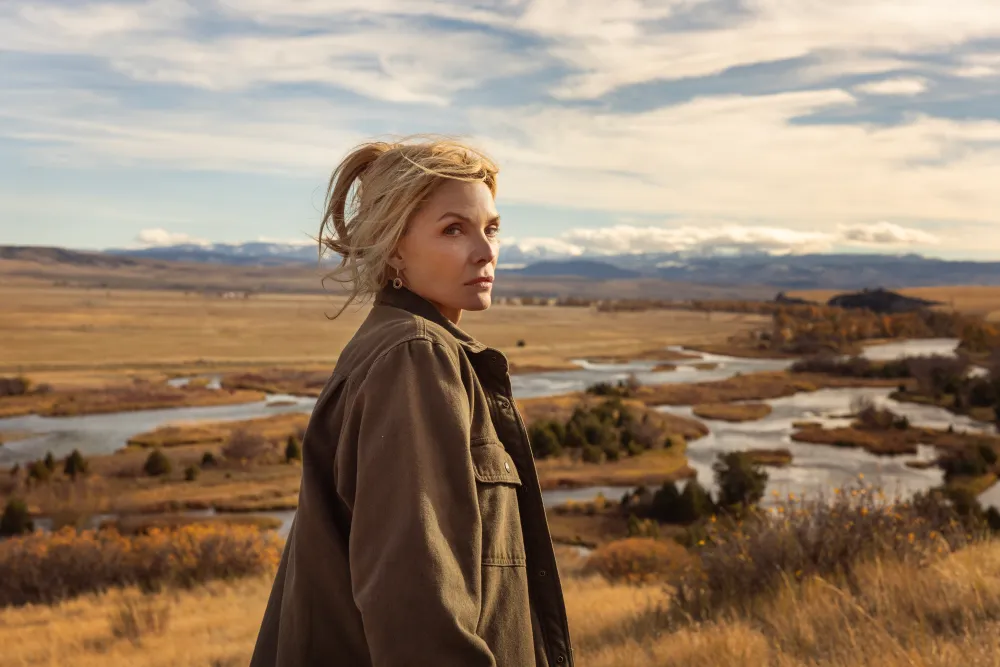
One thing you can’t deny about any Sheridan project is the way it looks. But The Madison takes that visual ambition to another level entirely. The Montana setting here isn’t just backdrop. It’s a living, breathing force that shifts from comforting to isolating depending on the character’s mood. Sweeping aerial shots of jagged peaks give way to intimate close-ups of dew on pine needles or the way light filters through aspen leaves. It’s the kind of cinematography that makes you want to pause every few minutes just to appreciate the frame.
Christina Alexandra Voros, who brought her eye to previous Sheridan works, handles both directing and cinematography duties across all episodes. The result feels cohesive and intentional. Colors pop in ways that feel almost painterly, especially during golden hour sequences where the landscape seems to glow from within. There’s a deliberate contrast between the sleek New York flashbacks and the rugged Montana present that underscores the family’s internal tug-of-war without ever feeling gimmicky.
I found myself geeking out over the practical choices too. No heavy reliance on CGI for the natural elements. Instead, the production leans into real locations and natural light, which gives every scene this grounded authenticity that pulls you deeper into the story. It’s the kind of beauty that sneaks up on you and lingers long after the credits roll, making you appreciate the natural world in a fresh way. For a show that’s ultimately about renewal and finding your place again, these visuals aren’t just pretty. They’re thematically essential.
If you’re the type who geeks out over production design and how a series uses its environment to amplify emotion, The Madison delivers in spades. It reminds me of those rare moments in cinema where the setting stops being scenery and starts shaping the narrative itself.
Michelle Pfeiffer and the Ensemble That Elevates Every Quiet Moment
Let’s talk performances, because this is where The Madison really flexes. Michelle Pfeiffer as Stacy Clyburn is operating on another plane entirely. She’s always been a powerhouse, but here she brings this layered vulnerability that feels raw and lived-in. Watching her navigate the early stages of grief, oscillating between numbness and explosive emotion, is mesmerizing. There’s a scene midway through the season where she finally lets a crack in her carefully maintained composure show, and it hits like a gut punch. If the Emmys sleep on this one, it’ll be one of those injustices we nerds complain about for years.
Kurt Russell brings his trademark gravelly warmth to Preston, the patriarch who’s more at home in boots than boardrooms. He plays the role with this gentle steadiness that anchors the more chaotic family dynamics. Their chemistry feels authentic, like two people who’ve built a life together but are now facing the reality that shared history isn’t always enough to bridge new gaps.
The younger Clyburns start off pretty insufferable, which is clearly by design. Beau Garrett and Elle Chapman portray the adult children with this entitled edge that makes you want to reach through the screen sometimes. But as the season progresses, their arcs reveal more nuance. The writing gives them space to evolve without rushing the process, showing how grief can force even the most self-absorbed people to confront their own immaturity.
Patrick J. Adams slots in nicely as a key supporting player who starts one-note but gains surprising depth. And then there’s Will Arnett showing up later, proving once again that he can dial down the comedy for something more grounded and affecting. The whole ensemble works in service of the story rather than trying to steal focus, which is refreshing in an era where big names often dominate every frame.
What I appreciated most was how the performances avoid the typical Sheridan trap of turning everyone into brooding tough guys or stoic archetypes. These characters feel like real, flawed humans who happen to have money and complicated backstories. Their growth feels organic rather than plot-driven.
How The Madison Stands Apart in the Sheridan Universe
Taylor Sheridan fans know what they’re usually signing up for. Intense moral dilemmas wrapped in violence, power struggles, and that signature blend of cynicism and hope. The Madison keeps some of those DNA strands, the dysfunctional rich family, the moral gray areas, the sense that everyone is wrestling with their own version of right and wrong. But it deliberately steps away from the action-heavy elements that defined shows like Yellowstone or Tulsa King.
This shift might disappoint viewers craving another adrenaline rush. There’s no massive conspiracy unfolding or rival factions plotting in the shadows. Instead, the conflicts are deeply personal, simmering beneath polite conversations and long silences. It’s a bolder creative choice than it might seem at first glance, especially for a creator who’s built such a reliable formula.
I respect the hell out of Sheridan for taking this swing. In a TV landscape obsessed with spectacle and franchise extensions, choosing to make something slower and more contemplative feels almost rebellious. The Madison isn’t trying to be the next big Yellowstone offshoot. It’s carving its own path, and that independence gives it a freshness that many prestige dramas lack.
That said, the slower pacing won’t work for everyone. If you’re the type who needs constant plot progression or high-stakes drama to stay engaged, you might find yourself checking your watch during certain stretches. But for those willing to meet the show on its terms, the rewards are substantial. It lingers with you in a way that more plot-driven series often don’t.
The Madison Delivers a Fresh Take on Grief in Modern Television
What makes The Madison worth your time isn’t just the stunning visuals or the powerhouse performances. It’s the way it approaches grief without turning it into melodrama or easy catharsis. The show understands that healing isn’t linear and that sometimes the most profound growth happens in the quiet moments when no one’s watching.
Sheridan has always excelled at exploring the spaces between right and wrong, but here he extends that to the messy territory of family bonds and personal renewal. The Montana setting becomes a metaphor for starting over, for stripping away the noise of modern life and confronting what really matters. It’s the kind of thematic depth that elevates the series beyond simple entertainment.
As someone who geeks out over storytelling that takes risks, I found myself thinking about this one long after finishing the season. It doesn’t have the immediate hook of some of Sheridan’s other hits, but it has staying power. In a year full of flashy releases and quick-binge options, The Madison stands out by daring to be different.
Whether you’re a die-hard Sheridan completionist or just someone looking for a thoughtful character drama with breathtaking scenery, this one deserves a spot on your watchlist. It might not convert every viewer, but for those it reaches, it leaves a mark.