
Anthropic has joined the race to build an AI that does more than wait for your next prompt. Its new personal agent, Claude Duet, is now in research preview. It puts Anthropic up against Meta’s Muse and OpenAI’s Dots in the category of proactive assistants that try to anticipate your needs instead of just answering them.
For now, access is limited. Only Claude subscribers in the US can join the waitlist, and Anthropic hasn’t said when the preview will expand or reach general availability.
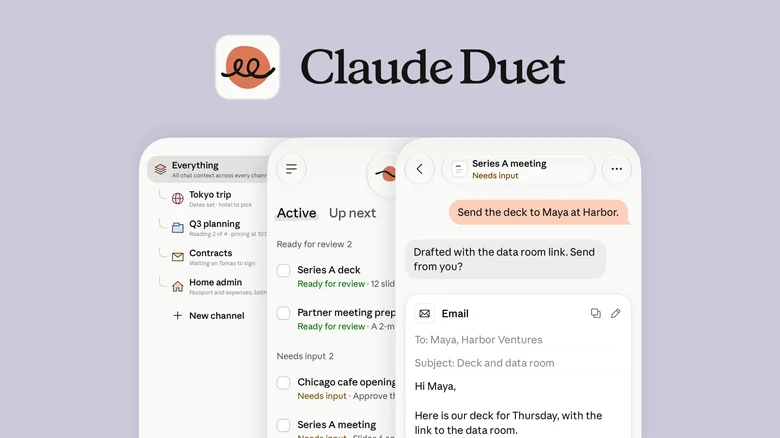
The idea will sound familiar to anyone following this space. Duet connects to your apps and produces a short daily briefing that lists the items it thinks need your attention. You can also give it work to do. Anthropic says that work can range from routine admin, like scheduling meetings, to more involved projects such as building dashboards across many tools, putting together financial or sales forecasts, prototyping, and creating web apps. The company says the agent will only contact you when something actually needs your input, and that it asks before acting on your behalf.
Under the hood, Duet runs on Opus 5.5 and works from its own virtual machine. That means it can keep going in the background without an open Claude session. Anthropic is also releasing standalone Duet apps for Android and iOS, which makes it a separate product rather than just another tab in the Claude interface.
Pricing could be Anthropic’s strongest selling point. When Duet launches widely, the company says it will be included in the $20-a-month Pro plan. OpenAI’s Dots is currently restricted to its Pro tier, which starts at $100 a month. The catch is that Duet draws from the same usage allowance as the rest of Claude, including Claude Code. Heavy users may find a background agent eating into limits they had planned to spend elsewhere. Anthropic seems aware of this. Duet checks connected accounts every few hours instead of continuously, and users will be able to control how often it sends messages and which topics it reports on.
Privacy is the bigger question. Anthropic says Duet uses a new classifier and system prompt designed to stop sensitive information from leaking. It also says the agent never directly sees passwords or sign-in tokens, and that health or financial data is only shared when the user explicitly allows it. The company has promised more detail on its safeguards soon. Until then, how useful Duet turns out to be depends largely on how much of their digital life people are willing to hand over.