
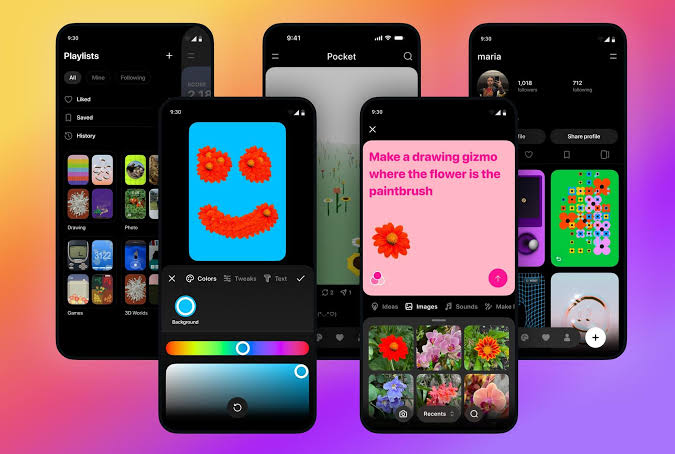
Meta has introduced Pocket, a standalone AI-powered app that allows users to generate, play, and share small interactive games through simple text descriptions. The tool builds on the growing trend of natural language interfaces for creative work, where users describe an idea and the system handles the underlying technical implementation.
At its core, Pocket revolves around what the company terms “gizmos”—short, interactive experiences created from prompts. A user might request a puzzle featuring a space cat or a scenario where a flower functions as a paintbrush, and the app produces a basic playable version. These can then be tested immediately, adjusted through further prompts, or shared with others. The app also includes a feed for browsing and remixing creations from the community, positioning it somewhere between a casual game platform and a social creativity space.
This approach draws from Meta’s earlier acquisition of Gizmo, a startup specializing in AI-generated interactive content. Rather than integrating the technology directly into Instagram or Facebook, the company opted for a dedicated app, a pattern seen in several of its recent experimental releases. It reflects a broader strategy of testing standalone tools to gauge interest before wider deployment across its main platforms. For users without coding experience, Pocket lowers the barrier to game creation considerably compared to traditional engines like Unity or Unreal, shifting effort from programming syntax to idea iteration.
Yet the limitations of current AI-generated games remain evident. While prompt-based tools can produce functional prototypes quickly, sustaining engagement often proves more difficult. Novelty may drive initial plays, but whether these mini-games offer lasting appeal or meaningful depth is another matter. Many similar efforts in generative AI have struggled with consistency, where outputs feel impressive in isolation but lack the polish or balance that comes from human iteration and testing. Pocket’s success will likely hinge not just on ease of creation, but on whether the resulting experiences prove genuinely entertaining over repeated sessions.
The launch fits into an expanding ecosystem of AI-assisted creativity applications. Tools for text, images, and now simple games continue to proliferate, appealing to hobbyists and casual creators who want quick results without steep learning curves. For Meta, it also serves as another entry point into AI engagement, potentially feeding back valuable usage data while exploring new forms of user-generated content. However, the company’s history with experimental apps suggests many such projects remain short-lived unless they demonstrate clear retention or integration potential.
In the context of mobile gaming and social platforms, Pocket highlights ongoing shifts toward more accessible creation. Android users in particular, with the platform’s open nature and broad app distribution, stand to benefit if the tool gains traction. Still, it arrives at a time when concerns around AI outputs—quality, originality, and potential for low-effort spam—persist across creative domains. Meta has positioned Pocket as an early step in what it sees as “vibe coding” for entertainment, but the real test will be whether it evolves beyond clever demos into something users return to regularly.