

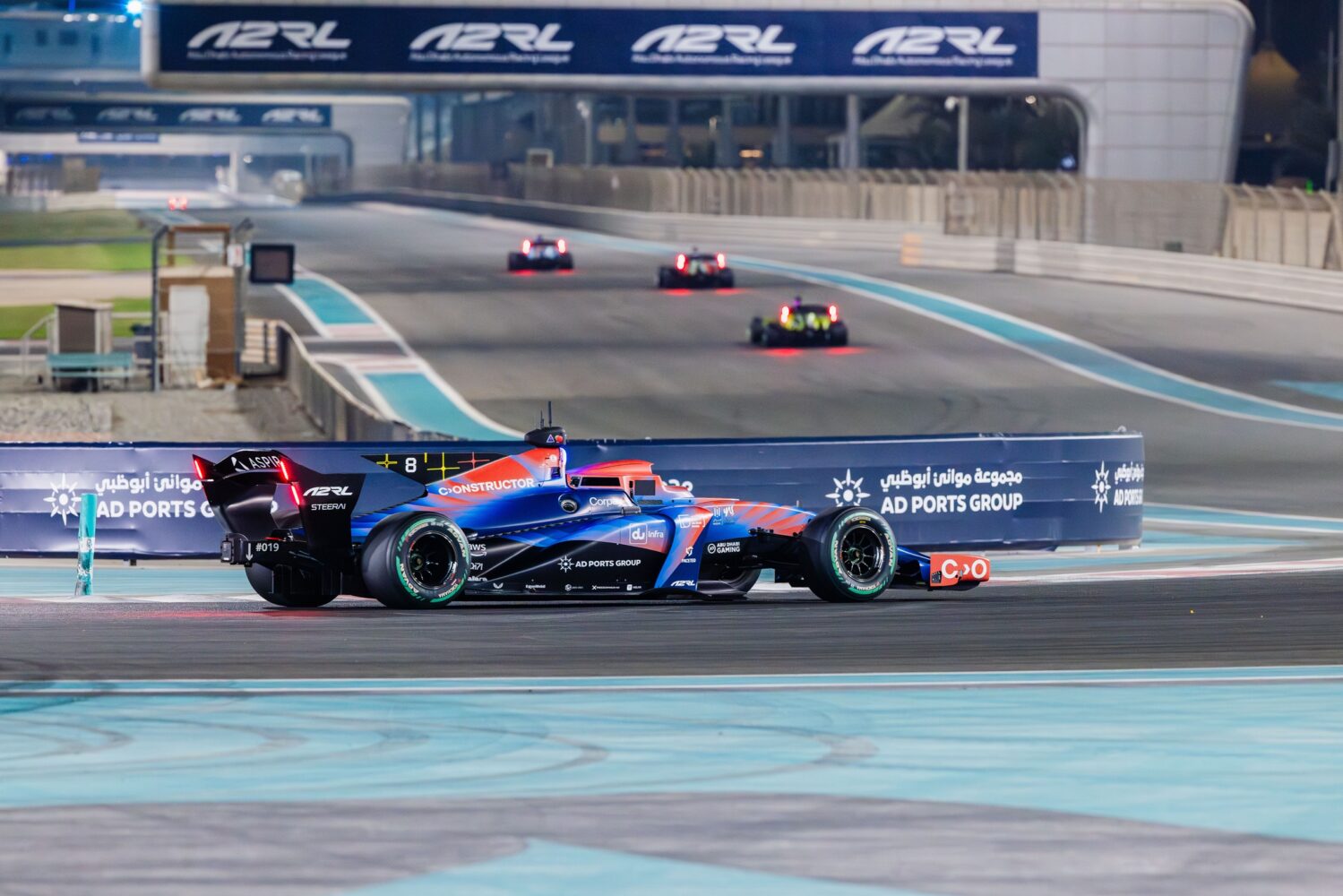
A2RL is set to make its European debut on 5 September 2026 at the Imola circuit in Italy, bringing up to five fully autonomous racecars based on the Dallara Super Formula SF23 to one of motorsport’s most technically demanding tracks. The event marks the first time the Abu Dhabi-based series will race outside the UAE, with the 2026 season concluding back at Yas Marina Circuit in Abu Dhabi later in the year.
Teams including Germany’s TUM, Italy’s PoliMOVE and Unimore Racing, along with UAE’s Kinetiz and Germany’s Constructor Racing, are expected to compete. Qualification will determine the final grid. Organized by ASPIRE, part of Abu Dhabi’s Advanced Technology Research Council, A2RL has developed from initial four-car demonstrations into a series featuring higher-speed, multi-car racing. In previous seasons at Yas Marina, the performance gap between autonomous systems and human drivers narrowed noticeably, from around 10 seconds in 2024 to under two seconds in 2025, highlighting incremental but measurable progress in real-time decision-making and sensor integration.
Imola presents a different kind of challenge compared with the relatively open layout of Yas Marina. The Italian track’s elevation changes, narrow lines, limited run-off areas, and tricky overtaking zones will test how well autonomous software handles grip management, traffic navigation, and split-second adjustments under pressure. These conditions reward precision over raw speed, offering a rigorous environment to evaluate current limitations in AI-driven racing. While simulation has improved preparation, translating virtual performance reliably to such a demanding physical circuit remains a core technical hurdle for all competitors.
Before arriving at Imola, teams will log extensive practice through the Sim Sprint virtual series, which runs until mid-July across digital replicas of several circuits, including Imola itself. This platform has already provided thousands of hours of collective testing, allowing developers to refine algorithms for overtakes, incident avoidance, and edge cases that are risky or impractical to replicate on track. Such hybrid preparation—simulation followed by limited physical testing—reflects a pragmatic approach to advancing autonomous systems safely.
Ahead of the race, A2RL engaged local motorsport and academic communities through Motor Valley Fest in Modena and university roadshows at institutions including Bologna, Modena and Reggio Emilia, and Politecnico di Milano. These activities included displaying a Super Formula car and discussing pathways for students and engineers to participate in the series. The outreach underscores the project’s aim to connect AI research with talent pipelines in a region rich in automotive heritage, though sustained impact will depend on how effectively these introductions translate into long-term collaboration.
A2RL’s expansion to Europe tests whether autonomous racing can build a genuinely international profile beyond its Abu Dhabi base. The series has shown steady technical evolution rather than overnight transformation, with real-world gains in speed and closeness of competition. Challenges remain, including the complexity of consistent performance across varied circuits, regulatory questions around fully driverless vehicles in motorsport, and the balance between spectacle and genuine innovation in mobility technology. Returning to Yas Marina for the season finale will provide a familiar benchmark against which to measure any lessons learned from Imola.
The initiative receives support from partners including SteerAI, AD Ports, du Infra, AWS, Abu Dhabi Mobility, and others, reflecting the blend of public research backing and private sector involvement typical in high-end autonomous development programs.