

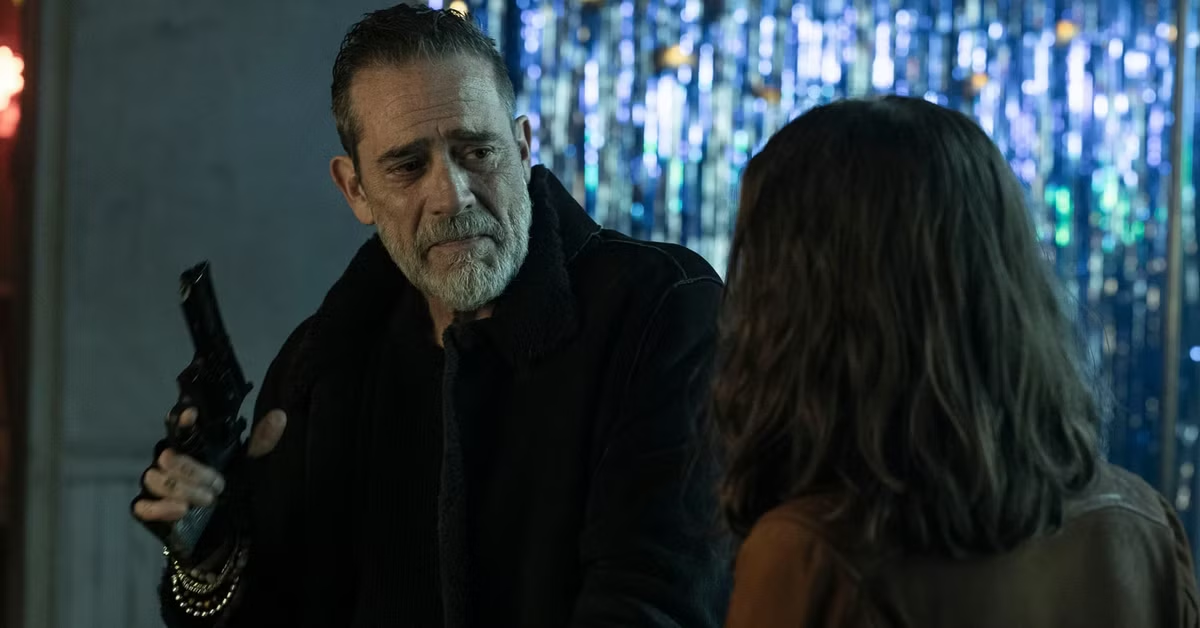
TL;DR: The Walking Dead: Dead City Season 3 Episode 7 turns Dillard’s heartbreak into terrifying revenge, powered by a superb Jimmi Simpson performance and a genuinely tragic fracture in his relationship with Negan.
The Walking Dead: Dead City has always worked best when it remembers that zombies are rarely the most dangerous things in The Walking Dead. Season 3, Episode 7, “Hourglass,” takes that franchise rule and runs it through a particularly nasty emotional grinder, placing Dillard at the centre of an episode built around grief, betrayal and the frightening speed at which affection can mutate into vengeance. With Jimmi Simpson given some seriously uncomfortable material to chew on, the penultimate episode turns a character who found an unusual version of peace in Manhattan into a volatile threat. More importantly, it makes that transformation feel rooted in something recognisably human rather than simply flipping the convenient “villain mode” switch.
Dillard becomes the emotional wildcard Dead City needed
Dillard has been one of Season 3’s strangest additions, and I mean that as a compliment. His attachment to walkers is disturbing by normal Walking Dead standards, which is quite an achievement in a universe where people have worn zombie faces as camouflage. Yet the idea underneath that behaviour is surprisingly sad: Dillard has found creatures easier to understand than people. Walkers are horrific, but they are also brutally predictable. Humans manipulate, betray and disappoint; the dead simply are what they are.
That psychology makes his relationship with Negan much more interesting than another temporary alliance formed because two survivors happen to need each other. Dillard sees something in Negan that persuades him to reopen a door he had effectively slammed shut on humanity. Negan, meanwhile, can relax around someone whose eccentricity makes his own considerable baggage look almost conventional. Jeffrey Dean Morgan and Jimmi Simpson sell that odd connection because neither treats it like a gag. Their chemistry gives Dillard’s eventual emotional collapse actual weight rather than making him another disposable obstacle waiting for the finale.
Negan accidentally creates a monster he never intended to make
The smartest part of “Hourglass” is that Negan doesn’t need to become malicious for everything to fall apart. His worldview simply crashes into Dillard’s. Negan has spent years surviving walkers and understands them as lethal threats; Dillard has emotionally reclassified them as family. From Negan’s perspective, killing dangerous walkers makes perfect sense. From Dillard’s perspective, it is an unforgivable violation committed by the one human being he had finally trusted.
That difference matters because it keeps the conflict from becoming cartoonishly simple. Negan isn’t twirling his moustache while destroying someone’s happiness, and Dillard isn’t reacting to something the audience can easily dismiss as meaningless. His response becomes horrifyingly disproportionate, but the emotional equation inside his head remains understandable. The Walking Dead has spent years exploring how trauma rewrites morality, and Episode 7 finds a fresh variation by asking what happens when someone’s carefully constructed sanctuary is destroyed by the person who helped convince him that human connection might still be worthwhile.
Jimmi Simpson makes Dillard’s breakdown disturbingly believable
Jimmi Simpson is the episode’s MVP because he refuses to play Dillard’s deterioration as generic madness. There is pain underneath the menace, which makes everything significantly creepier. Dillard’s increasingly destructive behaviour feels like someone desperately trying to give shape to an emotional wound he cannot process. He wants Negan to understand loss by experiencing it himself, and that motivation pushes his anger beyond Negan and toward Maggie.
That escalation is where Dillard crosses from wounded eccentric into genuine antagonist territory. Maggie hasn’t earned his hatred through some personal betrayal; she matters because Dillard understands that she matters to Negan. Their relationship may be one of television’s most aggressively complicated bonds — hardly friendship in any conventional sense, but far too deeply connected to be dismissed as simple hostility. Dillard recognising that connection gives his revenge a cruel logic. He isn’t merely trying to defeat Negan. He wants to damage him emotionally.
Simpson’s performance is essential because this could easily have become comic-book supervillain material. Instead, Dillard’s instability remains connected to the character we already knew. That doesn’t excuse his actions, especially once innocent people become collateral damage, but it gives those actions dramatic meaning. There is a massive difference between an antagonist doing terrible things because the script needs a boss fight and someone doing them because their broken worldview has reached its ugliest possible conclusion. “Hourglass” understands that distinction.
The police uniform says more than another villain speech could
Dillard returning to his old police uniform is perhaps the episode’s strongest visual expression of what has happened to him. It isn’t simply a costume upgrade before the final level. The uniform represents regression. The strange peace he found among walkers and the human connection he rediscovered through Negan are effectively gone, leaving him retreating into an older identity shaped by his bleak opinion of humanity.
That gives his transformation an almost tragic circularity. Dillard believed he had escaped the person he used to be, only for betrayal — intentional or otherwise — to convince him that his original cynicism was correct. The uniform therefore becomes emotional armour as much as physical clothing. He is rebuilding himself from an earlier save file because, in his mind, the newer one has become corrupted beyond repair.
“Hourglass” turns friendship into the season’s most dangerous weapon
What makes Episode 7 effective isn’t simply that Dillard becomes more violent. The Walking Dead has enough violent people to populate several apocalypses. The interesting part is how the episode weaponises intimacy. Negan’s ability to connect with Dillard briefly offered both men something resembling normal companionship, and the destruction of that bond becomes more dangerous than open hostility ever was.
That also gives the approaching finale useful emotional stakes. Dillard is no longer just another threat standing between Maggie, Negan and survival. His conflict with Negan is personal in an unusually intimate way, while his decision to target Maggie exploits one of Dead City’s defining relationships. The episode leaves him on a trajectory that feels almost impossible to reverse, which is exactly where a penultimate chapter should leave its most unstable character.
Verdict
“The Hourglass” succeeds because it treats Dillard’s villain turn as heartbreak before horror. Jimmi Simpson delivers a layered performance that keeps the character emotionally legible even when his behaviour becomes indefensible, while Jeffrey Dean Morgan gives their fractured relationship enough history and warmth for its destruction to sting. The episode’s biggest strength is its refusal to make Negan deliberately cruel simply to manufacture conflict; two incompatible understandings of survival are enough to detonate everything.
Viewers looking primarily for zombie carnage may find the psychological emphasis less immediately satisfying, but fans invested in The Walking Dead’s long-running fascination with trauma, morality and damaged human connection should find plenty here. As a penultimate episode, it does exactly what it needs to do: breaks an important relationship, turns emotional consequences into physical danger and points everyone toward a finale where reconciliation suddenly looks much harder than survival. Dillard may have found peace once, but “Hourglass” makes a compelling case that losing it could be far more dangerous than never finding it at all.