
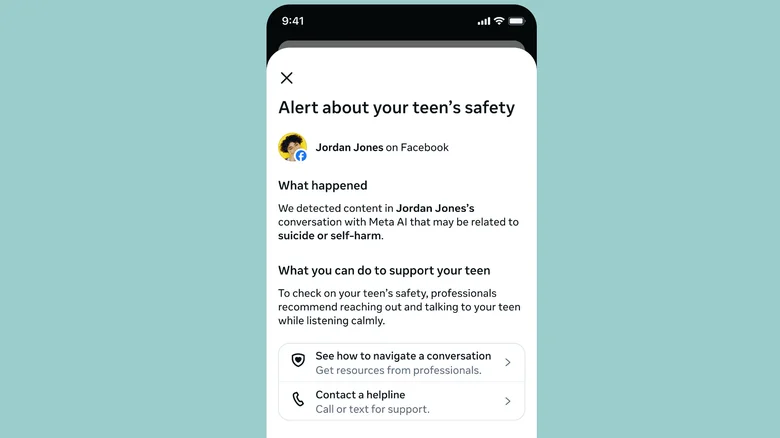
Meta is widening the net on one of its most sensitive teen safety features. Parents who supervise their teenagers’ Facebook accounts will now get an alert if their child repeatedly searches for suicide or self-harm content over a short stretch of time, and the same warning system now extends to conversations with Meta AI when a teen’s messages suggest they could be at risk.
The feature isn’t new in concept. Meta introduced these search-based alerts on Instagram earlier this year, and Facebook is simply catching up. The Meta AI component is the more significant addition. Chatbots have become a place where young people talk through things they might not search for publicly or say out loud, and that has turned AI assistants into a growing concern for parents, regulators and child safety groups. Bringing chatbot conversations into the alert system acknowledges that a teen’s distress may now surface in a private exchange with software rather than a search bar.
How the system decides when to step in remains deliberately unclear. Meta has said it set a threshold of a few searches within a short window, aiming to lean toward caution while avoiding unnecessary alarms. It hasn’t defined what “repeatedly” or “short period” actually mean, and it hasn’t explained how its AI determines that a conversation signals risk. That opacity may be intended to stop teens from working around the rules, but it also makes the feature difficult to judge from the outside.
When an alert triggers, parents hear about it by text, email or WhatsApp, plus a push notification in their own app. The message doesn’t reveal the exact search terms or the content of the AI chat. Instead, it encourages parents to talk with their teen and points them to helpline resources. That middle ground is sensible, as it flags a concern without exposing everything a teenager has typed, though it still asks parents to start one of the hardest conversations they’ll ever have with very little to go on.
The alerts only reach families using Meta’s supervised Teen Accounts, which give parents more control over privacy settings and are designed to limit exposure to sensitive posts and contact with adults. Teens outside that system, or those using a second account, fall beyond its reach entirely.
The real test will be whether the thresholds are tuned well enough to catch teens who need help without flooding parents with false alarms, and whether Meta will ever share data showing that these notifications make a measurable difference.