

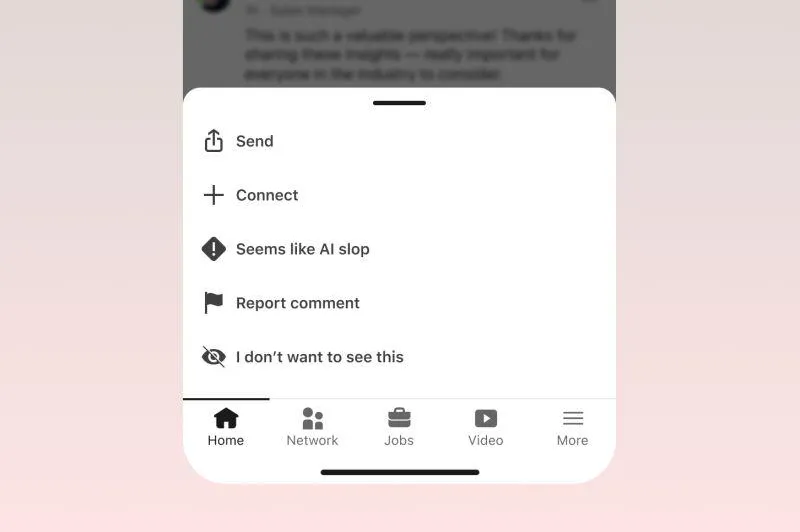
LinkedIn’s attempt to clean up low-quality AI-generated content appears to be getting plenty of help from its users. More than one million people have used the platform’s “Seems like AI slop” reporting option since it was introduced in late July, according to LinkedIn chief product officer Hari Srinivasan.
The feature sits inside the three-dot menu on posts and is designed to give LinkedIn another signal when identifying content that feels mass-produced, synthetic or otherwise low value. It is a notably direct piece of product language from a professional network that has spent years encouraging users to publish more often.
LinkedIn says those reports are feeding into a broader effort to reduce the visibility of what it classifies as AI slop. Srinivasan claims users are now seeing 40 percent fewer views on that type of content than they were only a few weeks ago. That figure comes from LinkedIn itself, so it should be treated as a platform-reported result rather than an independent measure of how much AI-generated material has actually disappeared.
The timing is not accidental. A recent analysis from AI detection company Pangram reportedly flagged 41 percent of long-form LinkedIn posts as fully AI-generated. Even allowing for the limitations of AI detection tools, the result underlined a problem many users had already noticed: generative AI has made it extremely easy to flood professional feeds with polished-sounding posts that say very little.
LinkedIn has responded on several fronts. Alongside the reporting button, the company has introduced updated classifiers for identifying AI-generated material and removed a tool that automatically helped users “enhance” their posts with AI. Earlier this year, it also said it was targeting comments produced at scale with little or no human input.
The next step is more unusual. LinkedIn is beginning to show some users a notice when other members have flagged their post as appearing AI-generated. The message is framed as feedback rather than a penalty, telling the author that other people thought the post “seems like AI.”
That softer approach makes sense because the problem is difficult to police cleanly. Plenty of people now use AI to edit grammar, tighten wording or translate drafts without handing over the entire writing process. At the same time, human-written corporate posts can easily resemble AI output because professional social media has long rewarded a highly repetitive style.
That leaves LinkedIn with a difficult moderation problem: reduce low-effort automated content without punishing ordinary users simply for sounding polished or formulaic.
The one-million-click milestone suggests people are eager to participate in that cleanup. The harder test will be whether LinkedIn can turn those reports into a noticeably better feed without creating a new kind of false-positive problem around perfectly human writing.