
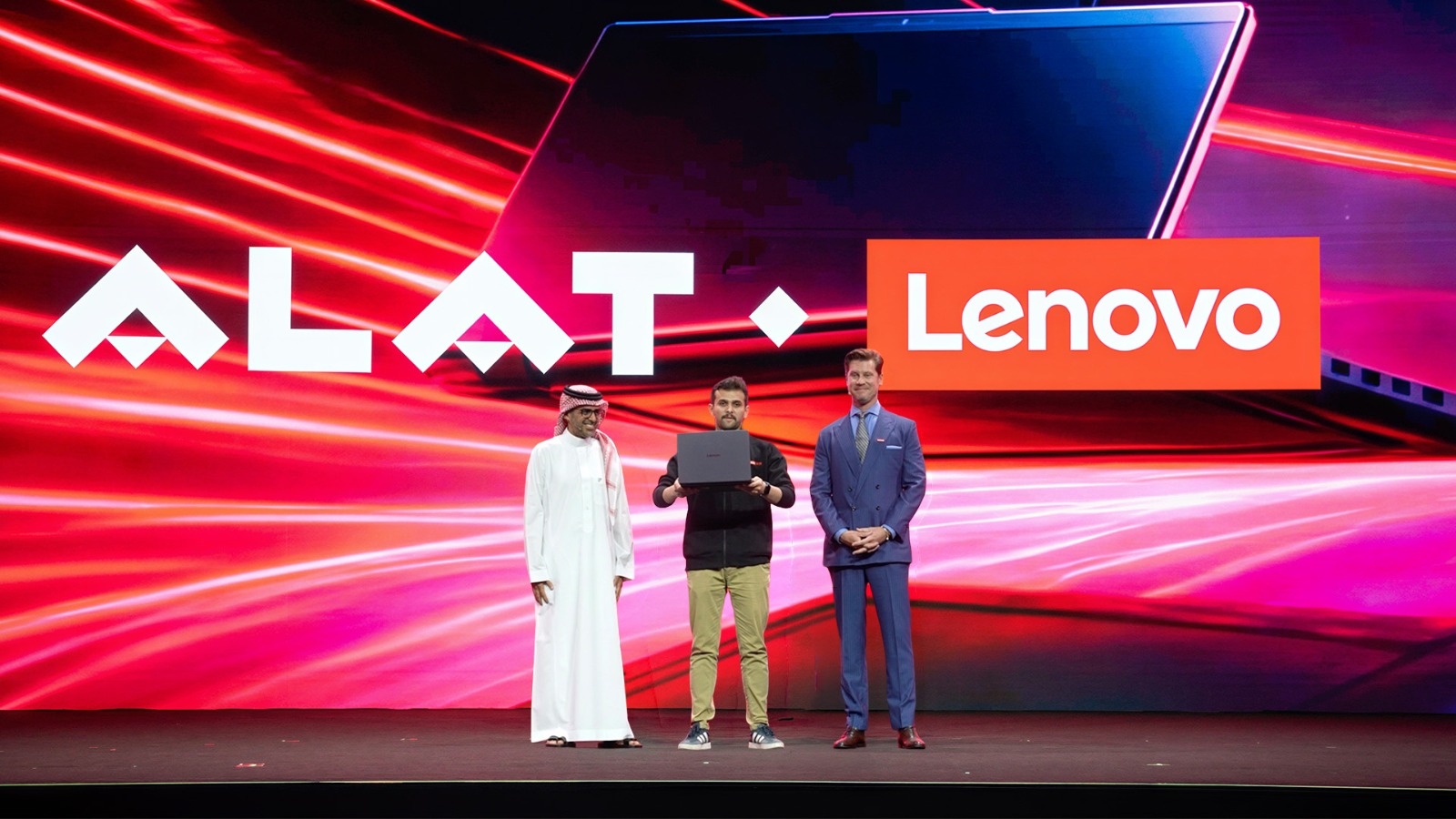
Lenovo has produced its first laptop in Saudi Arabia, giving the company an early proof point for its planned expansion into local technology manufacturing and bringing Riyadh closer to becoming a meaningful part of its global supply chain.
The laptop was unveiled at LEAP 2026 and manufactured at Lenovo’s new Riyadh facility, although the announcement should be viewed as the beginning rather than the completion of the project. Lenovo says mass production of a limited selection of products is scheduled to start in late 2026, meaning the bigger test will be how quickly the facility can move from milestone devices to sustained commercial-scale output.
The Saudi manufacturing operation stems from Lenovo’s strategic partnership with ALAT, the Public Investment Fund-backed company established to develop electronics and advanced industrial manufacturing inside the Kingdom. The collaboration is closely aligned with Saudi Vision 2030, particularly its push to diversify the economy and develop domestic capabilities beyond traditional industries.
What makes the Riyadh facility particularly notable is its intended scope. Lenovo says it will be the first site in its global manufacturing network capable of producing its entire product portfolio, spanning PCs and desktops alongside Motorola smartphones and servers. Lenovo currently operates more than 30 manufacturing sites across 11 markets, so adding Saudi Arabia also gives the company another geographic option within an increasingly distributed global supply chain.
Local production is only one part of Lenovo’s Saudi expansion. The company has established its Middle East, Türkiye and Africa regional headquarters in Riyadh and is developing local research and development operations led by Dr. Rabeah Alzaidy. It has also partnered with ALAT, Saudi Arabia’s Human Resources Development Fund and the Ministry of Industry and Mineral Resources on training programmes focused on smart manufacturing.
The first group of Saudi engineers involved in that programme has already completed specialist training at Lenovo manufacturing facilities elsewhere in the world. Building a sustainable pool of engineers and manufacturing specialists will arguably matter more over the long term than simply assembling finished devices locally, particularly if Saudi Arabia wants to develop deeper expertise across electronics production, research and supply-chain operations.
Lenovo is simultaneously expanding its enterprise technology offering in the Kingdom, including AI systems aimed at industries such as manufacturing, energy, retail and sports. At LEAP, the company demonstrated robotic inspection technology designed for environments including oil and gas, power and utilities, where automated systems could reduce the need for workers to perform some manual inspections.
For Saudi Arabia, however, the locally manufactured laptop is the more tangible development. It provides an early indication that the Lenovo-ALAT partnership is moving beyond investment announcements and headquarters openings into physical production.
The more important milestone arrives later in 2026. Starting mass production, maintaining output and expanding the range of locally manufactured hardware will determine how significant Riyadh eventually becomes within Lenovo’s international manufacturing network.