

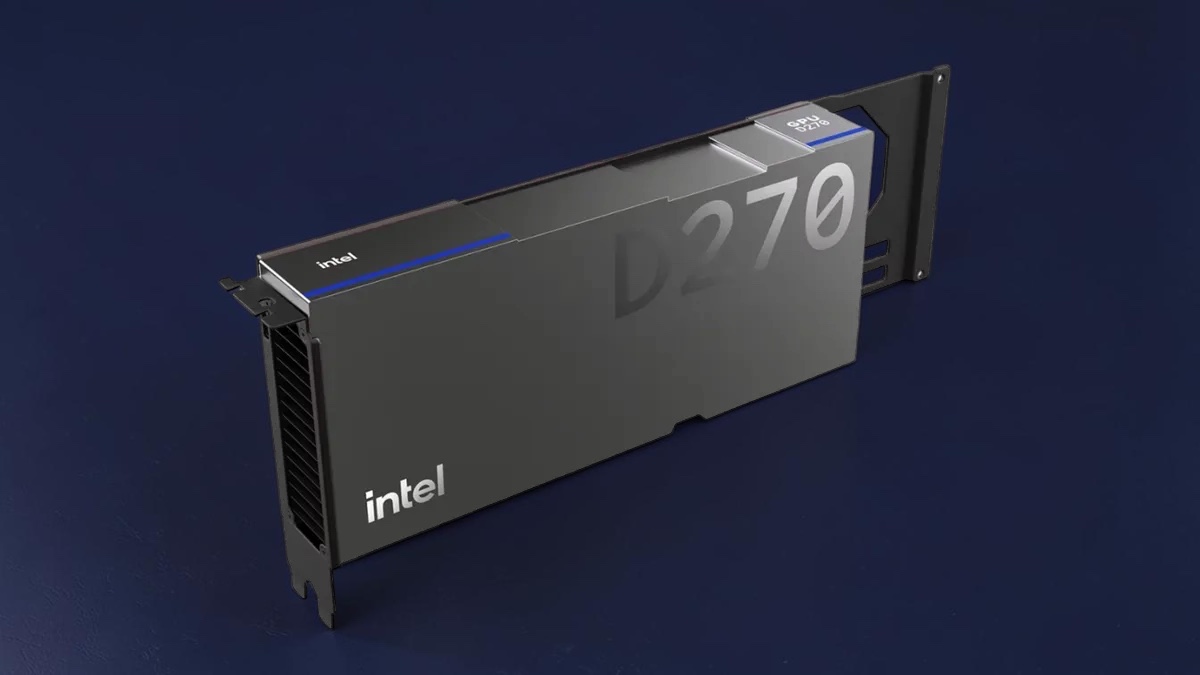
Intel has a new data center GPU, and its headline number is bigger than the storage on many mid-range laptops: up to 480GB of memory on a single card. The Intel GPU D-series, previously known by the codename Crescent Island, was shown at the Open Compute Project Global Summit. Intel is aiming it squarely at AI inference, not training, and certainly not gaming.
The memory choice is the most interesting part. Intel did not use the GDDR7 found in current graphics cards or the HBM stacked onto Nvidia’s flagship accelerators. It used LPDDR5X, the low-power memory normally soldered into thin laptops and phones. That gives up raw speed in exchange for density and efficiency. The D-series is rated at 1.5TB/s of memory bandwidth, which is far below the roughly 8TB/s that HBM3e delivers on Nvidia’s Blackwell Ultra B300. On capacity, though, Intel now leads: the B300 carries 288GB.
That trade-off says a lot about where Intel thinks the AI market is heading. Training frontier models rewards bandwidth above almost everything else. Serving those models to customers is different. The model weights, long context windows and many concurrent requests all have to fit somewhere, and capacity often becomes the constraint. Intel says a single card can hold models of up to 300 billion parameters, and an eight-GPU server can handle models of more than a trillion. The company lists long prompts, enterprise AI services and robotics as the target uses.
Compute is rated at 1.3 petaflops in FP8. The more practical details may matter more to buyers. The card draws 350W, uses a standard PCIe form factor and is air-cooled. That means it is meant to fit into existing racks without the liquid cooling and custom chassis that top-end Nvidia systems increasingly require. Intel also plans to pair it closely with Xeon processors, so the CPUs handle orchestration, data movement and the parts of multi-step AI pipelines that don’t need a GPU.
Some caution is warranted. Memory capacity alone does not determine how fast a card serves tokens, and Intel has not published inference benchmarks against Nvidia or AMD. The capacity has also grown sharply since Crescent Island was first previewed last year with 160GB, so final specifications may still change. Intel has not announced pricing or a general availability date either.
The pitch is clear even without those details: Intel is not trying to beat Nvidia on peak performance. It is betting that enterprises running open models will value affordable, roomy and easy-to-deploy hardware. Whether that holds up depends on the price and on how well Intel’s software stack runs on real workloads, and Intel has not shown either yet.