
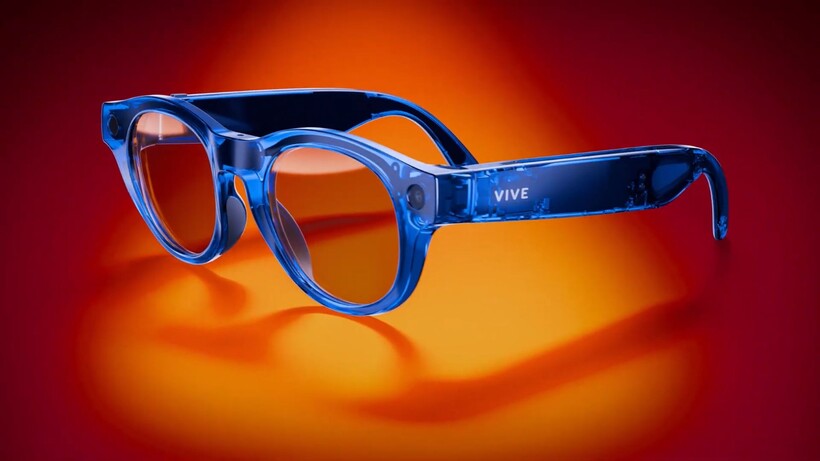
HTC is joining the increasingly crowded AI smart glasses market with the VIVE Eagle, a $499 pair of camera-equipped glasses that attempts to tackle one of the category’s biggest problems: convincing everyone around the wearer that they are not being secretly recorded.
Available to order in North America, Europe and Australia, the VIVE Eagle combines a 12-megapixel camera with HTC’s VIVE AI platform, open-ear audio and features including live translation, meeting transcription and hands-free assistance. Pricing starts at $499 in the US, £429 in the UK and €469 in Europe. North American shipments are beginning immediately, while European deliveries start September 21.
Privacy is the more interesting part of HTC’s pitch. Camera glasses inevitably create questions about bystanders who may not realise they are being photographed or filmed, so HTC has built several safeguards directly into the hardware.
A notification LED lights up or pulses whenever the camera captures a photo or records video, with brightness automatically changing to remain visible in different environments. More unusually, sensors are designed to stop recording if that LED is covered, damaged or otherwise compromised. Recording is also disabled when the glasses are not being worn.
HTC offers an optional feature allowing someone nearby to say “Stop filming” to halt recording. It is a notable attempt to give people other than the wearer some control, although its practical effectiveness will depend on how reliably the glasses recognise the command in noisy environments.
Photos and videos are encrypted and stored locally, with the wearer choosing whether to move them into HTC’s VIVE Connect app or a cloud photo service. HTC says another person cannot simply pair the glasses with a different smartphone to access the original owner’s data.
The AI side supports both OpenAI and Google Gemini models, with HTC saying requests sent to third-party models are de-identified. The company also says information collected through VIVE AI is not used to train its own AI models.
Hardware includes a 12MP camera capable of electronically stabilised 3K video, four microphones with noise cancellation and directional open-ear stereo speakers. VIVE AI can perform image-to-text translation across more than 100 languages and real-time spoken translation across more than 90. Meeting recording and AI-generated notes are supported too.
Battery life is rated at four to six hours of continuous active use or up to 36 hours on standby. Fast charging reaches a claimed 50% in 10 minutes and 80% in 23 minutes. An optional $49/£45/€49 Power Boost battery adds up to 80% more battery life while adding 8g.
HTC is offering Square and Pantos frame designs with clear, sun and adaptive ZEISS lenses, while eligible purchases include two years of VIVE AI Plus.
Smart glasses are rapidly becoming another battleground for consumer AI, but cameras worn at eye level remain socially complicated. HTC clearly understands that better specifications alone will not settle that debate. The VIVE Eagle’s most important feature may therefore be the one designed not for the person wearing the glasses, but for everyone standing in front of them.