
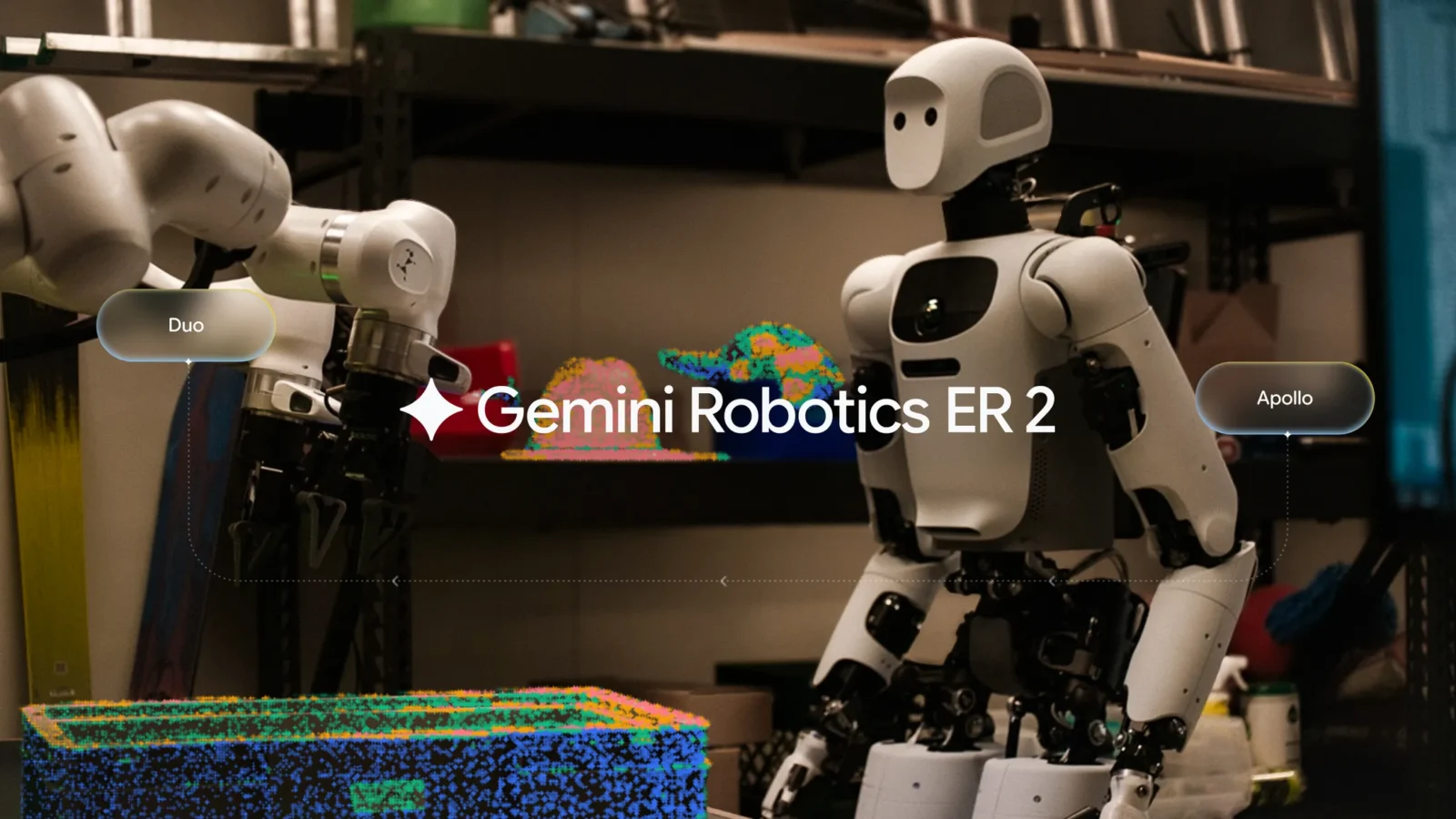
Google DeepMind has released Gemini Robotics ER 2, an updated embodied reasoning model intended to serve as a high-level planner for physical robots. The system interprets continuous video, converses with people, breaks complex jobs into steps, and passes motor commands to separate vision-language-action models or other low-level controllers. It can also invoke external tools such as search or custom functions while the robot is already moving, aiming to reduce the stop-and-think delays common in earlier setups.
Compared with the previous ER 1.6 version, the new model places greater weight on live video understanding. It classifies task progress into five rough stages and attempts to identify the precise moment a critical action should end, such as stopping a pour or confirming a screw is seated. Reported figures put progress classification accuracy at 57.4 percent and moment-finding accuracy at 91.3 percent with a mean error of under a second. These numbers improve on prior internal results and some competing systems, though they remain laboratory metrics rather than guarantees of reliable performance in unstructured homes or factories.
The same release adds support for multi-robot coordination. Different machines can share a semantic description of a job and hand work between themselves, illustrated in demos pairing a humanoid with a dual-arm manipulator. A separate demonstration uses the model to direct Boston Dynamics’ Spot robot through navigation and grasping sequences triggered by ordinary speech. Developers can access the model through the Gemini API and Google AI Studio, with a private enterprise preview available as well.
Spatial reasoning receives incremental upgrades. Failure detection now runs on video streams instead of single frames, instrument reading covers a wider range of dials and displays, and visual question-answering benefits from broader multimodal training. Safety benchmarks also show gains. The model is said to pause a humanoid when a person enters its workspace and resume only after the area clears. A new evaluation suite tests whether the high-level planner can enforce physical constraints and request clarification when uncertainty rises.
These capabilities address long-standing gaps between language models and real-world machinery. High-level reasoning has often lagged behind the speed and reliability required for continuous physical interaction. Latency-sensitive streaming, progress monitoring, and inter-robot handoffs are logical responses to that mismatch. Yet the gap between controlled benchmarks and messy environments remains wide. Progress percentages and sub-second timing look promising on paper; sustained autonomy amid clutter, lighting changes, or unexpected human movement is another matter. Multi-robot systems introduce further coordination overhead that current demos only begin to explore.
Gemini Robotics ER 2 therefore functions as a more capable orchestration layer rather than a finished solution for everyday robots. It gives researchers and developers additional tools for chaining perception, planning, and action while keeping low-level control modular. Whether the measured improvements translate into robots that are genuinely more useful outside the lab will depend on further testing under less forgiving conditions.