
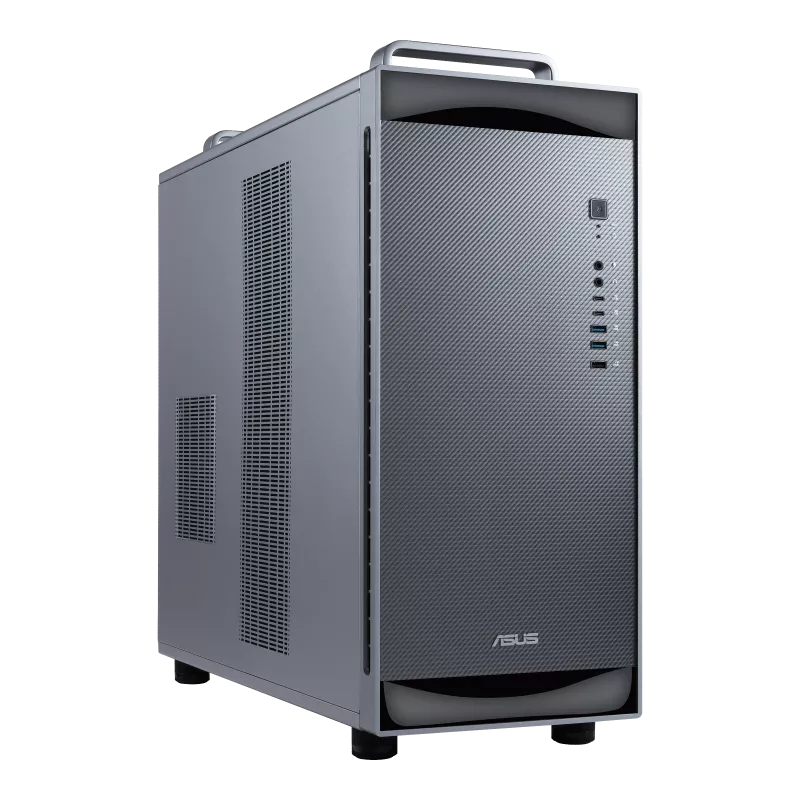
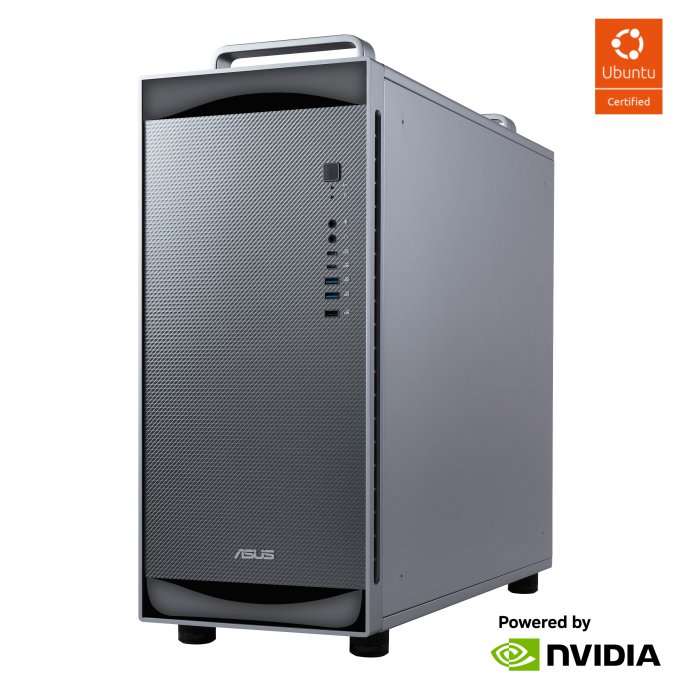
ASUS is bringing NVIDIA’s latest Grace Blackwell hardware out of the data center and into the office with the ExpertCenter Pro ET900N G3, a deskside AI system aimed at developers, researchers and businesses that want serious local AI compute without building dedicated server infrastructure.
At the heart of the machine is NVIDIA’s GB300 Grace Blackwell Ultra Desktop Superchip, running on the DGX Station GB300 architecture. The headline specification is 748GB of coherent CPU-GPU memory, giving the system enough capacity, according to ASUS, to work with AI models containing as many as one trillion parameters. ASUS also rates the ET900N G3 for up to 20 PFLOPS of AI performance.
That combination makes this considerably different from the increasingly common “AI PC.” Rather than accelerating relatively lightweight assistants, image generation and other consumer-facing workloads, the ExpertCenter Pro is targeting large language model fine-tuning, inference, deep learning, simulations, physical AI and autonomous agent development. NVIDIA NVLink-C2C provides the high-bandwidth connection between CPU and GPU resources, while the coherent memory architecture is particularly important when model size becomes a limiting factor.
The appeal is less about replacing cloud AI altogether and more about giving organisations another place to run demanding workloads. Keeping models and datasets on-premises can be useful where privacy, governance or latency matter, while local hardware can also make costs more predictable for workloads that would otherwise consume substantial cloud GPU resources. Whether the economics make sense will depend heavily on the eventual configuration, utilisation and pricing — and ASUS has not published a retail price.
ASUS is also making some specific performance claims. In internal stress testing using vLLM and a large Qwen open-source model, the company says the ET900N G3 produced roughly 864 output tokens per second, with combined input and output processing reaching approximately 1,600 tokens per second. Those numbers are potentially impressive, but they remain vendor-supplied results rather than independent benchmarks, and performance will naturally vary according to model, quantisation, batch size and workload configuration.
Software is another important part of the proposition. The system supports NVIDIA’s AI software stack as well as NVIDIA NemoClaw workflows, positioning it for organisations experimenting with persistent AI assistants and autonomous agents that need to operate locally. ASUS also says Windows-based AI development and agentic environments are planned for future support, rather than being available as a headline capability at launch.
The ExpertCenter Pro ET900N G3 is available to order worldwide, although configurations and availability vary by region. Pricing is being handled through local ASUS representatives rather than disclosed publicly.
For enterprises increasingly caught between expensive cloud compute and the complexity of running their own AI infrastructure, machines such as the ET900N G3 point toward a third option: workstation-sized systems with hardware derived from data-center platforms. The bigger question is whether their price and real-world performance can make that proposition practical beyond well-funded AI teams.