

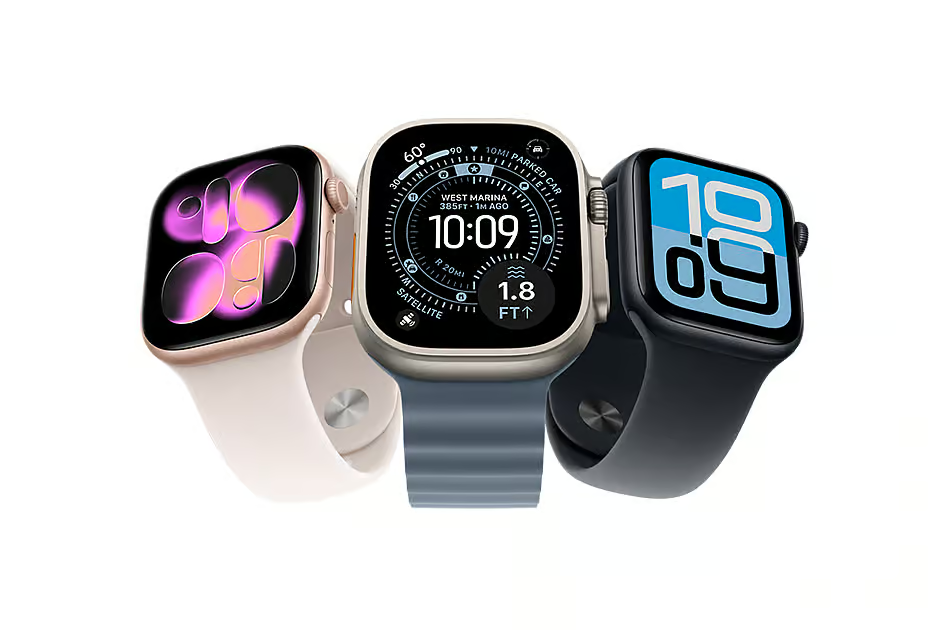
Apple could be preparing a meaningful health-tracking upgrade for the Apple Watch Series 12 and Apple Watch Ultra 4, with the company reportedly testing continuous heart rate monitoring alongside a new generation of Apple silicon. If it makes the final cut, the change would address one area where dedicated fitness wearables have held an advantage over Apple’s smartwatch.
Apple Watch already tracks heart rate continuously during workouts, but outside exercise sessions it generally takes measurements periodically rather than maintaining an uninterrupted reading. Competitors including Whoop and Fitbit have made continuous monitoring a core part of their approach to fitness and recovery data. According to Bloomberg’s Mark Gurman, Apple is now testing an always-on heart rate sensor for its next watches, although there is no guarantee the feature will ship.
The biggest obstacle is predictable: battery life. Continuous sensor activity requires additional power, and Apple has historically had to balance increasingly ambitious health features against a smartwatch that already needs considerably more frequent charging than some dedicated fitness trackers.
A new S-series processor could help. The Apple Watch Series 12 and Ultra 4 are expected to receive a new chip designed to improve performance and efficiency. Apple’s current architecture traces back to the S10 introduced with the Apple Watch Series 10 in 2024, so a more substantial silicon update could provide some additional headroom for background health monitoring without dramatically increasing power consumption.
Continuous heart rate data would become more useful if Apple also changes what it does with that information. The company is reportedly working on redesigned Health and Fitness apps that would surface more wellness and fitness insights, putting its software closer to the data-heavy approach associated with platforms such as Whoop and Oura.
That distinction matters. Collecting more measurements isn’t particularly valuable on its own; the real challenge is converting them into understandable information about training, recovery and general health. Apple already has an enormous installed base of Watch users, so deeper interpretation of existing and new sensor data could be more consequential than simply adding another hardware feature.
The Series 12 might also revive an old premium material. Apple has reportedly tested white and dark gray ceramic cases for the upcoming watch. Ceramic Apple Watches aren’t new — the material previously appeared on the Series 2, Series 3 and Series 5 before disappearing from the lineup.
Anyone hoping for a dramatic visual redesign may be disappointed, however, as major external changes are not currently expected.
For now, continuous heart rate monitoring remains a feature under testing rather than a confirmed Apple Watch Series 12 specification. If Apple can introduce it without making battery life noticeably worse, though, the next Apple Watch could close one of the more obvious gaps between a mainstream smartwatch and the increasingly sophisticated fitness trackers competing for space on the same wrist.