
Apple has rolled out a series of updates aimed at streamlining app development, with fresh intelligence frameworks and enhancements to Xcode 27 that promise to ease the integration of AI capabilities while refining core tools for developers. These changes arrive amid a broader industry push toward agentic AI systems and on-device processing, where efficiency and privacy concerns often clash with the demands of complex model deployment.
At the center of the announcements are expansions to Apple Intelligence and related frameworks. Updates to App Intents now allow deeper connections to Siri AI features, including better handling of personal context, app actions, and onscreen awareness. Building on last year’s Foundation Models framework, the new Swift API supports a wider range of models—both on-device and server-side—with image input and custom skill building. Developers can tap into Apple’s latest foundation models, developed in collaboration with Google’s Gemini, or integrate alternatives like Claude and other providers via a standardized protocol.
A notable inclusion is free access to these models on Private Cloud Compute for smaller developers in the App Store Small Business Program, those with under 2 million first-time downloads. This could lower barriers for indie creators experimenting with AI, though it remains to be seen how seamless the experience proves in real workflows compared to more open ecosystems. The introduction of Dynamic Profiles adds flexibility for adaptive behaviors, while the new Core AI framework targets on-device LLM deployment, leveraging Apple silicon’s unified memory and Neural Engine. It’s a practical step toward local processing, addressing latency and privacy priorities that have grown central since early generative AI experiments highlighted cloud dependency risks.
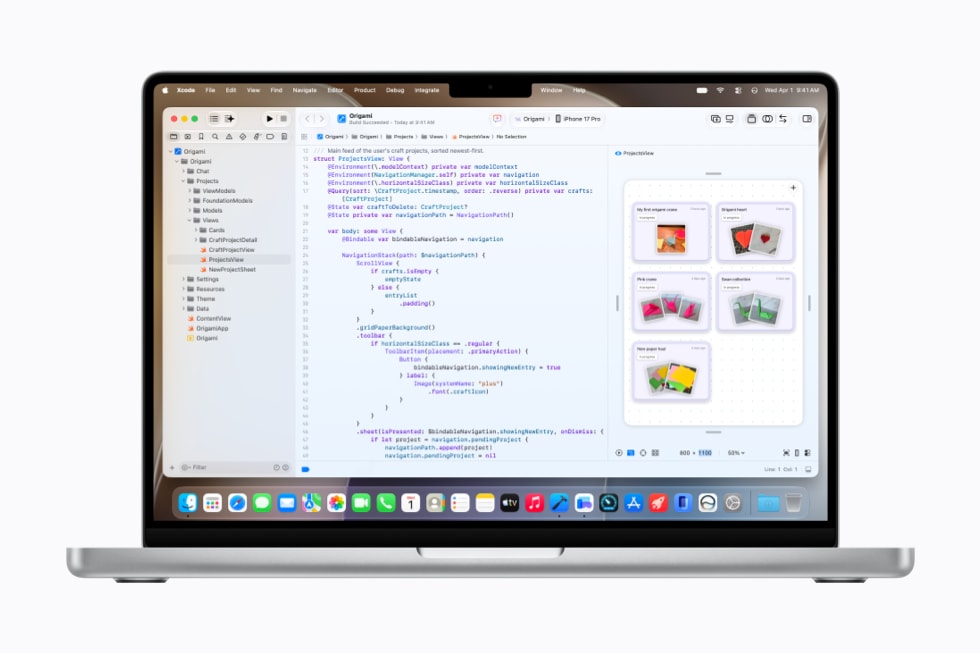
Xcode 27 receives significant attention with agentic coding features that integrate models from Anthropic, Google, and OpenAI more directly into the IDE. Developers gain interactive planning, multiturn conversations, and a canvas for rendering changes alongside code. Agents can now self-validate by running tests, using Playgrounds, and simulating environments through the new Device Hub. Plug-ins extend this further, with initial support from GitHub and Figma. These additions reflect a maturing approach to AI-assisted development, yet they also raise familiar questions about over-reliance on external models and the debugging overhead that can accompany autonomous agents. On the performance side, Xcode is now Apple silicon exclusive, smaller, and faster, with a customizable toolbar and theme system. Xcode Cloud improvements target Metal and visionOS builds for quicker iterations.
Design tools continue evolving with Liquid Glass refinements for better legibility and customization, including a transparency slider and accessibility adaptations. SwiftUI gains efficiency in state handling and layout, reducing boilerplate with reorderable containers and Spatial Preview for visionOS. Swift 6.4 focuses on everyday usability through refined diagnostics and attributes. For games, Managed Background Assets smartly trim install sizes by language, while the Game Porting Toolkit, Unity plug-ins, and Reality Composer Pro updates aim to smooth ports and spatial development.
Overall, these enhancements build incrementally on prior years’ foundations, offering tangible workflow benefits without dramatic leaps. They position Apple’s platform as a more capable environment for AI-infused apps, though success will hinge on how readily developers adopt them amid competing tools from Google and others. Developer betas are now available for the latest OS versions and Xcode.