

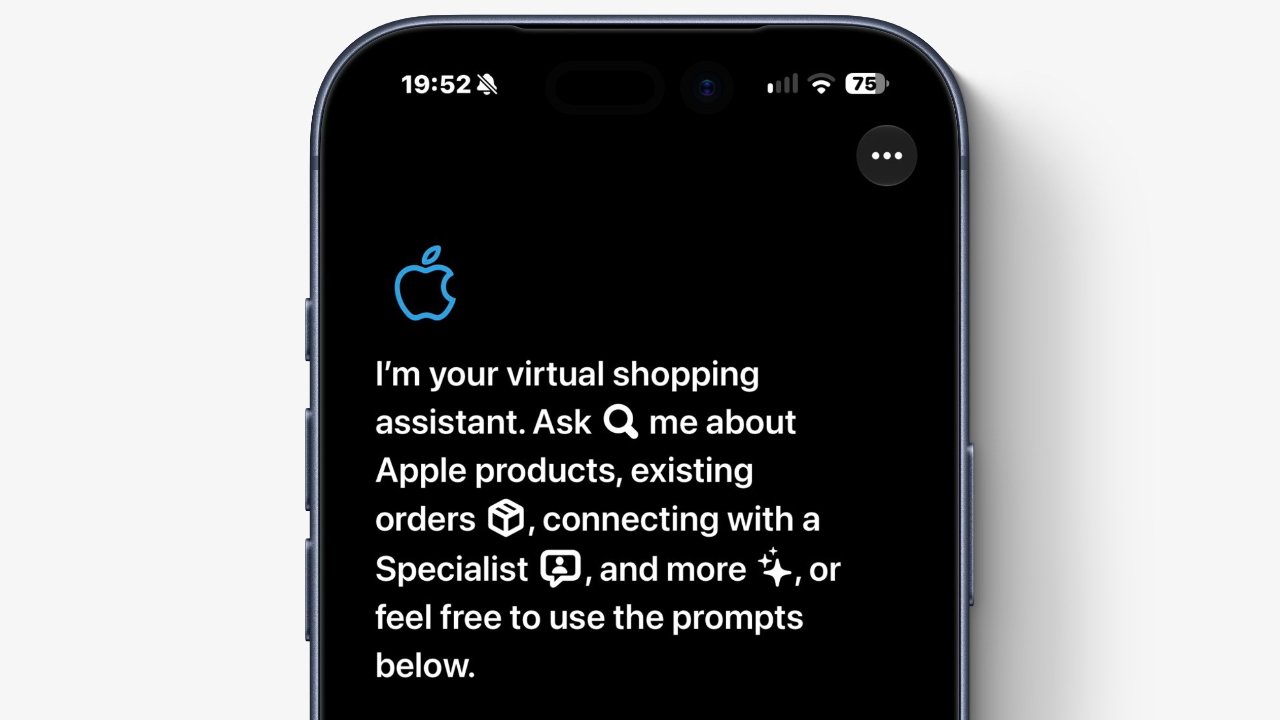
Apple appears to be quietly testing a new AI-powered shopping assistant inside the Apple Store app, giving some iPhone users a conversational way to compare products, ask buying questions and get help with existing orders.
The feature, referred to as the Virtual Shopping Assistant, is currently showing up for a limited number of users and is labelled as an “Early Preview.” Apple has not announced a broad launch, so the rollout looks more like a controlled test than a finished consumer release.
Its purpose is fairly straightforward. Rather than digging through product pages or starting a chat with a sales specialist, users can ask the assistant questions about Apple hardware, payment options, trade-ins and order status. A prompt such as choosing an Apple Watch could, in theory, turn into a guided conversation around models, sizes and accessories.
That puts Apple in familiar territory. AI-assisted shopping has become an increasingly common use case for large language models, particularly when customers are choosing between products with overlapping specifications. Apple’s catalogue is especially suited to that approach because many buying decisions now involve several layers of comparison, from device tiers and storage options to accessories, financing and trade-in values.
The feature also appears to rely on product and support information similar to the material available to Apple’s human sales teams. As with other generative AI systems, however, Apple is warning users that responses may not always be accurate. That caveat matters more in a shopping context than it might in a casual chatbot, since incorrect advice could affect purchases, compatibility decisions or payment choices.
Privacy is another part of the rollout worth watching. Earlier references to the Virtual Shopping Assistant appeared in Apple documentation before the feature surfaced publicly. The current implementation reportedly tells users that Apple may retain conversation transcripts for quality, system performance and fraud monitoring. That is not unusual for AI services, but it does mean users are effectively trading some conversational data for convenience.
The assistant also reflects a broader shift in Apple’s AI strategy. Rather than limiting generative AI to Siri or system-wide productivity features, the company appears willing to deploy it in narrower, task-specific experiences where the value proposition is easier to understand. Shopping is a practical example: customers ask repetitive product questions, Apple already has structured answers, and a chatbot can potentially reduce the need for human support.
For now, the biggest unknown is scale. The feature remains difficult to find in the wild, and Apple has not confirmed when or whether it will reach all Apple Store app users. If the test expands, its usefulness will depend less on how conversational it feels and more on whether it can provide reliable recommendations without turning the buying process into another layer of AI-generated uncertainty.