

1Password has introduced a feature called Agentic Mode that allows Anthropic’s Claude AI to interact with protected online accounts without directly accessing or viewing user credentials. The password manager injects login details and multi-factor authentication codes on behalf of the AI, keeping sensitive information shielded from both the model and Anthropic’s systems. This addresses a persistent friction in AI adoption: granting agents enough autonomy for useful work while maintaining security boundaries.
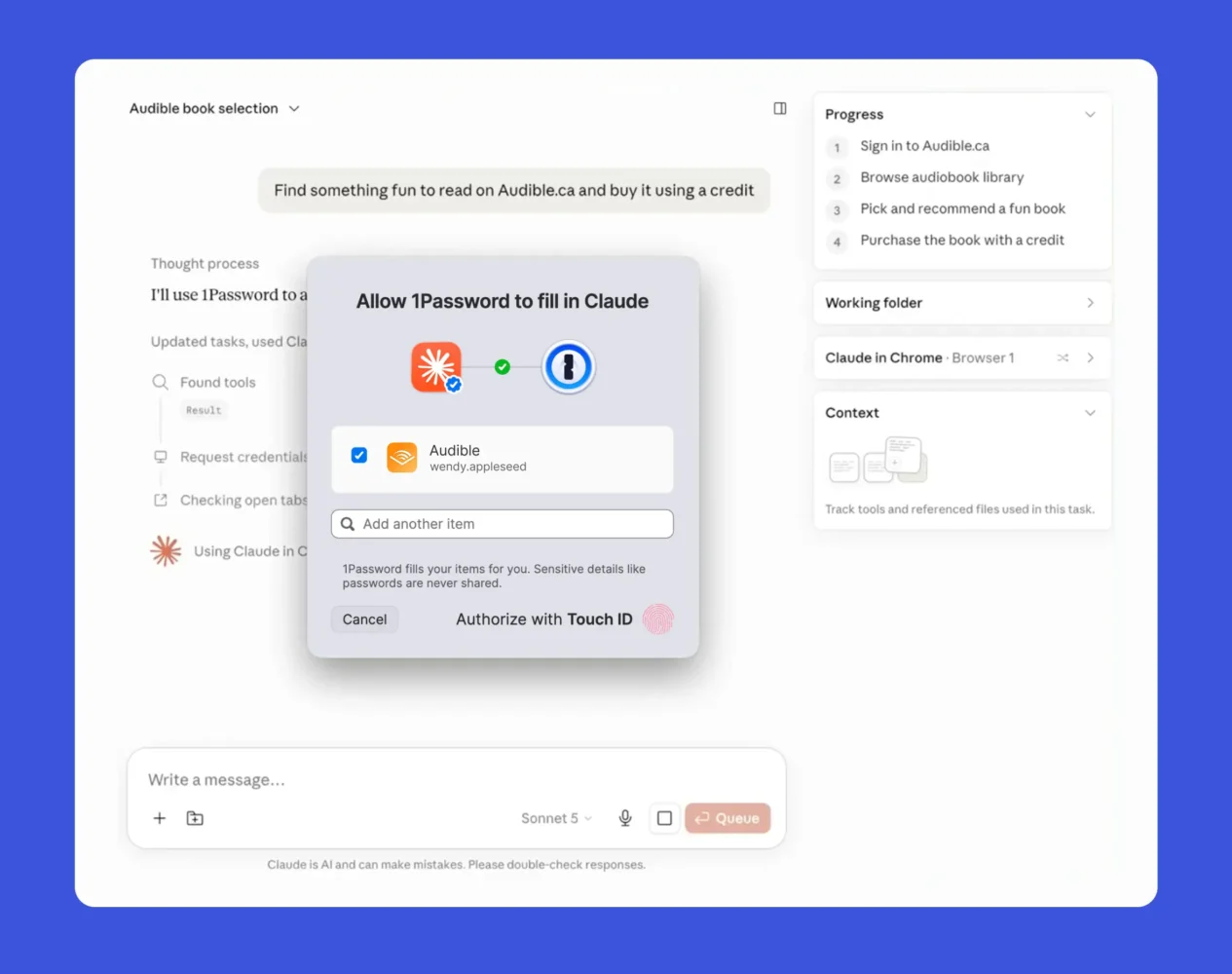
The setup works through a controlled approval process. When Claude needs access for a specific task, it prompts 1Password, which presents the user with an authorization request. Approval can come via biometrics, password, or Touch ID, after which credentials are filled directly into the target site. Once the task completes, access ends. There is no persistent or standing permission; each request is scoped narrowly to the immediate job at hand. For repeated actions, fresh approvals are required, and users can cancel Agentic Mode at any time through the browser extension.
This matters because everyday digital work increasingly involves accounts behind logins—banking platforms, payment processors like Stripe, hosting services, accounting tools, and content libraries. Delegating routine analysis or research to AI agents saves time but traditionally risks overexposure. 1Password’s approach attempts to thread that needle by keeping the AI blind to actual secrets. In demonstrations, a manager might ask Claude to scan Stripe transactions for anomalies, or an Audible subscriber could request audiobook recommendations tailored to unused credits. The former feels practically valuable for financial oversight; the latter highlights how some early use cases risk feeling trivial.
Security questions remain. Browser sessions can linger through cookies or cached states even after a task ends, potentially complicating the clean “log out and revoke” ideal. 1Password acknowledges that explicit instructions, such as directing Claude to log out upon completion, help enforce boundaries. Yet real-world website behaviors vary, and users must stay vigilant. The feature activates automatically when a recognized AI agent assumes browser control, limiting exposure to only the approved credentials for that session. No broader vault access is granted.
Agentic Mode launches initially with Claude and is available immediately to all 1Password users. Support for additional elements like payment cards and identity details is promised in follow-up updates, with the underlying framework designed to extend to other browser-based agents. This positions 1Password as a practical bridge in the expanding AI agent ecosystem, where tools from multiple providers seek deeper integration into daily workflows.
Historically, password managers evolved from simple vaults to autofill helpers and now to gatekeepers for autonomous AI actions. The move reflects broader industry efforts to balance convenience with risk as agents grow more capable. Skepticism is healthy—entrusting even mediated access to financial or administrative accounts requires trust in both the password manager’s implementation and the AI’s reliability. Not every user will feel comfortable approving Claude for sensitive domains on day one. Still, the technical separation of credentials from the model reduces one major vector of exposure compared to giving agents raw login details.
For organizations and individuals experimenting with AI coworkers, features like this lower some practical barriers without fully eliminating the need for oversight. The real test will come as adoption scales and edge cases surface.