
TL;DR: UGREEN’s MagFlow Pro combines a 10,000mAh battery with 25W Qi2.2 wireless charging, liquid cooling, 45W wired charging and a built-in USB-C cable. It’s heavier and more complicated than basic power banks, but the features complement each other surprisingly well. Pricing will ultimately determine its value, but the hardware proposition is excellent.
Power banks have reached that slightly ridiculous stage of gadget evolution where simply storing electricity is no longer enough. Apparently, they now need displays, integrated cables, magnetic charging and — because somebody clearly looked at a gaming PC and thought yes, but smaller — liquid cooling. That is essentially the pitch behind the UGREEN MagFlow Pro Magnetic Power Bank 10000mAh 25W, a Qi2.2-certified magnetic battery pack with considerably more technology stuffed inside than its name initially suggests.
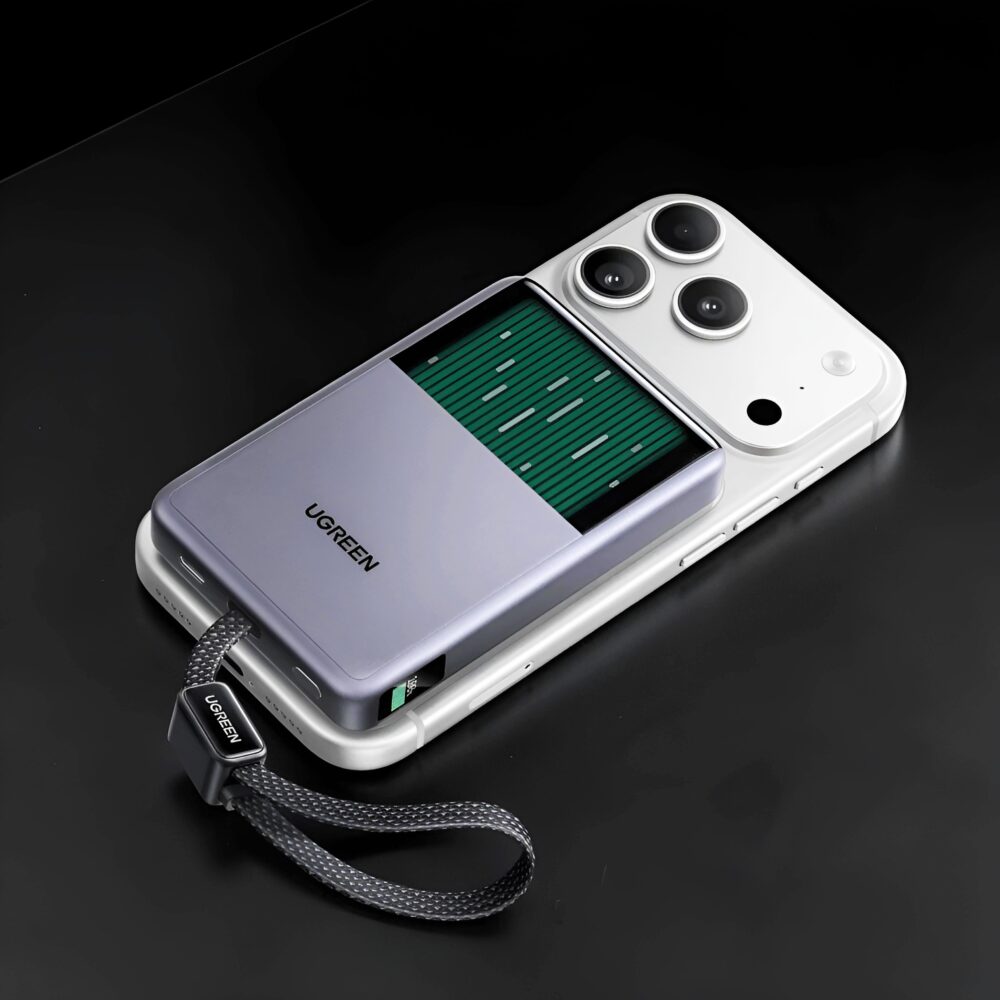
The headline feature is 25W Qi2.2 wireless charging backed by a liquid-cooling system designed to control one of wireless charging’s oldest enemies: heat. But UGREEN hasn’t built the entire product around one party trick. There is also a 10,000mAh battery, an integrated 45W USB-C cable, another USB-C connection, simultaneous three-device charging and a proper information display. On paper, this is less “emergency phone battery” and more tiny charging command centre.
The important question is whether all that engineering actually solves meaningful problems or simply gives a power bank its own tech-demo boss battle.
Liquid cooling sounds excessive, but the problem it attacks is very real
Wireless charging is wonderfully convenient and fundamentally inefficient. Some of the energy moving between charger and phone becomes heat, and as charging power increases, thermal management becomes increasingly important. Excess heat isn’t merely uncomfortable; it can cause charging systems to reduce power to protect the hardware, undermining the very speed you bought the faster charger to achieve.
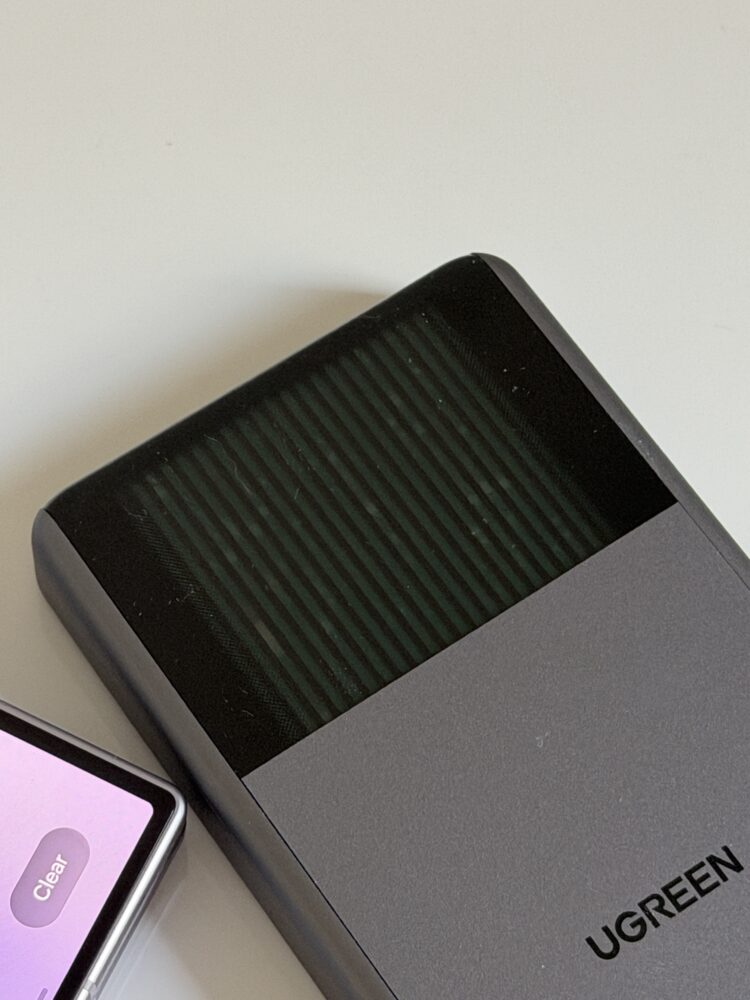
UGREEN’s answer with the MagFlow Pro is liquid cooling. The company describes it as the world’s first liquid-cooled Qi2 25W magnetic power bank and says the cooling system can operate 18°F cooler than conventional chargers. More unusually, the coolant itself is visible, giving the MagFlow Pro a little bit of gaming-PC theatre instead of hiding the engineering behind anonymous grey plastic. Those are manufacturer claims rather than independent thermal measurements, but the underlying idea makes considerably more sense than it first appears.
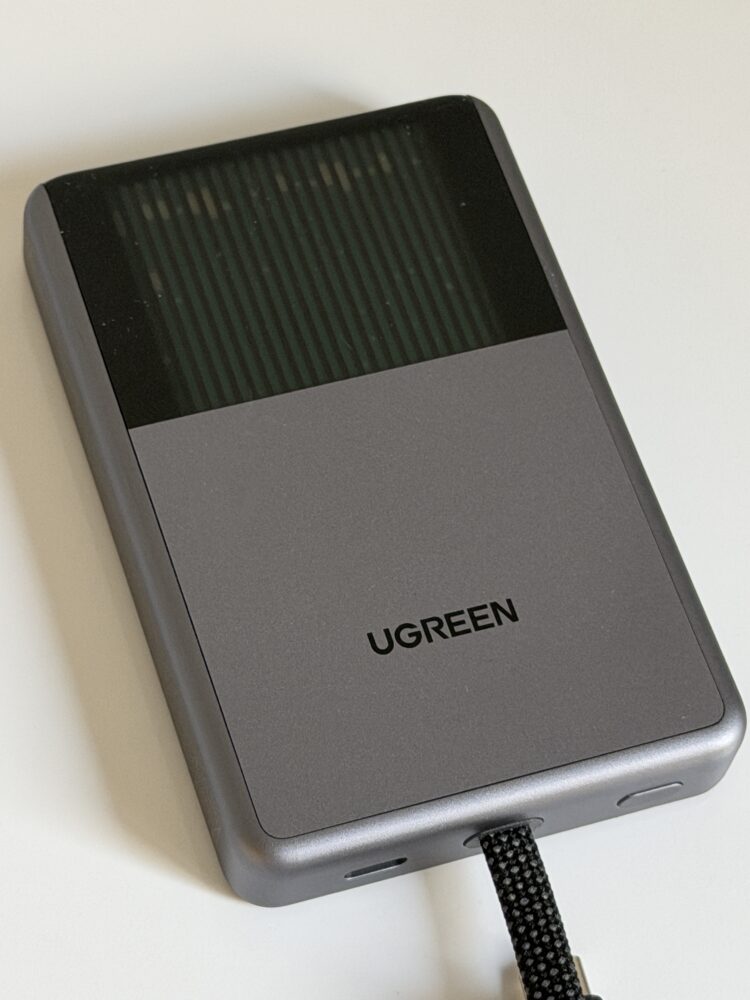
The MagFlow Pro supports Qi2.2-certified wireless charging at up to 25W. UGREEN claims an iPhone 17 Pro Max can reach 50% in 40 minutes wirelessly, which it positions as 50% faster than conventional 7.5W MagSafe charging. Again, those numbers come from UGREEN rather than my own testing, so they should be treated accordingly. What matters more conceptually is that cooling and faster wireless charging aren’t two unrelated bullet points: the cooling exists specifically to make sustained high-power wireless charging more practical.
That makes the liquid-cooling system much easier to take seriously. Is it still gloriously over-engineered? Absolutely. But this isn’t the gadget equivalent of putting RGB lighting on a toaster. Thermal management is directly connected to charging performance, and tackling it inside a compact magnetic battery pack is genuinely interesting engineering.
The MagFlow Pro understands that cables aren’t going anywhere
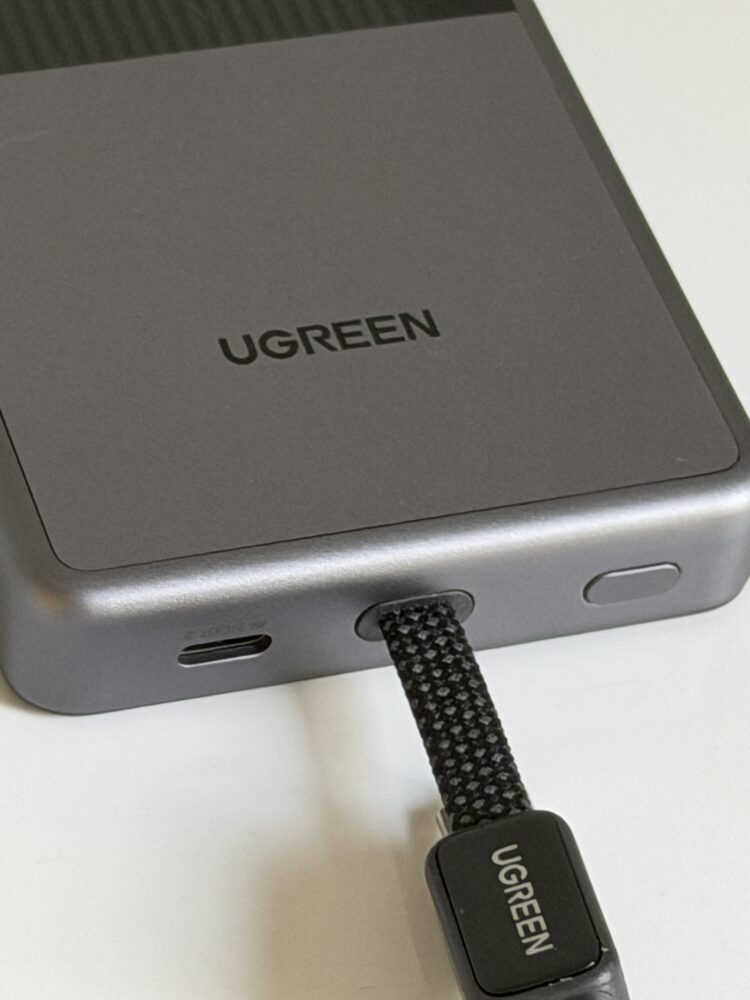
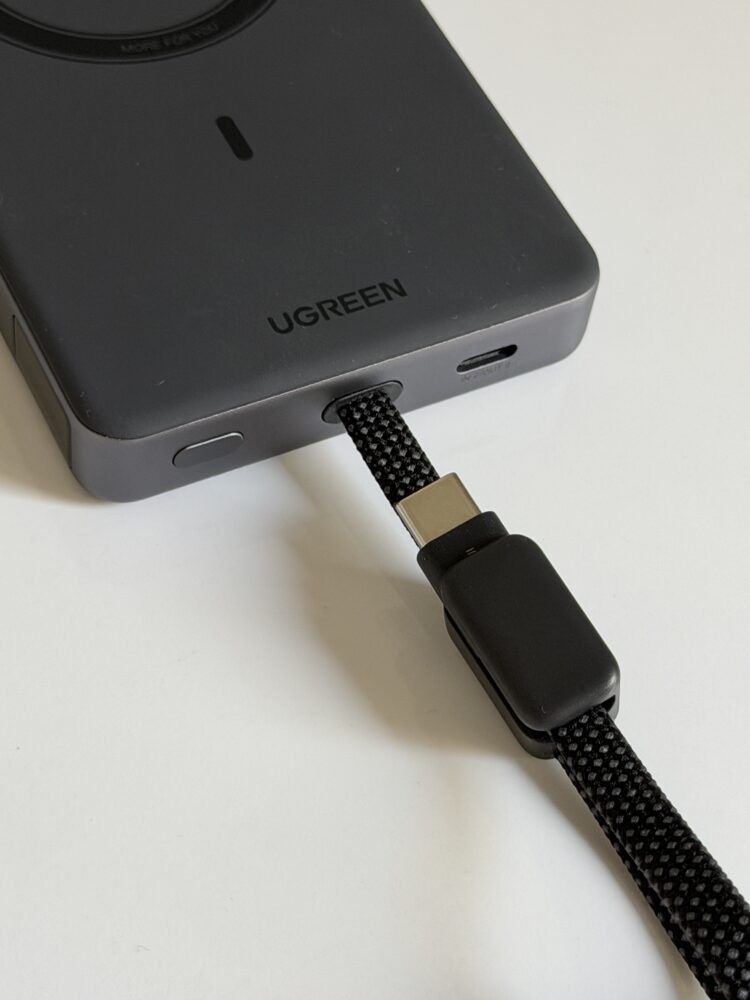
For all the attention lavished on wireless charging, one of the MagFlow Pro’s smartest features may be decidedly less futuristic: its built-in USB-C cable. It supports charging at up to 45W and doubles as a carrying strap, meaning there is one fewer cable to remember when leaving the house. UGREEN says the cable has been tested for more than 10,000 bends, although long-term durability will ultimately matter more than a laboratory figure.
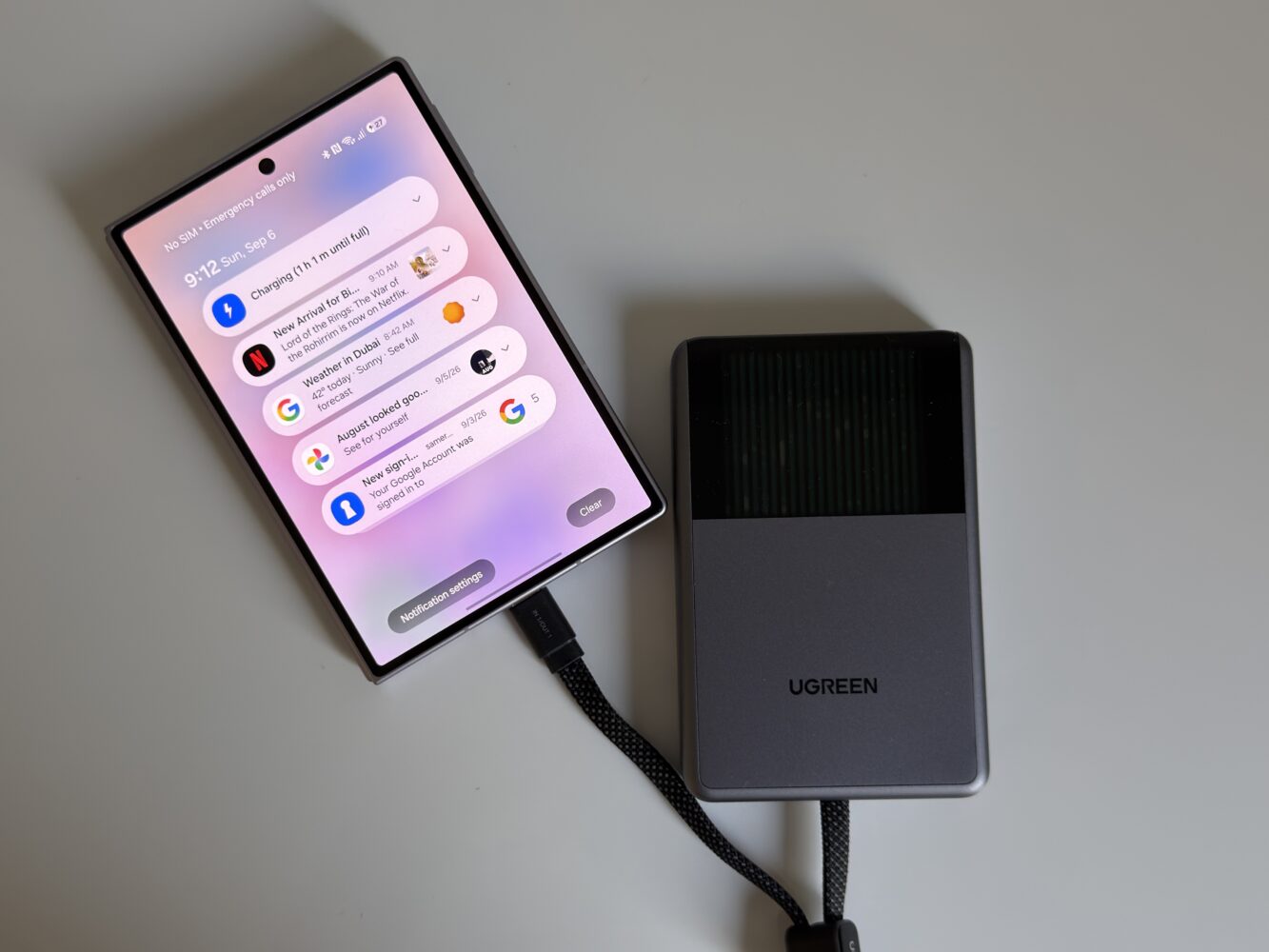
The inclusion of 45W wired charging also prevents the MagFlow Pro from becoming overly dependent on its magnetic party piece. Wireless is fantastic when convenience matters; wired charging remains preferable when speed and efficiency become the priority. Having both immediately available gives the power bank much broader usefulness, particularly when you’re carrying devices beyond a compatible smartphone.
There is another USB-C connection alongside the integrated cable, and the MagFlow Pro can simultaneously supply power to three devices using its two USB-C options and wireless charging. UGREEN quotes up to 45W charging output to connected devices and up to 30W input when recharging the power bank itself. The company also claims its wired connection can take an iPhone 17 Pro Max from empty to 65% in 30 minutes.
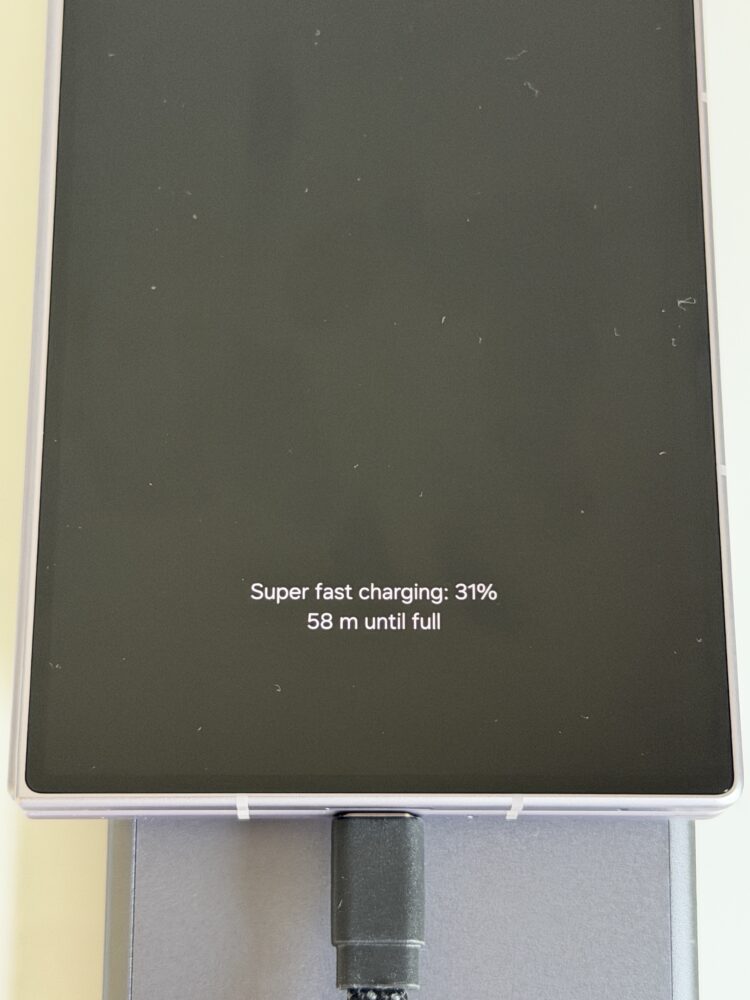
Three-device charging inevitably means thinking about how available power is being distributed rather than imagining three devices magically receiving maximum output simultaneously. Still, the flexibility is the attraction here. A power bank that can magnetically charge your phone while providing wired power elsewhere is much more useful than one built around a single charging method.
10,000mAh remains the sensible capacity sweet spot
UGREEN has chosen a 10,000mAh battery, which feels appropriate for what the MagFlow Pro is trying to accomplish. Increasing capacity further would provide more endurance, obviously, but magnetic power banks eventually become absurd appendages hanging from the back of your phone. Portability matters almost as much as capacity in this category.
The MagFlow Pro weighs 230g. That’s substantial enough that nobody will mistake it for part of the phone, but reasonable considering the battery capacity, cooling hardware, integrated cable, magnets and display packed inside. UGREEN also states that the power bank complies with airline regulations, making the capacity practical for travel rather than merely impressive on a specification sheet.
UGREEN estimates 1.36 charges for an iPhone 17 Pro Max and 2.03 charges for an iPhone 17 Air. Real-world battery replenishment can vary with charging method, conversion losses, device usage and other conditions, so those numbers are better viewed as UGREEN’s reference figures than universal expectations. Wireless charging in particular introduces efficiency losses that make raw milliamp-hour comparisons deceptively simple.
That distinction matters because 10,000mAh printed on a power bank does not mean 10,000mAh will magically materialise inside your phone. What the capacity does provide is enough energy to make the MagFlow Pro useful beyond an emergency top-up while remaining small enough to function as an everyday accessory.
Strong magnets matter more than another flashy specification
A magnetic battery pack lives or dies by its attachment. Fast charging means very little if the thing shifts around every time you pull your phone from a pocket or attempt to use it while charging.
UGREEN uses 17 N52H magnets and rates the magnetic grip at 8N. The objective is straightforward: maintain reliable alignment between the charging coils while keeping the battery securely attached during normal use. UGREEN specifically pitches the design for one-handed calls and selfies, situations where a weak magnetic connection would become irritating remarkably quickly.
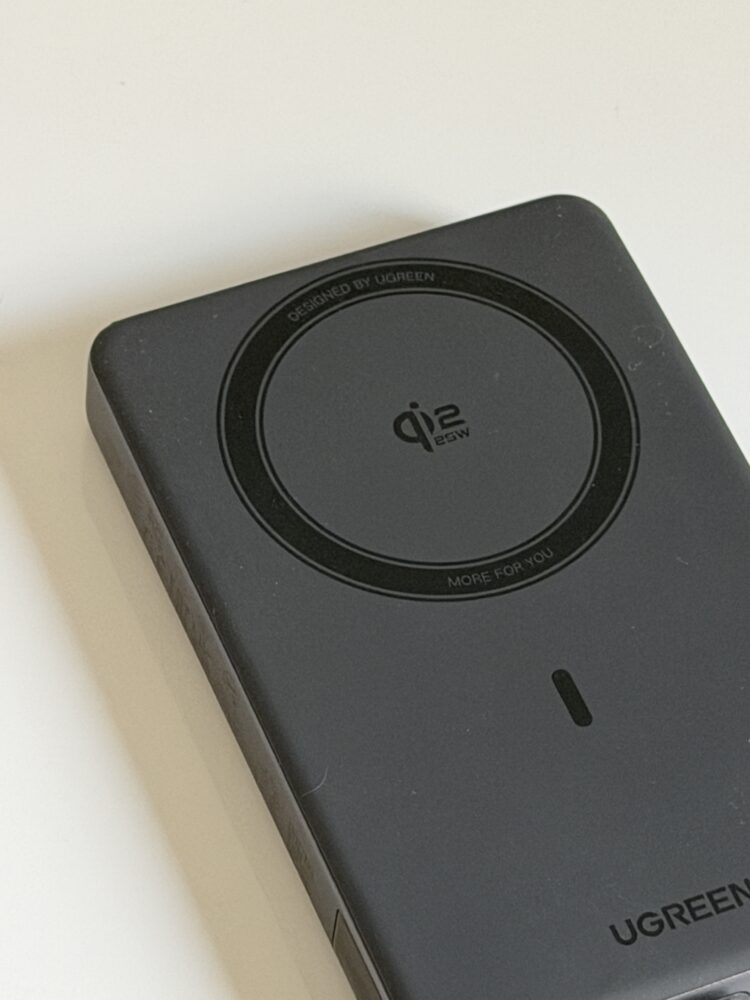
There is an important relationship between magnetic strength and wireless performance here. Magnetic alignment isn’t merely about stopping the battery from falling off; accurate coil positioning is fundamental to reliable inductive charging. A secure magnetic connection therefore contributes to both ergonomics and the charging system itself.
The 230g weight remains worth remembering, though. Even excellent magnets cannot make physics rage-quit. Adding a 230g accessory to the rear of a phone will noticeably alter its balance, so anyone prioritising the lightest possible magnetic setup may prefer a smaller-capacity alternative.
The display gives useful information instead of decorative nonsense
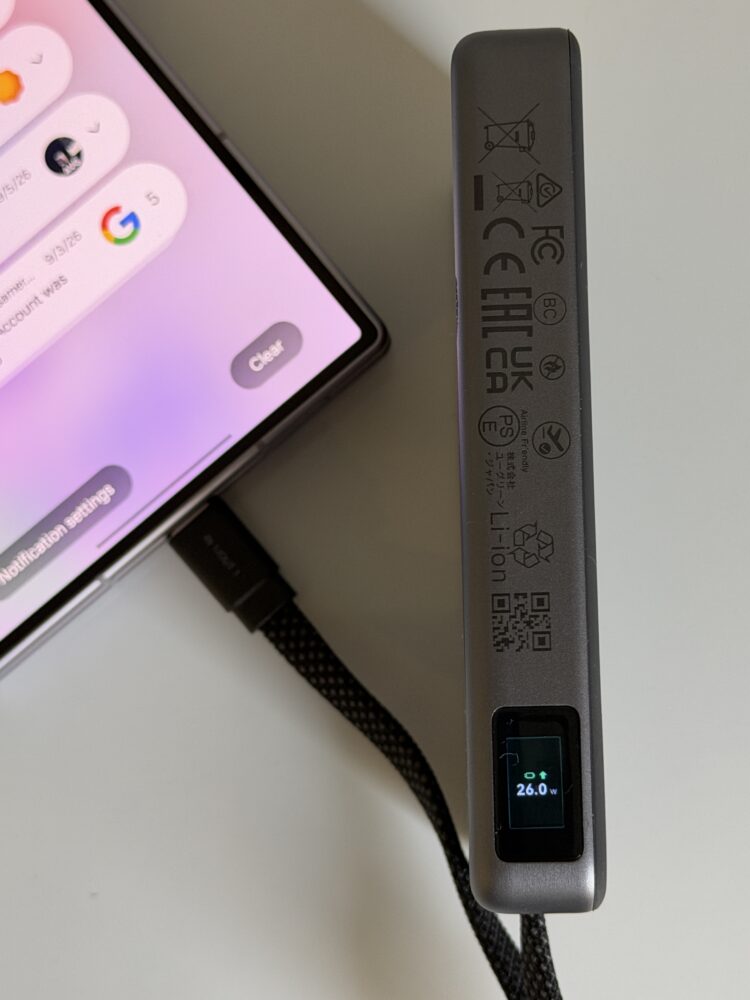
Displays on chargers can easily descend into spec-sheet jewellery, but UGREEN appears to have given this one information worth displaying. The screen can show remaining battery percentage, charging power and cycle count. Those are exactly the kinds of details that turn a screen from decoration into something useful.
Battery percentage is already preferable to deciphering four blinking LEDs like some ancient technological prophecy. Seeing charging power provides additional context about what the MagFlow Pro is actually doing, particularly when switching between wired and wireless devices. Cycle information is more niche, but geeks interested in battery longevity will appreciate having visibility into the pack’s usage.
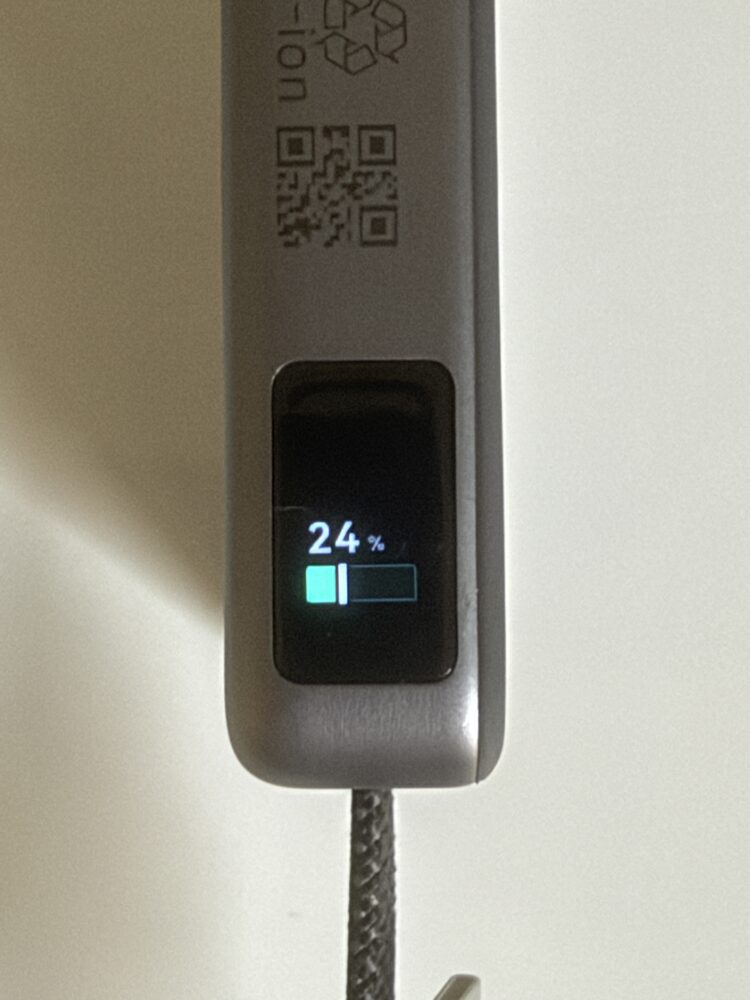
The feature becomes more relevant because UGREEN is making specific longevity claims about the battery. The MagFlow Pro uses what the company calls Dymondcell 2.0 with ATL high-density cells, with a claimed retention of more than 80% capacity after 800 cycles. Being able to see cycle information gives owners at least one useful metric for understanding how that battery ages.
It is a small detail, but one I like conceptually. Good gadget design isn’t always about adding more capability; sometimes it’s about exposing useful information the hardware already knows.
Battery safety gets unusually serious attention
High charging speeds, wireless heat and lithium batteries living together in a pocket-sized enclosure make safety engineering rather important. UGREEN says the MagFlow Pro uses a 13-layer protection structure around its ATL cells, and its promotional testing includes resistance to a two-tonne crush, needle puncture and temperatures of 140°C without fire or explosion.
Those are manufacturer-provided test claims, so they shouldn’t be confused with independent abuse testing of a retail unit. Still, UGREEN clearly isn’t treating cell protection as a footnote. Combining thermal management with physical and electrical battery protection is especially relevant in a device designed to push comparatively high wireless charging power.
The claimed 80%-plus battery capacity after 800 cycles is also encouraging from a longevity perspective. Power banks are increasingly sophisticated devices, and that makes replacing the entire thing because its cells deteriorated prematurely even more wasteful. Whether individual units achieve that figure will depend on usage and environmental conditions, but publishing a cycle-retention target is preferable to pretending batteries don’t age.
Repairability remains another question entirely. Nothing in the supplied product information establishes whether the internal battery can practically be replaced, so I wouldn’t award sustainability points that haven’t been earned.
Verdict
The UGREEN MagFlow Pro makes the humble power bank genuinely interesting. Its 25W Qi2.2 wireless charging, liquid cooling, 10,000mAh capacity, built-in 45W USB-C cable and useful display combine into a seriously capable portable charger.
At 230g, it’s not the lightest option, and without pricing, value remains difficult to judge. But for Qi2.2 phone owners who want fast, flexible wireless charging, the MagFlow Pro packs plenty of clever engineering into one impressively geeky battery brick.