

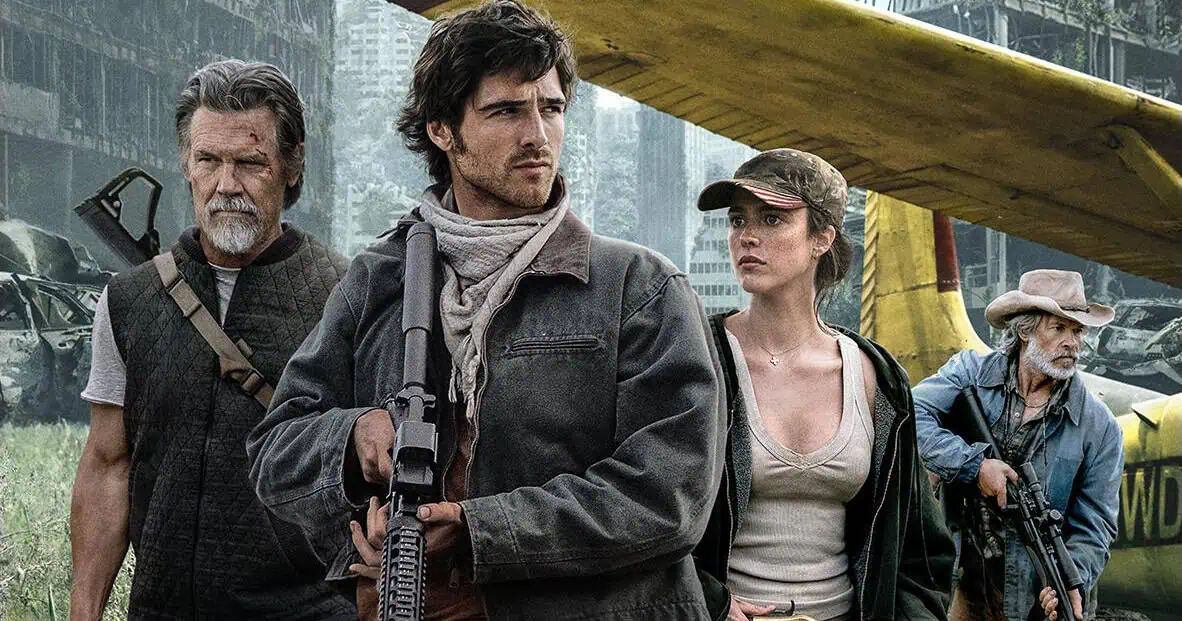
TL;DR: Ridley Scott’s The Dog Stars delivers gorgeous apocalypse imagery, a scene-stealing Josh Brolin and compelling ideas about grief, but Jacob Elordi’s emotional journey and the uneven screenplay take too long to fully click.
Ridley Scott returning to science fiction should feel like somebody activating the Bat-Signal for movie geeks. This is the filmmaker who gave us Alien, Blade Runner and The Martian, so dropping him into a post-apocalyptic America with Jacob Elordi, Josh Brolin, Margaret Qualley and Guy Pearce sounds almost unfairly promising. The Dog Stars, adapted from Peter Heller’s novel, certainly has moments where that combination clicks: enormous landscapes, sudden violence, lonely flights over an Earth that has mostly moved on from humanity, and Brolin apparently having the time of his life as civilization’s grumpiest surviving roommate. Unfortunately, the movie spends much of its 119 minutes searching for the emotional frequency it eventually finds, leaving us with a visually spectacular apocalypse that occasionally feels like several different movies fighting over the last can of beans.
The apocalypse looks surprisingly beautiful from up here
It’s 2035, and a devastating super flu has wiped out most of humanity. Hig (Jacob Elordi) survives with his dog Jasper at an isolated mountain compound alongside Bangley (Josh Brolin), a heavily armed former Marine whose survival philosophy essentially boils down to trusting nobody and keeping the ammunition close. Hig is wired differently. Still grieving his wife, he retains a stubborn desire to believe that humanity might contain something worth saving, regularly helping a nearby Mennonite community rather than treating every remaining human being like a potential Fallout raider.
That philosophical divide gives The Dog Stars an intriguing foundation. Bangley has adapted to the apocalypse by becoming harder; Hig survives while desperately trying not to. When Hig picks up a mysterious radio transmission while flying his old Cessna, the possibility that something—or someone—might exist beyond his tiny world becomes impossible for him to ignore. Eventually his journey leads him to Cima (Margaret Qualley), a doctor-in-training, and her protective father Pops (Guy Pearce), opening the movie into a larger meditation on whether surviving catastrophe actually means anything without human connection.
It’s familiar post-apocalyptic territory, but familiar isn’t automatically bad. Give me one lonely survivor, one mysterious radio signal and an aircraft with questionable reliability and my gamer brain is already expecting a quest marker to appear over the horizon. The issue is that The Dog Stars has so many tonal destinations programmed into its GPS that it keeps recalculating the route.
Jacob Elordi survives the apocalypse but can’t completely carry its grief
Hig is designed as an emotionally bruised hero whose journey is less about defeating enemies than deciding whether he wants to properly live again. That requires Jacob Elordi to communicate a tremendous amount underneath the action: grief for his wife, attachment to his dog, frustration with Bangley, faith in strangers and eventually the possibility of affection with Cima. Physically, Elordi fits comfortably into Scott’s rugged world. Whether flying, scavenging or handling the film’s more traditional action material, he convincingly occupies the role.
The emotional side is less consistent. The screenplay tells us how deeply grief has consumed Hig, but the movie doesn’t always translate that pain into something we can instinctively feel through Elordi. His decision to pursue that distant radio transmission should feel like a huge psychological threshold—the moment loneliness finally becomes more frightening than danger—but the motivation doesn’t receive enough dramatic oxygen.
His developing relationship with Cima suffers from a similar problem. Margaret Qualley is an actor capable of making even deeply strange characters feel alive, yet Cima isn’t afforded enough complexity for their connection to become the emotional reactor core the film needs. Two lonely people discovering that companionship might still be possible after civilization has collapsed is powerful material. The Dog Stars understands that intellectually, but it sometimes races toward the emotional result without completing all the side quests required to earn it.
Josh Brolin apparently received the fun version of the apocalypse
Then there’s Josh Brolin, who walks into this bleak future as Bangley and immediately makes surviving humanity’s collapse look disturbingly entertaining. The character is recognizable—the paranoid, gun-loving veteran whose aggressively practical exterior is protecting something considerably softer—but Brolin knows exactly what movie he’s in. His performance supplies humour, menace and personality without turning Bangley into a cartoon.
More importantly, his dynamic with Hig gives the opening stretch some of the film’s strongest character tension. Their disagreement isn’t simply about tactics; it represents two competing definitions of survival. Hig keeps reaching toward other people while Bangley views connection as another vulnerability waiting to get you killed. Once the story moves away from their compound, Brolin’s reduced presence is noticeable because the film loses some of its most entertaining friction.
Guy Pearce brings a different flavour of hardened-survivor energy as Pops, while Benedict Wong makes an impression during limited screen time as a welcoming Mennonite farmer. Alison Janney also appears in a smaller role that injects another unexpected texture into the film. Ironically, these supporting performances often feel freer than the central romance because they aren’t required to carry the movie’s entire philosophical argument on their backs.
Ridley Scott still knows how to make humanity look tiny
Where The Dog Stars rarely struggles is visually. Cinematographer Erik Messerschmidt gives Scott a post-human America that is simultaneously magnificent and unsettling, replacing the dusty wasteland aesthetic we’ve seen approximately 9,000 times with enormous green mountains, open valleys and wilderness reclaiming its dominance. The landscapes were actually filmed in Italy rather than Colorado, which somehow feels appropriate for a movie that occasionally behaves like a Western wearing science-fiction armour.
The aerial imagery is especially effective. Hig’s Cessna becomes more than transportation; from above, humanity’s disappearance feels almost insignificant against landscapes that existed long before us and will continue without us. The abandoned remnants of Denver and the presence of animals roaming through this emptied world create a haunting contrast between human catastrophe and nature’s complete indifference.
Scott also knows exactly when to puncture that beauty with violence. Some of the movie’s most effective danger arrives abruptly rather than through elaborate action choreography, reminding us how quickly this supposedly peaceful wilderness can become lethal. Those sequences expose the version of The Dog Stars I wanted more consistently: quiet, beautiful, lonely and capable of becoming terrifying without warning.
The Dog Stars can’t decide which apocalypse it wants
The screenplay is where things become considerably shakier. At different points, The Dog Stars operates as survival thriller, grief drama, Western, romance, road movie and philosophical science-fiction story. None of those ingredients are incompatible, but they don’t always combine into the same meal. It’s like somebody opened the post-apocalyptic genre inventory and equipped every item simultaneously.
The antagonistic forces are particularly underdeveloped, appearing more as threats necessary to generate action than people or groups with sufficiently defined motivations. Meanwhile, Hig’s central conflict—whether remaining emotionally open is courageous or suicidal—deserves considerably more exploration than it receives. That’s arguably the movie’s most interesting question, because Bangley’s worldview makes horrible sense in this environment.
Things finally become more coherent during the third act, when the movie’s ideas about grief, memory and obsession with the vanished world begin aligning. The Dog Stars suggests that surviving isn’t enough if you’re psychologically trapped among the dead. Holding onto love matters, but allowing loss to freeze your future can become its own form of extinction.
It’s a genuinely worthwhile idea. I just wish the film had built toward it with the same precision Scott and Messerschmidt bring to the imagery. By the time The Dog Stars finally reveals what it really wants to say, I was onboard—but also wondering why the emotional navigation system had taken such a scenic route.
Verdict
The Dog Stars is nowhere near Ridley Scott’s science-fiction mountaintop, and anyone arriving expecting another Alien, Blade Runner or The Martian should recalibrate immediately. This is a smaller, stranger and more introspective apocalypse concerned with grief, loneliness and the stubborn human instinct to reconnect after everything familiar disappears. Its greatest strengths are Scott’s visual instincts, Erik Messerschmidt’s sweeping cinematography and a supporting cast led by an immensely entertaining Josh Brolin.
The frustrating part is that the movie’s emotional ambition exceeds its execution. Jacob Elordi looks completely at home as a post-apocalyptic survivor but never fully unlocks Hig’s internal devastation, while Margaret Qualley’s Cima deserves more development before their relationship is asked to carry such significant thematic weight. The screenplay also bounces between genres and ideas before eventually discovering a compelling message about refusing to let yesterday consume whatever tomorrow remains.
Still, this is Ridley Scott photographing humanity at the edge of extinction, and when The Dog Stars stops explaining itself and simply lets one tiny aircraft cross an enormous wilderness, there’s genuine cinematic power here. It may get lost several times on the road to its destination, but there are enough beautiful, strange and surprisingly hopeful sights along the way to make the journey worthwhile.