


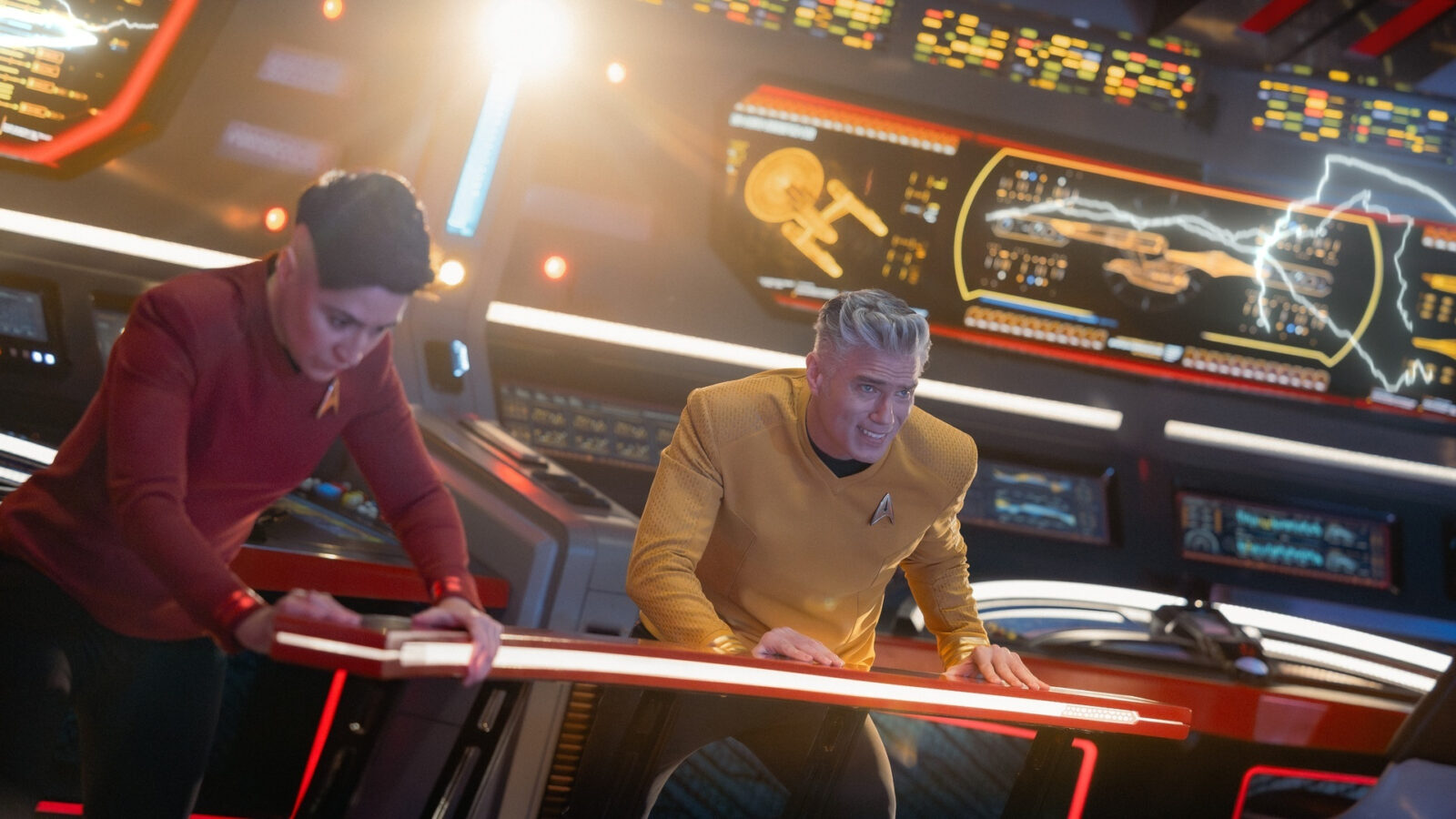
TL;DR: A tense Enterprise disaster gives M’Benga and Chapel excellent emotional material while Scotty continues growing naturally into a Trek icon. “Off-Hour” proves Strange New Worlds does not need an outrageous gimmick when strong characters and good old-fashioned space peril will do.
After spending a few episodes enthusiastically experimenting with its own format, Star Trek: Strange New Worlds Season 4 remembers something rather important with Episode 6, “Off-Hour”: sometimes you just need to put the Enterprise in serious trouble and watch a ridiculously capable crew desperately try to keep everyone alive. The result is an episode built around catastrophic space danger, mounting pressure and characters who matter more than whatever sci-fi nightmare is currently trying to kill them. It is still unmistakably Strange New Worlds, complete with a suitably Trek-flavoured technical crisis, but the gimmick serves the drama rather than becoming the drama. More importantly, it gives Dr. M’Benga, Nurse Chapel, Scotty and Pelia meaningful material instead of simply finding another weird genre costume for the series to wear.
“Off-Hour” makes the Enterprise feel genuinely dangerous again
The basic setup is wonderfully straightforward: the Enterprise becomes trapped in a slipstream wormhole, leaving the ship badly damaged and its crew dealing with failures that turn their familiar home into a death trap. “Off-Hour” approaches the situation almost like a disaster movie, with environmental hazards escalating while everyone races against circumstances they cannot simply phaser into submission. Gravity itself becomes dangerous, parts of the ship are devastated, and Spock and La’an are forced outside the Enterprise during a neutrino storm. There is a physicality to the danger that makes this feel refreshingly different from watching another bridge crew calmly announce declining shield percentages.
That approach also gives the episode real momentum. Instead of relying on one giant mystery waiting to be solved, the tension comes from watching multiple systems and people reach their limits simultaneously. Yes, the eventual escape inevitably involves the sort of technobabble that has been keeping Starfleet engineers employed for generations, but that hardly matters when the journey towards that solution is this entertaining. Trek has always possessed the magical ability to make someone shouting about fictional particles sound like the most important sentence in the universe, and “Off-Hour” understands that the trick only works when we care about the people doing the shouting.
M’Benga and Chapel give the disaster its emotional weight
The smartest decision is making Dr. M’Benga and Nurse Chapel central to the episode. M’Benga survives the initial catastrophe but suffers an injury that leaves him trapped and facing an apparently fatal outcome if he is moved. It is an ugly predicament, and the episode does not need to turn it into gratuitous spectacle to make the situation horrifying. The real tension comes from Chapel being there with him and from everything their relationship already carries after several seasons together.
Babs Olusanmokun and Jess Bush have enough established chemistry that the episode can lean on history rather than manufacture emotion through melodrama. M’Benga is also considering leaving the Enterprise, adding another layer of uncertainty to a situation already overflowing with it. The arrival of Dr. Boyce, played by Brian Markinson, connects that possibility to the Enterprise’s complicated medical lineage, but the continuity material never needs to become homework. Longtime Trek fans can enjoy watching pieces move towards the future they recognise, while everyone else still gets a strong character story about two people facing the possibility that their time together may be ending.
There is obviously an unusual problem with creating mortal danger around characters whose franchise futures are already known. Strange New Worlds largely beats that problem by making survival only part of the equation. The interesting question becomes what an experience like this does to M’Benga and Chapel, rather than simply whether somebody’s pulse will disappear before the credits. Canon can tell us where certain characters eventually exist; it cannot automatically tell us what emotional baggage they will carry there.
Scotty is becoming the engineer we know without turning into an impersonation
The other major pleasure of “Off-Hour” comes from Scotty and Pelia. Martin Quinn’s Scotty increasingly feels like a character growing naturally towards the legendary engineer rather than somebody performing a collection of familiar mannerisms for the Trekkies in the cheap seats. Here, his developing ability to understand the Enterprise almost instinctively becomes especially important. The idea of Scotty effectively learning to read his ship through feel is exactly the kind of character-based continuity nod that works because it means something even without recognising the reference.
Pelia’s role as his mentor strengthens that evolution. Carol Kane may not dominate the episode, but their dynamic helps explain how this younger Scotty develops the confidence and almost supernatural mechanical intuition associated with the character. That is prequel storytelling done properly. Rather than constantly waving a neon sign saying “REMEMBER THIS?”, Strange New Worlds can use familiar destinations to make the journey more satisfying.
It also helps that Scotty’s material belongs organically inside the crisis. He is not present because the series needs to remind us that an iconic character exists; he is useful because the Enterprise is falling apart and engineering suddenly matters quite a lot. Funny how well characters work when the story actually gives them something important to do.
The harsher edge mostly works, although the gore is becoming noticeable
“Off-Hour” does not completely pull its punches when showing what a starship disaster might actually do to human bodies. Alongside M’Benga’s catastrophic injury, the episode includes a compound fracture involving Una and another particularly nasty injury for Chapel. Star Trek has never been incapable of body horror — transporters alone should probably have generated several centuries of collective therapy — but Strange New Worlds has been leaning into graphic injuries enough this season for it to become noticeable.
Here, most of that brutality has a purpose. The Enterprise is usually photographed and experienced as somewhere warm, elegant and safe, so seeing that environment suddenly become physically hostile sells the scale of the emergency. The danger feels less abstract when the consequences are visible. Still, there is a fine line between making space travel frightening and repeatedly making viewers inspect somebody’s latest mangled appendage. The episode occasionally wanders close to it.
This is Strange New Worlds playing to its greatest strengths
What ultimately makes Episode 6 satisfying is not the wormhole, the gravity failures or even the impressive spectacle. It is the balance between all those ingredients. Strange New Worlds works best when its episodic structure creates unusual situations that reveal something meaningful about its characters, and “Off-Hour” understands that distinction. The concept generates pressure; M’Benga, Chapel, Scotty and Pelia provide the reason to care about it.
There is also something wonderfully old-school about watching Starfleet personnel confront an impossible technical disaster through competence, trust and ingenuity. Nobody needs to save the galaxy this week. The Enterprise simply needs to survive, and that smaller scale ironically makes the stakes feel more immediate. After some of Season 4’s more aggressively conceptual adventures, an hour that combines disaster-movie tension with character drama feels almost like comfort food — assuming your comfort food occasionally involves catastrophic gravity failures and severed body parts.
Verdict
“Off-Hour” is Star Trek: Strange New Worlds operating in one of its strongest configurations: a dangerous sci-fi problem, a crew forced to improvise under pressure and enough emotional investment to make the technical solution secondary to the people trying to reach it. Babs Olusanmokun and Jess Bush give the episode its heart through M’Benga and Chapel, while Martin Quinn and Carol Kane continue developing an enjoyable Scotty-Pelia mentor relationship that connects naturally with Trek history.
The technobabble resolution is familiar territory, and the season’s growing fondness for graphic injuries may be testing the limits of some viewers. Neither issue seriously undermines an episode that delivers tension, spectacle and character development in roughly equal measure. For viewers who love Strange New Worlds most when it feels like classic Star Trek given modern production muscle, this is an easy recommendation and one of Season 4’s more satisfying adventures.